Findings could lead to therapies that lower health risks for children born to women with preeclampsia
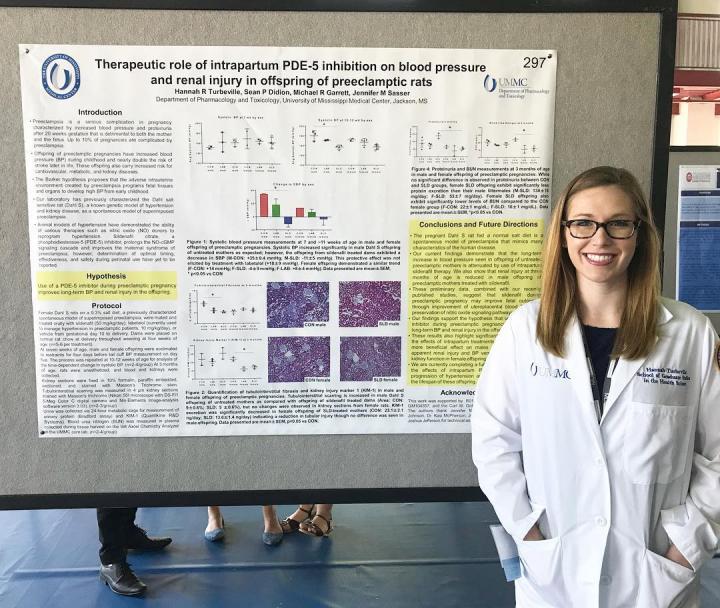
Credit: Courtesy of Hannah Turbeville, University of Mississippi Medical Center
Orlando, Fla. (April 6, 2019) – An estimated six to 15 million people in the U.S. are children born of a pregnancy complicated by preeclampsia. New research performed in rats reveals that treating preeclampsia with sildenafil citrate (Viagra) may help protect the cardiovascular health of the offspring.
Preeclampsia occurs when women with otherwise normal blood pressure experience elevated blood pressure during pregnancy. Children of women with preeclampsia during pregnancy have higher blood pressure during childhood and almost double the risk of stroke later in life.
“The ultimate goal of our work is to improve the long-term health of women and children affected by preeclampsia,” said Hannah Turbeville, a doctoral student at the University of Mississippi Medical Center, who conducted the new study. “There are limited guidelines for addressing the health risks to these groups, and we hope not only to bring attention to these risks but also to propel research forward that will inform preventative interventions.”
Turbeville will present the new research at the American Physiological Society’s annual meeting during the 2019 Experimental Biology meeting to be held April 6-9 in Orlando, Fla.
In previous work, the researchers found that sildenafil citrate, which lowers blood pressure by acting on the nitric oxide pathway, can treat preeclampsia in a rat model of the condition while also decreasing blood pressure in offspring. In the new work, they wanted to determine how sildenafil citrate affects the offspring’s response to stressors that normally increase blood pressure.
To mimic human preeclampsia as much as possible, the researchers used a rat model that develops the condition without a procedure or drug. They then exposed the offspring to a stressor that increases blood pressure. The researchers observed smaller increases in blood pressure for male offspring of rats treated with sildenafil citrate compared to those that did not no receive treatment or received a more commonly used blood pressure medication. The protective effect was not apparent in female offspring.
“Our studies demonstrate the potential for targeted therapy of the nitric oxide pathway to improve the body’s response to stressors in the later lives of children of women who experienced preeclampsia,” said Turbeville. “This pathway plays an important role in improving blood flow and lowering blood pressure.”
The researchers are working to better understand the gender-specific response to sildenafil citrate. They are also exploring whether the improved response to stressors leads to decreased risk of chronic diseases such as high blood pressure and chronic kidney disease when these offspring become adults.
Hannah Turbeville will present this research on Saturday, April 6, at 2:30 p.m. in the Plaza International Ballroom G, the Hyatt, and on Sunday, April 7, from 10:15 a.m. -12:15 p.m. in Exhibit Hall-West Hall B, Orange County Convention Center (poster E569 574.10) (abstract). Contact the media team for more information or to obtain a free press pass to attend the meeting.
###
Image available.
About Experimental Biology 2019
Experimental Biology is an annual meeting that attracts more than 14,000 scientists and exhibitors from five host societies and more than two dozen guest societies. With a mission to share the newest scientific concepts and research findings shaping clinical advances, the meeting offers an unparalleled opportunity for exchange among scientists from across the U.S. and the world who represent dozens of scientific areas, from laboratory to translational to clinical research. http://www.
About the American Physiological Society (APS)
APS is a nonprofit organization devoted to fostering education, scientific research and dissemination of information in the physiological sciences. The Society was founded in 1887 and today represents more than 10,500 members and publishes 14 peer-reviewed journals. http://www.
Find more news briefs and tipsheets at: https:/
Media Contact
Anne Frances Johnson
[email protected]