• HOME
  • NEWS
  • EXPLORE
    • CAREER
      • Companies
      • Jobs
    • EVENTS
    • iGEM
      • News
      • Team
    • PHOTOS
    • VIDEO
    • WIKI
  • BLOG
  • COMMUNITY
    • FACEBOOK
    • INSTAGRAM
    • TWITTER
Friday, June 26, 2026
BIOENGINEER.ORG
No Result
View All Result
  • Login
  • HOME
  • NEWS
  • EXPLORE
    • CAREER
      • Companies
      • Jobs
        • Lecturer
        • PhD Studentship
        • Postdoc
        • Research Assistant
    • EVENTS
    • iGEM
      • News
      • Team
    • PHOTOS
    • VIDEO
    • WIKI
  • BLOG
  • COMMUNITY
    • FACEBOOK
    • INSTAGRAM
    • TWITTER
  • HOME
  • NEWS
  • EXPLORE
    • CAREER
      • Companies
      • Jobs
        • Lecturer
        • PhD Studentship
        • Postdoc
        • Research Assistant
    • EVENTS
    • iGEM
      • News
      • Team
    • PHOTOS
    • VIDEO
    • WIKI
  • BLOG
  • COMMUNITY
    • FACEBOOK
    • INSTAGRAM
    • TWITTER
No Result
View All Result
Bioengineer.org
No Result
View All Result
Home NEWS Science News Chemistry

Portland State researchers receive $3.15M grant to develop drug to cure malaria

Bioengineer by Bioengineer
July 3, 2019
in Chemistry
Reading Time: 3 mins read
0
IMAGE
Share on FacebookShare on TwitterShare on LinkedinShare on RedditShare on Telegram

IMAGE

Credit: Portland State University

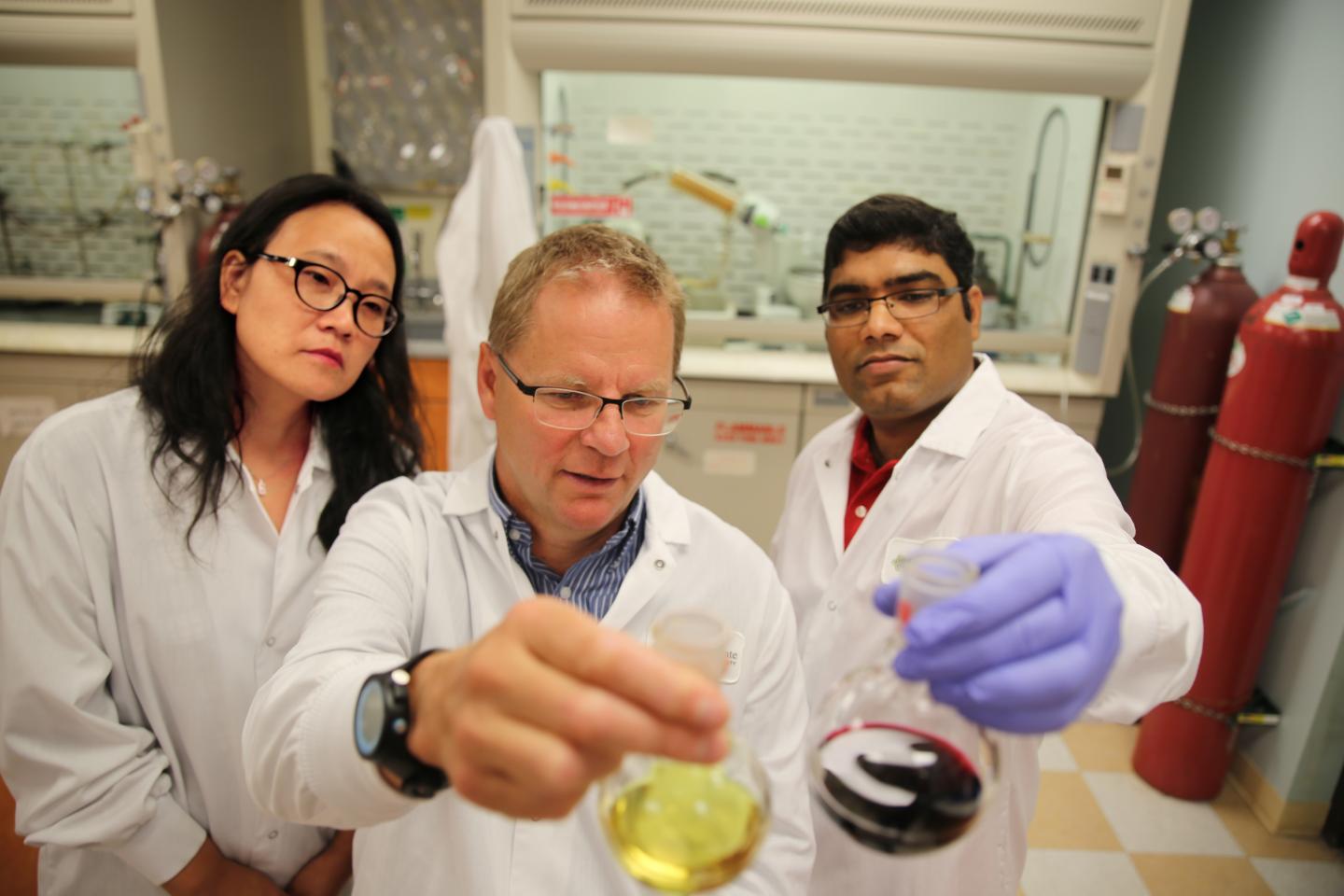
A team of Portland State University researchers who have discovered a possible one-pill cure for malaria has received a $3.15 million grant from the National Institutes of Health to further the research, with the goal of bringing it to clinical trials.

The basis of the potential cure is a compound based on a natural red pigment that comes from a soil bacterium. PSU chemistry professor Kevin Reynolds began researching the compound a decade ago after reading about its potential as a malaria treatment in a research paper from the 1970s. For one reason or another — whether inadequate technology or the variety of malarial cures already in existence — nobody had given the 1970s research much thought, Reynolds said, until he rediscovered it.

Reynolds enlisted fellow PSU chemistry researchers Jane Kelly and Papireddy Kancharla, and together they made and tested hundreds of variants of the original compound. They discovered a number of versions that could kill the malaria parasite in mice and in human blood with a single low dose.

Kelly said that over the last four years, the team worked with Medicines for Malaria Venture (MMV), a nonprofit partnership, to further test the compound’s potential. MMV found that not only was the compound effective at killing the malaria virus in blood, but it could kill it in the liver before it reaches the bloodstream.

“The liver stage is the key,” Kelly said. “The malaria virus gets in the liver first, so if you can catch it then, it’s much more effective in eliminating the disease.”

MMV also found that the compound is effective in killing the malaria virus in its reproductive stage, which prevents its transmission.

Malaria is a mosquito-borne parasite that has plagued humanity for as long as recorded history. Today, even with effective treatments for the disease and advancements in medical science, malaria kills about half a million people per year. Most of the deaths occur in sub-Saharan Africa and Southeast Asia. Most of the victims are children under the age of five.

PSU’s one-pill treatment, if it becomes a medicine for widespread use, would be revolutionary, not just as a cure, but as a preventative, according to Kelly.

The new NIH grant, paid to PSU in annual increments over five years, will allow the research team to further refine their compounds.

“Hopefully at end of year five, we’ll be at the pre-clinical evaluation stage – or, even better, clinical trials,” Kelly said.

Portland State is involved with other malaria research as well. Last fall, PSU spinoff company DesignMedix began human clinical trials on its anti-malarial drug, DM1157, which was designed to overcome the serious issue of growing drug resistance among malaria medicines.

###

About Portland State University

As Oregon’s only urban public research university, Portland State offers tremendous opportunity to over 27,000 students from all backgrounds. Our mission to “let knowledge serve the city” reflects our dedication to finding creative, sustainable solutions to local and global problems. Our location in the heart of Portland, one of America’s most dynamic cities, gives our students unmatched access to career connections and an internationally acclaimed culture scene. U.S. News & World Report ranks PSU as Oregon’s most innovative university and among the most innovative in the nation

Media Contact
Kevin Reynolds
[email protected]

Original Source

https://www.pdx.edu/news/portland-state-researchers-receive-315m-%C2%A0grant-develop-drug-cure-malaria

Tags: Chemistry/Physics/Materials SciencesClinical TrialsDisease in the Developing WorldEpidemiologyInfectious/Emerging DiseasesMedicine/HealthPharmaceutical SciencePharmaceutical SciencesPublic HealthVirology
Share12Tweet7Share2ShareShareShare1

Related Posts

AI and Physics Collaborate to Design Advanced Hydrogen Storage Materials

June 25, 2026

International Team Including Dresden Scientists Develops Novel Designer Proteins for Advanced Study of Living Tissue

June 25, 2026

New Study Uncovers Key Factors Driving Water Chemistry in Nanoscale Environments

June 25, 2026

Plasma Technology Extends Catalyst Lifespan in Hydrogen Production

June 24, 2026
Please login to join discussion

POPULAR NEWS

  • Saying Goodbye to PGY-6: Pediatric Fellowship Realities

    103 shares
    Share 41 Tweet 26
  • Multi-Hospital Study Reveals Long Covid Burden Is Twice as High as Current Estimates

    92 shares
    Share 36 Tweet 23
  • Detection of EDCs in Breast Milk and Infant Urine Up to Six Months Highlights Early Exposure Risks

    77 shares
    Share 31 Tweet 19
  • New Drug Candidate Developed at McMaster Shows Potential for Treating Brain Cancer

    58 shares
    Share 23 Tweet 15

About

We bring you the latest biotechnology news from best research centers and universities around the world. Check our website.

Follow us

Recent News

Tracking Lanthanide-Labeled Microplastics in Plants

POSTECH Researchers Slash Cost of Reconstituted Cell-Free Systems by 95%

AI and Physics Collaborate to Design Advanced Hydrogen Storage Materials

Subscribe to Blog via Email

Success! An email was just sent to confirm your subscription. Please find the email now and click 'Confirm' to start subscribing.

Join 82 other subscribers
  • Contact Us

Bioengineer.org © Copyright 2023 All Rights Reserved.

Welcome Back!

Login to your account below

Forgotten Password?

Retrieve your password

Please enter your username or email address to reset your password.

Log In
No Result
View All Result
  • Homepages
    • Home Page 1
    • Home Page 2
  • News
  • National
  • Business
  • Health
  • Lifestyle
  • Science

Bioengineer.org © Copyright 2023 All Rights Reserved.