• HOME
  • NEWS
  • EXPLORE
    • CAREER
      • Companies
      • Jobs
    • EVENTS
    • iGEM
      • News
      • Team
    • PHOTOS
    • VIDEO
    • WIKI
  • BLOG
  • COMMUNITY
    • FACEBOOK
    • INSTAGRAM
    • TWITTER
Monday, May 11, 2026
BIOENGINEER.ORG
No Result
View All Result
  • Login
  • HOME
  • NEWS
  • EXPLORE
    • CAREER
      • Companies
      • Jobs
        • Lecturer
        • PhD Studentship
        • Postdoc
        • Research Assistant
    • EVENTS
    • iGEM
      • News
      • Team
    • PHOTOS
    • VIDEO
    • WIKI
  • BLOG
  • COMMUNITY
    • FACEBOOK
    • INSTAGRAM
    • TWITTER
  • HOME
  • NEWS
  • EXPLORE
    • CAREER
      • Companies
      • Jobs
        • Lecturer
        • PhD Studentship
        • Postdoc
        • Research Assistant
    • EVENTS
    • iGEM
      • News
      • Team
    • PHOTOS
    • VIDEO
    • WIKI
  • BLOG
  • COMMUNITY
    • FACEBOOK
    • INSTAGRAM
    • TWITTER
No Result
View All Result
Bioengineer.org
No Result
View All Result
Home NEWS Science News Chemistry

Porous materials unfavorable for coronavirus survival

Bioengineer by Bioengineer
February 9, 2021
in Chemistry
Reading Time: 3 mins read
0
IMAGE
Share on FacebookShare on TwitterShare on LinkedinShare on RedditShare on Telegram

Why coronavirus survives for less time on porous materials and the implications for the safety of different materials in schools, workplaces, and public spaces
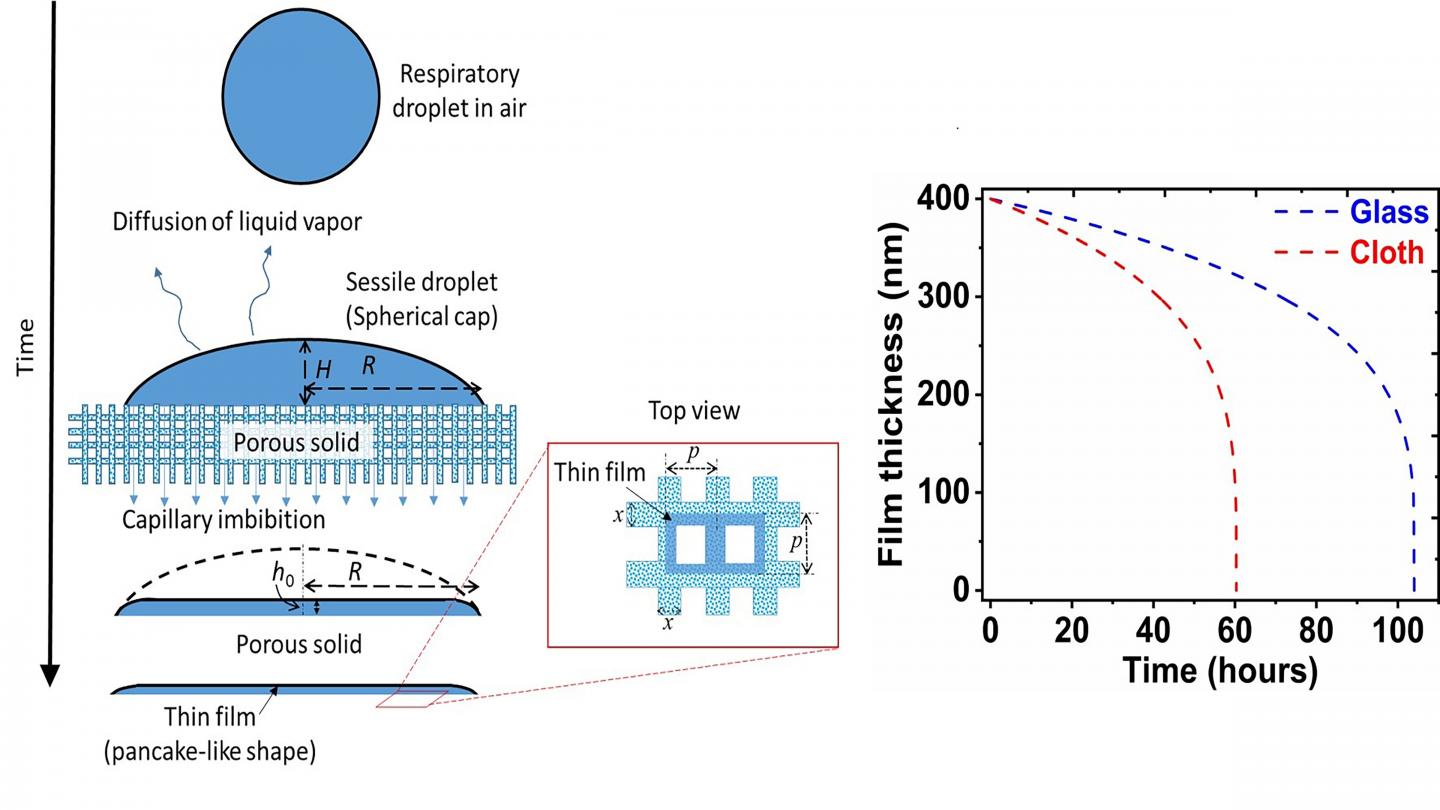
IMAGE

Credit: S. Chatterjee, J. S. Murallidharan, A. Agrawal, and R. Bhardwaj

WASHINGTON, February 9, 2021 — As COVID-19 spreads via respiratory droplets, researchers have become increasingly interested in the drying of droplets on impermeable and porous surfaces. Surfaces that accelerate evaporation can decelerate the spread of the COVID-19 virus.

In Physics of Fluids, by AIP Publishing, researchers from IIT Bombay show a droplet remains liquid for a much shorter time on a porous surface, making it less favorable to survival of the virus.

The researchers found the coronavirus can survive for four days on glass, seven days on plastic, and seven days on stainless steel. But on paper and cloth, the virus survived for only three hours and two days, respectively.

“Based on our study, we recommend that furniture in hospitals and offices, made of impermeable material, such as glass, stainless steel, or laminated wood, be covered with porous material, such as cloth, to reduce the risk of infection upon touch,” said author Sanghamitro Chatterjee.

Similarly, the researchers suggest seats in public places, such as parks, shopping malls, restaurants, and railway or airport waiting halls, could be covered with cloth to alleviate the risk of disease spread.

For both impermeable and porous surfaces, 99.9% of the droplet’s liquid content is evaporated within the first few minutes. After this initial state, a microscopic thin residual liquid film remains on the exposed solid parts, where the virus can still survive.

The researchers discovered the evaporation of this remnant thin film is much faster in the case of porous surfaces as compared to impermeable surfaces. The d¬¬¬¬roplets spread due to capillary action between the liquid near the contact line and the horizontally oriented fibers on the porous surface and the void spaces in porous materials, which accelerates evaporation.

“The fact that just the geometric features rather than the chemical details of the porous material make the thin-film lifetime significantly less was surprising,” said Rajneesh Bhardwaj.

Specific findings, such as the droplet’s liquid phase lifetime of approximately six hours on paper, will be particularly relevant in certain contexts, like schools. While this timescale is shorter than that of any permeable material (e.g., glass with a liquid phase lifetime of approximately four days), it would impact the exchange of notebooks, for example, as policymakers evaluate safe measures for reopening schools or the exchange of currency note transactions in retail banks.

Similarly, cardboard boxes, used commonly by e-commerce companies around the world, could be deemed relatively safe, since they would inhibit the virus survival.

###

The article “Why coronavirus survives longer on impermeable than porous surfaces” is authored by Sanghamitro Chatterjee, Janani Srree Murallidharan, Amit Agrawal, and Rajneesh Bhardwaj. The article will appear in Physics of Fluids on Feb. 9, 2021 (DOI: 10.1063/5.0037924). After that date, it can be accessed at https://aip.scitation.org/doi/10.1063/5.0037924.

ABOUT THE JOURNAL

Physics of Fluids is devoted to the publication of original theoretical, computational, and experimental contributions to the dynamics of gases, liquids, and complex fluids. See https://aip.scitation.org/journal/phf.

Media Contact
Larry Frum
[email protected]

Related Journal Article

http://dx.doi.org/10.1063/5.0037924

Tags: Atomic/Molecular/Particle PhysicsBiologyBiomechanics/BiophysicsChemistry/Physics/Materials SciencesEpidemiologyInfectious/Emerging DiseasesMedicine/HealthVirology
Share12Tweet8Share2ShareShareShare2

Related Posts

Miniature Sensor Uses Light to Detect Touch — Chemistry

Miniature Sensor Uses Light to Detect Touch

May 8, 2026
Iron Minerals Determine Whether Dissolved Organic Matter Fuels Microbes or Becomes Long-Term Carbon Storage — Chemistry

Iron Minerals Determine Whether Dissolved Organic Matter Fuels Microbes or Becomes Long-Term Carbon Storage

May 8, 2026

Kate Evans Appointed Associate Lab Director for Biological and Environmental Systems Science at ORNL

May 8, 2026

Advancing Multiscale Modeling and Overcoming Operational Challenges in Autothermal CO₂-to-Methanol Reactors

May 8, 2026
Please login to join discussion

POPULAR NEWS

  • Research Indicates Potential Connection Between Prenatal Medication Exposure and Elevated Autism Risk

    840 shares
    Share 336 Tweet 210
  • New Study Reveals Plants Can Detect the Sound of Rain

    727 shares
    Share 290 Tweet 181
  • Salmonella Haem Blocks Macrophages, Boosts Infection

    61 shares
    Share 24 Tweet 15
  • Breastmilk Balances E. coli and Beneficial Bacteria in Infant Gut Microbiomes

    57 shares
    Share 23 Tweet 14

About

We bring you the latest biotechnology news from best research centers and universities around the world. Check our website.

Follow us

Recent News

New Post-Hoc Analysis Explores Daily Oral Orforglipron Use in Adults Over 65 with Obesity, Regardless of Diabetes Status

Evaluating Digoxin Use in Patients with Symptomatic Rheumatic Heart Disease

Evaluating the Effectiveness and Safety of Digitalis Glycosides in Treating Heart Failure

Subscribe to Blog via Email

Enter your email address to subscribe to this blog and receive notifications of new posts by email.

Join 82 other subscribers
  • Contact Us

Bioengineer.org © Copyright 2023 All Rights Reserved.

Welcome Back!

Login to your account below

Forgotten Password?

Retrieve your password

Please enter your username or email address to reset your password.

Log In
No Result
View All Result
  • Homepages
    • Home Page 1
    • Home Page 2
  • News
  • National
  • Business
  • Health
  • Lifestyle
  • Science

Bioengineer.org © Copyright 2023 All Rights Reserved.