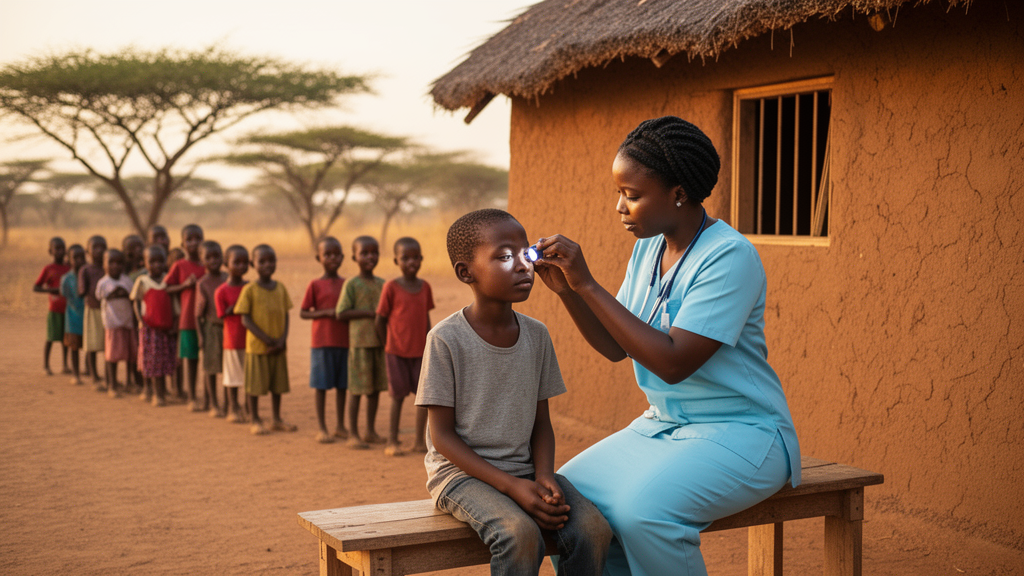
Active trachoma remains widespread among young children in Ethiopia, according to an umbrella review published in BMC Infectious Diseases that synthesizes the findings of previous systematic reviews and meta-analyses. The pooled analysis, covering data from 745,994 children aged 1 to 9 years, estimated the overall prevalence of active trachoma at 22.28 percent, with a 95 percent confidence interval of 19.51 to 25.06 percent. The authors emphasize that this figure should be read as a broad summary of currently available evidence rather than an absolute national figure, yet it still exceeds the elimination targets set by the World Health Organization.
The review was conducted by a team led by Abraham Dessie Gessesse and published online on 28 October 2026 as an open-access article. Trachoma, the researchers note in their background section, ranks as the third leading cause of avoidable blindness, behind cataracts and glaucoma. Although numerous individual studies have estimated its prevalence and identified potential risk factors, the reported findings have remained inconsistent, which motivated the authors to consolidate the existing systematic reviews into a single comprehensive overview intended to inform targeted public health interventions.
Methodologically, the umbrella review searched six databases: Web of Science, Scopus, PubMed Central, CINAHL, EMBASE, and Google Scholar, for relevant systematic reviews and meta-analyses published from the beginning of records through 27 November 2025. From 876 articles retrieved, five systematic reviews and meta-analyses met the inclusion criteria. Five authors independently extracted data for analysis in STATA version 17.0, and the methodological quality of the included reviews was assessed using the Joanna Briggs Institute rating technique for prevalence data.
Because the total number of included systematic reviews was fewer than ten, the authors did not formally evaluate publication bias using funnel plots or Egger’s test, in accordance with standard Cochrane and PRISMA guidance. A random-effects model was employed to pool the prevalence of active trachoma, and the results were displayed using a forest plot.
Beyond the headline prevalence estimate, the review identified two factors significantly associated with an increased risk of active trachoma among children. Non-latrine utilization was associated with roughly 3.79 times the odds of active trachoma compared with latrine use, with a 95 percent confidence interval of 2.29 to 5.29. Lack of soap usage for face washing was associated with roughly 2.92 times the odds, with a 95 percent confidence interval of 1.43 to 4.40. These adjusted odds ratios point to sanitation and facial hygiene as the environmental and behavioral factors most consistently linked to infection in the synthesized evidence.
The findings carry direct implications for Ethiopia’s ongoing efforts against trachoma.
The confidence interval of 19.51 to 25.06 percent reflects the uncertainty around the central estimate.
Subject of Research: The pooled prevalence of active trachoma among children aged 1 to 9 years in Ethiopia and its associated sanitation and hygiene factors.
Article Title: Prevalence of active trachoma among children aged 1–9 years in Ethiopia: umbrella review
Article References: Gessesse, A. D., Tigabu, D., Kelkay, J. M., Kidie, D. M., Akele, M. A., Demeke, A. D., Azmeraw, M., Adisu, M. A., & Derso, Y. A. (2026). Prevalence of active trachoma among children aged 1–9 years in Ethiopia: umbrella review. BMC Infectious Diseases. https://doi.org/10.1186/s12879-026-14738-w
Image Credits: AI Generated
DOI: 10.1186/s12879-026-14738-w
Keywords: trachoma, Ethiopia, children, umbrella review, prevalence, blindness, sanitation, latrine use, face washing, SAFE strategy, public health, meta-analysis
News Source: Phoebe Ingram. (October 28, 2026). Pooled data show active trachoma affects over one in five Ethiopian children. Scienmag.