• HOME
  • NEWS
  • EXPLORE
    • CAREER
      • Companies
      • Jobs
    • EVENTS
    • iGEM
      • News
      • Team
    • PHOTOS
    • VIDEO
    • WIKI
  • BLOG
  • COMMUNITY
    • FACEBOOK
    • INSTAGRAM
    • TWITTER
Sunday, May 10, 2026
BIOENGINEER.ORG
No Result
View All Result
  • Login
  • HOME
  • NEWS
  • EXPLORE
    • CAREER
      • Companies
      • Jobs
        • Lecturer
        • PhD Studentship
        • Postdoc
        • Research Assistant
    • EVENTS
    • iGEM
      • News
      • Team
    • PHOTOS
    • VIDEO
    • WIKI
  • BLOG
  • COMMUNITY
    • FACEBOOK
    • INSTAGRAM
    • TWITTER
  • HOME
  • NEWS
  • EXPLORE
    • CAREER
      • Companies
      • Jobs
        • Lecturer
        • PhD Studentship
        • Postdoc
        • Research Assistant
    • EVENTS
    • iGEM
      • News
      • Team
    • PHOTOS
    • VIDEO
    • WIKI
  • BLOG
  • COMMUNITY
    • FACEBOOK
    • INSTAGRAM
    • TWITTER
No Result
View All Result
Bioengineer.org
No Result
View All Result
Home NEWS Science News Chemistry

Polymer reversibly glows white when stretched

Bioengineer by Bioengineer
April 24, 2019
in Chemistry
Reading Time: 2 mins read
0
IMAGE
Share on FacebookShare on TwitterShare on LinkedinShare on RedditShare on Telegram

IMAGE

Credit: American Chemical Society

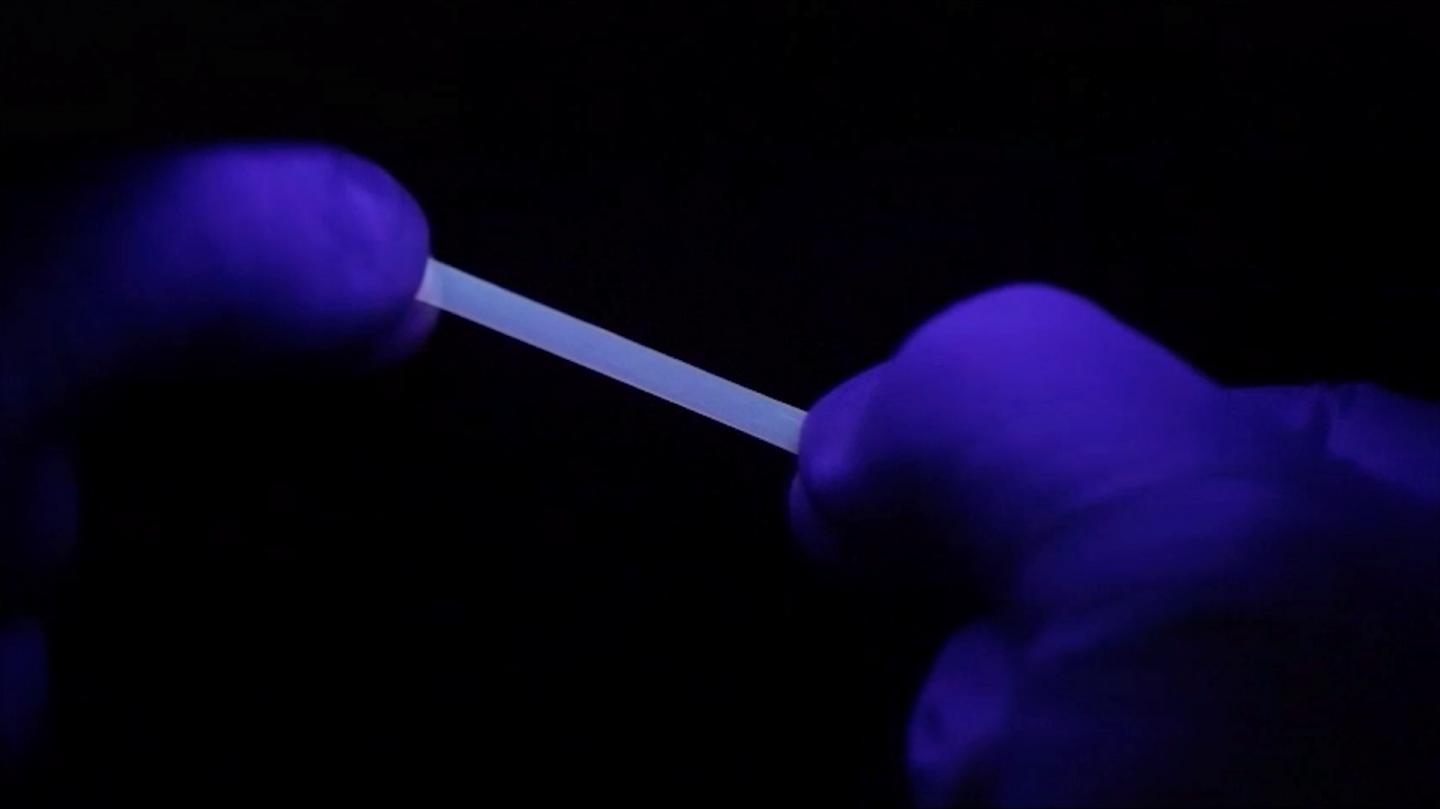
Polymers that change their appearance in response to mechanical forces can warn of damage developing in a material before the stress causes structural failure. Researchers now report in ACS Central Science that they’ve developed a first-of-its-kind elastic polymer blend that displays white fluorescence when deformed and then goes dark after relaxing back to its original shape.

A general approach to create such stress-sensing polymers is to integrate sensor molecules that change their optical properties when activated by mechanical force. In most previous types of these polymers, however, activation is irreversible because it breaks covalent bonds in the sensors. These bonds can also be unintentionally broken by other stimuli, such as heat or light, so an optical change doesn’t always prove the material has been mechanically damaged. Yoshimitsu Sagara, Christoph Weder and colleagues wanted to overcome these disadvantages. To do this, they built upon their previous work, published last year, in which they reported a polyurethane containing stress-sensing rotaxane consisting of ring-shaped fluorescent molecules threaded on dumbbell-shaped molecules featuring quencher groups at their center. In the relaxed polymer, the quenchers were near the fluorescent rings and prevented them from glowing under ultraviolet light. Stretching the polymer moved the quenchers and fluorescent rings apart, so the material glowed green. The process was fully reversible and couldn’t be triggered by heat or light.

In the current study, the researchers developed three new polyurethanes that glowed blue, green or orange when stretched, demonstrating that the color can be tailored simply by using different cyclic fluorescent rings in the rotaxanes. The materials emitted light of greater or lesser intensity, depending on how much they were stretched. By combining the three polymers, the researchers say they created the first white-light-emitting polymer that can instantly be switched on and off mechanically. Applications include study of the physical forces in cells and tissues, as well as visualizing damage in polymeric materials.

###

A video of the material being stretched can be found on the ACS YouTube Headline Science channel (or click here to directly access the video).

The authors acknowledge funding from Japan Science and Technology Agency, PRESTO (JPMJPR17P6) and the Swiss National Center of Competence in Research Bio-Inspired Materials.

The paper’s abstract will be available on April 24 at 8 a.m. Eastern time here:
http://pubs.acs.org/doi/abs/10.1021/acscentsci.9b00173.

The American Chemical Society, the world’s largest scientific society, is a not-for-profit organization chartered by the U.S. Congress. ACS is a global leader in providing access to chemistry-related information and research through its multiple databases, peer-reviewed journals and scientific conferences. ACS does not conduct research, but publishes and publicizes peer-reviewed scientific studies. Its main offices are in Washington, D.C., and Columbus, Ohio.

To automatically receive news releases from the American Chemical Society, contact [email protected].

Follow us: Twitter | Facebook

Media Contact
Katie Cottingham
[email protected]

Tags: BiotechnologyChemistry/Physics/Materials SciencesCivil EngineeringIndustrial Engineering/ChemistryMaterialsPolymer ChemistryResearch/Development
Share12Tweet8Share2ShareShareShare2

Related Posts

Miniature Sensor Uses Light to Detect Touch — Chemistry

Miniature Sensor Uses Light to Detect Touch

May 8, 2026
Iron Minerals Determine Whether Dissolved Organic Matter Fuels Microbes or Becomes Long-Term Carbon Storage — Chemistry

Iron Minerals Determine Whether Dissolved Organic Matter Fuels Microbes or Becomes Long-Term Carbon Storage

May 8, 2026

Kate Evans Appointed Associate Lab Director for Biological and Environmental Systems Science at ORNL

May 8, 2026

Advancing Multiscale Modeling and Overcoming Operational Challenges in Autothermal COâ‚‚-to-Methanol Reactors

May 8, 2026
Please login to join discussion

POPULAR NEWS

  • Research Indicates Potential Connection Between Prenatal Medication Exposure and Elevated Autism Risk

    840 shares
    Share 336 Tweet 210
  • New Study Reveals Plants Can Detect the Sound of Rain

    727 shares
    Share 290 Tweet 181
  • Scientists Investigate Possible Connection Between COVID-19 and Increased Lung Cancer Risk

    68 shares
    Share 27 Tweet 17
  • Salmonella Haem Blocks Macrophages, Boosts Infection

    61 shares
    Share 24 Tweet 15

About

We bring you the latest biotechnology news from best research centers and universities around the world. Check our website.

Follow us

Recent News

Evaluating Digoxin Use in Patients with Symptomatic Rheumatic Heart Disease

Evaluating the Effectiveness and Safety of Digitalis Glycosides in Treating Heart Failure

Urdu Fall Risk Questionnaire Adapted for Elderly

Subscribe to Blog via Email

Success! An email was just sent to confirm your subscription. Please find the email now and click 'Confirm' to start subscribing.

Join 82 other subscribers
  • Contact Us

Bioengineer.org © Copyright 2023 All Rights Reserved.

Welcome Back!

Login to your account below

Forgotten Password?

Retrieve your password

Please enter your username or email address to reset your password.

Log In
No Result
View All Result
  • Homepages
    • Home Page 1
    • Home Page 2
  • News
  • National
  • Business
  • Health
  • Lifestyle
  • Science

Bioengineer.org © Copyright 2023 All Rights Reserved.