In a review published in Frontiers in Cell and Developmental Biology, researchers Si-Yu Huang, Ming-Shun Zhang, Ze-Sen Feng, Wei Cui, and Fu-Hui Xiao from Ningbo University delineated how aging and malignant signaling dynamically remodel circulating platelets, transforming these anucleate blood components from mediators of hemostasis into active drivers of thromboinflammation and tumor progression. While platelets have historically been studied for blood clotting and wound repair, the authors synthesize evidence demonstrating that organismal aging and cellular senescence alter platelet production, morphology, transcriptomes, and functional reactivity. These aging-associated shifts establish a hyperactive, pro-inflammatory state that exacerbates cardiovascular risks while fostering biological niches for neoplastic proliferation, immune evasion, and metastatic dissemination.
Physiologically, platelets are the smallest anucleate cellular components in human blood, existing as disc-shaped fragments measuring roughly two to five micrometers across. Their biogenesis occurs continuously within bone marrow, where mature megakaryocytes undergo thrombopoiesis under thrombopoietin regulation following hematopoietic stem cell differentiation. During maturation, megakaryocytes undergo endomitosis, duplicating genomic DNA without cell division to achieve polyploidization and cytoplasmic expansion alongside an invaginated membrane system that supplies essential membrane structures. The mature megakaryocytes subsequently extend proplatelet elongations into sinusoidal vasculature, where hemodynamic shear forces sever these projections into functional circulating fragments. Human platelets maintain a circulating lifespan of seven to ten days before cellular aging triggers clearance signals prompting their systemic elimination.
Despite lacking a nucleus, circulating platelets harbor an active internal architecture enriched with mitochondria, lysosomes, peroxisomes, alpha-granules, and dense granules. Platelets inherit a functional megakaryocyte-derived ribonucleic acid repertoire comprising approximately 9,500 protein-coding messenger RNA transcripts and non-coding RNAs retaining splicing and translational capabilities. Proteomic investigations have identified over 4,000 distinct platelet proteins, encompassing coagulation factors, cytokines, chemokines, growth factors, and immunomodulatory molecules. Following vascular injury, platelets adhere to exposed collagen through surface complexes like glycoprotein Ib-IX-V, initiating activation, structural remodeling, and the autocrine release of adenosine diphosphate and thromboxane A2 to drive aggregation. Simultaneously, platelets express immune molecules such as Toll-like receptors and Fc receptors, secreting interleukin-1 beta and CD40 ligand to interact directly with leukocytes during inflammatory defense.
Across human populations, organismal aging introduces profound alterations in platelet abundance and compartment dynamics. Epidemiological evaluations across multiple ethnic populations demonstrate that platelet counts decline significantly in elderly individuals, following a non-linear progression across the lifespan. Platelet concentrations drop during early childhood, stabilize throughout middle age, and fall again in later decades. Furthermore, epidemiological evaluations confirm persistent sexual dimorphism in circulating abundance, with females consistently maintaining higher platelet concentrations than males. Relative to early infancy, circulating platelet counts fall by thirty-five percent in elderly men and twenty-five percent in elderly women. While the biological drivers of this late-life decline remain theoretically linked to diminished hematopoietic stem cell reserves or potential survival advantages among individuals with lower counts, the underlying causal mechanisms remain uncertain.
In parallel with declining numbers, platelets undergo conspicuous morphological remodeling across chronological and circulatory aging. At the population level, epidemiological measurements document a modest increase in mean platelet volume among older cohorts, potentially reflecting shifts in systemic production and clearance equilibria. Conversely, single-cell analyses reveal an opposite pattern, wherein senescent individual platelets exhibit contracted dimensions corresponding to roughly half the cross-sectional area of younger counterparts. This apparent structural paradox highlights the reality that mean volume registers an entire circulating pool that may skew toward younger fragments in elderly hosts, whereas single-cell resolution directly measures individual senescence. Structurally, senescent platelets exhibit degraded cytoskeletal density and diminished mitochondrial content, while platelets from elderly donors present irregular, disrupted plasma membranes characterized by slender pseudopodia and altered buoyant density.
As individual platelets approach the terminal phase of their circulating existence, progressive cellular senescence reshapes their functional profile and surface composition. Senescent platelets shed critical adhesive surface glycoproteins, specifically glycoprotein Ib alpha and glycoprotein VI, marking them for hepatic and splenic clearance. Concurrently, these expiring fragments experience marked depletion of internal ribonucleic acid content, accompanied by diminished alpha-granule and dense-granule secretion and elevated microparticle shedding. Consequently, senescent platelets exhibit diminished hemostatic proficiency and reduced aggregation responsiveness when challenged with traditional agonists. However, these aged fragments paradoxically acquire heightened reactivity toward inflammatory stimuli, demonstrating an enhanced capacity to form platelet-leukocyte aggregates, adhere firmly to neutrophils, execute bactericidal defense, and present a pronounced procoagulant surface through accelerated phosphatidylserine externalization and desialylation.
At the organismal scale, advanced chronological age represents an established independent clinical risk factor for fatal thrombosis and cardiovascular pathology, driven largely by an overarching shift toward a hyperreactive platelet phenotype. Clinical investigations indicate that platelets isolated from elderly human subjects exhibit elevated baseline activation states, reduced activation thresholds, heightened responsiveness to adenosine diphosphate, and relative thrombin resistance. Molecular profiling reveals that this aged phenotype involves transcriptomic and proteomic alterations across pathways governing degranulation, complement cascades, and nuclear factor kappa B signaling. Additionally, platelets from older individuals secrete granzyme A, an effector molecule that fuels systemic inflammation via interleukin-8 induction. Research also identifies an age-dependent shortcut in megakaryocyte differentiation that yields hyperreactive platelets, while reduced global ubiquitination combined with ubiquitin-specific peptidase 25 upregulation stabilizes talin-1 to fuel platelet hyperactivity.
In oncology, platelets engage in continuous bidirectional communication with malignant tissues, serving as potent circulating modulators of primary tumor proliferation and neoangiogenesis. Tumors release agonists such as thrombin and adenosine diphosphate that engage platelet protease-activated receptors and P2Y12 receptors, triggering alpha-granule degranulation and the local release of transforming growth factor beta and insulin-like growth factor 1, which directly stimulate cancer cell proliferation. Concurrently, activated platelets stimulate tumor angiogenesis through the secretion of vascular endothelial growth factor and platelet-derived growth factor, which activates platelet-derived growth factor receptors on interstitial cells to recruit pericytes and fibroblasts around newly forming vessels. Platelets also discharge matrix metalloproteinases that degrade surrounding extracellular matrices to facilitate endothelial sprouting. While platelets naturally carry angiogenesis inhibitors like platelet factor 4, thrombospondin-1, and endostatin, malignant signals induce selective sorting favoring pro-angiogenic release.
The mechanistic involvement of platelets extends directly to cancer dissemination and protection against cell death pathways. Platelet-derived extracellular vesicles internalized by neoplastic cells upregulate integrin beta 3 and trigger the MAPK/ERK/ATF4/Nrf2 signaling axis, enhancing SLC7A11 expression to shield malignant cells from ferroptosis, an iron-dependent form of cell death. Furthermore, platelets aggregate around circulating tumor cells through P-selectin, glycoprotein Ib-IX-V, von Willebrand factor, and surface integrins, shielding malignant cells from immune clearance. This physical association amplifies transforming growth factor beta 1 signaling, activating Smad and nuclear factor kappa B pathways within tumor cells to downregulate epithelial E-cadherin while upregulating mesenchymal vimentin and N-cadherin, thereby orchestrating epithelial-mesenchymal transition. Platelets also assist extravasation as integrin alpha IIb beta 3 binds endothelial intercellular adhesion molecule-1, and platelet-secreted adenosine diphosphate acts through endothelial P2Y2 receptors to disrupt intercellular junctions.
Beyond facilitating metastasis, platelets actively construct an immunosuppressive tumor microenvironment that shields cancer cells from immune destruction. Platelet-derived transforming growth factor beta, presented via surface glycoprotein A repetitions predominant, potently suppresses cytotoxic T lymphocytes and expands immunosuppressive regulatory T cell populations. Furthermore, platelets acquire programmed death-ligand 1 from malignant cells via fibronectin, integrin alpha 5 beta 1, and glycoprotein Ib alpha, disabling T cell responses, while simultaneously transferring major histocompatibility complex class I molecules onto circulating tumor cells to mask their foreign identity. Exposure to tumor-derived small extracellular vesicles further reprograms circulating platelets into tumor-educated platelets carrying diagnostic cancer-specific ribonucleic acid profiles capable of detecting multiple malignant types in liquid biopsies.
The physical interplay between platelets and neoplastic cells frequently culminates in tumor cell-induced platelet aggregation through specific receptor pairings. Tumor-expressed podoplanin binds platelet C-type lectin-like receptor 2, initiating an intracellular Syk-dependent signaling cascade, while tumor galectin-3 engages platelet glycoprotein VI to trigger aggregation and promote extravasation. Crucially, the review highlights emerging biological intersections between platelet senescence and malignant progression that have historically been overlooked by studies treating circulating platelets as uniform entities. As platelets age, surface desialylation prompts recognition by hepatic Ashwell-Morell receptors, activating Kupffer cells to trigger systemic immunosuppressive remodeling. Additionally, externalized phosphatidylserine promotes procoagulant interactions among platelets, cancer cells, and leukocytes. Preclinical murine models have further identified an aging-associated Tpm2-high platelet subpopulation that directly accelerates pulmonary metastasis, whereas chemotherapy treatments like doxorubicin provoke premature platelet aging phenotypes through glycoprotein Ib alpha shedding.
These interconnected pathophysiological mechanisms carry profound clinical ramifications, particularly given that venous thromboembolism constitutes the second leading cause of mortality among cancer patients. Although cancer patients frequently display systemic platelet hyperreactivity, they simultaneously experience thrombocytopenia, revealing a pronounced decoupling of circulating platelet counts from baseline functional capacity during malignant disease. Huang and colleagues conclude that resolving the exact molecular cascades connecting platelet senescence to cancer progression remains an urgent research priority. Significant questions persist regarding whether therapeutic interventions directed against hyperreactive or aged platelet populations can foster healthy aging or mitigate oncological risks. Ultimately, delineating how numerical declines and qualitative functional remodeling interact within heterogeneous platelet populations will be essential for developing targeted therapeutic strategies capable of disrupting thromboinflammation and curtailing age-associated cancer metastasis.
Subject of Research: Mechanisms of platelet remodeling during organismal aging and their functional contributions to cancer progression
Article Title: The evolving role of platelets in aging and cancer progression
Article References: Huang, S.-Y., Zhang, M.-S., Feng, Z.-S., Cui, W., & Xiao, F.-H. (2026). The evolving role of platelets in aging and cancer progression. Frontiers in Cell and Developmental Biology, 14, Article 1946388. https://doi.org/10.3389/fcell.2026.1946388
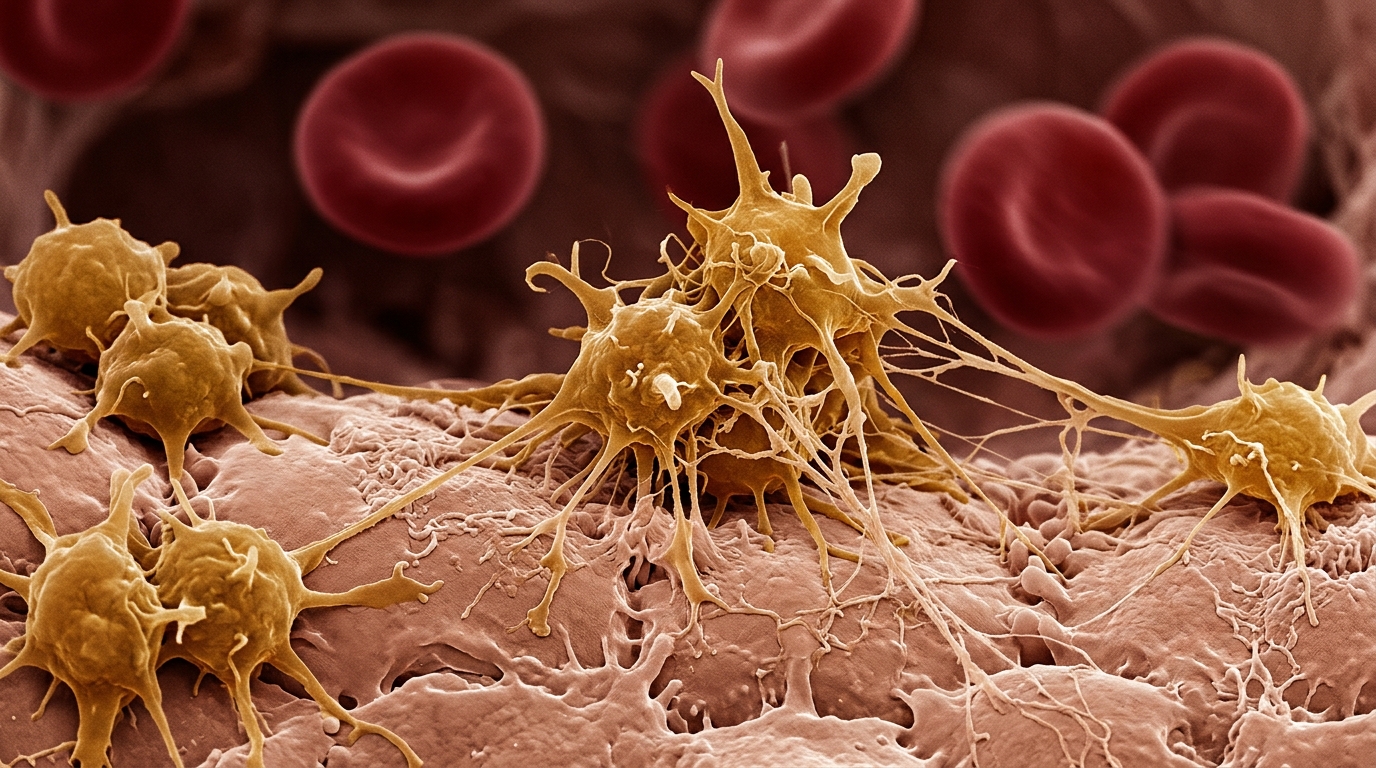
Image Credits: AI Generated
DOI: 10.3389/fcell.2026.1946388
Keywords: platelets, aging, cellular senescence, cancer biology, thromboinflammation, metastasis, tumor microenvironment, tumor-educated platelets, evolving, role, cancer, progression
News Source: Nathaniel Bowman. (November 6, 2026). Platelets Undergo Lifespan Remodeling That Promotes Thromboinflammation and Fuels Tumor Progression. Scienmag.