Sea urchin larvae raised in high levels of plastic pollution die due to developmental abnormalities, new research shows.
Credit: Dr Eva Jimenez-Guri
Sea urchin larvae raised in high levels of plastic pollution die due to developmental abnormalities, new research shows.
Scientists put fertilised urchin eggs in seawater with varying levels of plastic, and compared the effects of newly made PVC pellets (called nurdles) with fragments collected on beaches.
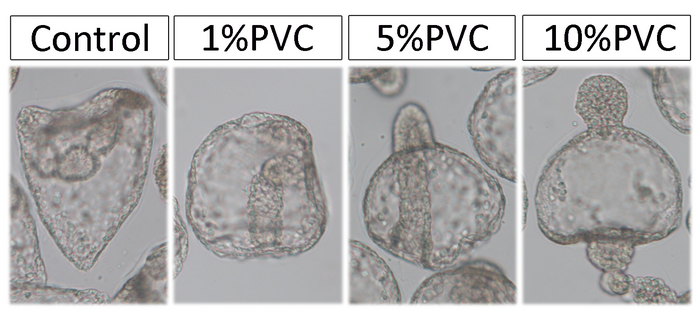
In all three concentrations tested (1%, 5% and 10% of plastic in seawater), PVC led to significant abnormalities and all urchin larvae died.
Beach-collected fragments at 10% concentration also killed the larvae, which developed no proper shape.
Lower concentrations of beach-collected plastic did not kill the embryos, suggesting newly made plastic – which still contains high levels of additives that can leach out – are more harmful.
Although the concentrations tested in the study are rare in the oceans, they could occur after spills of plastic or in areas like the tide line where pollution accumulates.
The research team – from the Anton Dohrn Zoological Station and National Biodiversity Future Center (Italy), and the University of Exeter (UK) – previously found plastic additives can harm sea urchin larvae, and the new study develops this and reveals how this harm is caused.
“The larvae affected by plastic pollution showed developmental abnormalities including malformation of the skeleton, neural and immune cells,” said Dr Eva Jimenez-Guri, from the Anton Dohrn Zoological Station and the University of Exeter.
“They also showed ‘radialisation’ – meaning they lacked proper symmetrical structure, and were instead largely formless and therefore unable to survive.
“In these larvae, mitochondria (the ‘powerhouses’ of cells) didn’t work properly, and they showed signs of oxidative stress, which damages cells.”
The study reveals the genetic processes behind these abnormalities.
In the case of new PVC nurdles, the damage was caused by high concentrations of zinc that leached into the water.
Larvae exposed 10% PVC pollution developed their gut outside their body, while the 5% and 1% levels also lead to fatal abnormalities.
The beach-collected samples – gathered in Cornwall, UK – did not release high levels of zinc, as most of the additives they contained would already have been released in the sea.
However, such particles are known to collect a variety of organic pollutants, and the release of these pollutants explains the abnormalities seen in this study.
“Our findings point to clear and specific detrimental effects of marine plastic pollution on the development of sea urchin larvae,” said Dr Jimenez-Guri.
“We have identified the genes that are affected by these pollutants, and we know many animal species rely on the same genes for key early stages of development.
“So it’s possible that plastic pollution could cause similar abnormalities in other species, and we are already investigating this in the next stage of our research.
“While the levels of pollution assessed in the study are not common in the ocean, marine plastic pollution continues to increase at a rapid rate – with potentially serious consequences for marine life.”
Dr Jimenez-Guri’s work was funded by a Marie Skłodowska-Curie fellowship.
The paper, published in the journal Science of the Total Environment, is entitled: “Plastic leachate-induced toxicity during sea urchin embryonic development: Insights into the molecular pathways affected by PVC.”
Journal
Science of The Total Environment
DOI
10.1016/j.scitotenv.2022.160901
Method of Research
Observational study
Subject of Research
Animals
Article Title
Plastic leachate-induced toxicity during sea urchin embryonic development: Insights into the molecular pathways affected by PVC
Article Publication Date
13-Dec-2022