• HOME
  • NEWS
  • EXPLORE
    • CAREER
      • Companies
      • Jobs
    • EVENTS
    • iGEM
      • News
      • Team
    • PHOTOS
    • VIDEO
    • WIKI
  • BLOG
  • COMMUNITY
    • FACEBOOK
    • INSTAGRAM
    • TWITTER
Sunday, July 5, 2026
BIOENGINEER.ORG
No Result
View All Result
  • Login
  • HOME
  • NEWS
  • EXPLORE
    • CAREER
      • Companies
      • Jobs
        • Lecturer
        • PhD Studentship
        • Postdoc
        • Research Assistant
    • EVENTS
    • iGEM
      • News
      • Team
    • PHOTOS
    • VIDEO
    • WIKI
  • BLOG
  • COMMUNITY
    • FACEBOOK
    • INSTAGRAM
    • TWITTER
  • HOME
  • NEWS
  • EXPLORE
    • CAREER
      • Companies
      • Jobs
        • Lecturer
        • PhD Studentship
        • Postdoc
        • Research Assistant
    • EVENTS
    • iGEM
      • News
      • Team
    • PHOTOS
    • VIDEO
    • WIKI
  • BLOG
  • COMMUNITY
    • FACEBOOK
    • INSTAGRAM
    • TWITTER
No Result
View All Result
Bioengineer.org
No Result
View All Result
Home NEWS Science News Chemistry

Plants as protein factories: Antioxidant boosts the yield of valuable biologics

Bioengineer by Bioengineer
March 9, 2021
in Chemistry
Reading Time: 2 mins read
0
IMAGE
Share on FacebookShare on TwitterShare on LinkedinShare on RedditShare on Telegram

Research team at University of Tsukuba finds spraying leaves with vitamin C prevents cell death and enhances production of high-value pharmaceutical proteins in plants
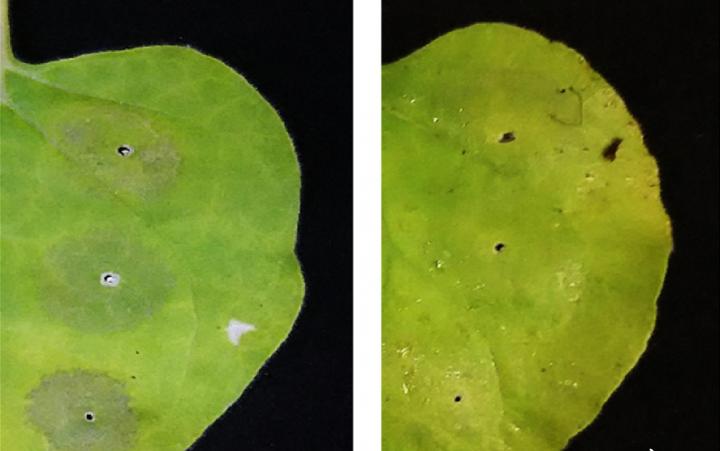
IMAGE

Credit: University of Tsukuba

Tsukuba, Japan – Producing high-value pharmaceutical proteins in plants–sometimes called “molecular pharming”–offers advantages over some other manufacturing methods, notably the low cost and ease of scaling up production to meet demand. But expressing large quantities of “foreign” proteins in plants can also sometimes lead to problems, such as dehydration and premature cell death in the leaves.

Now a team led by Professor Kenji Miura of the University of Tsukuba has discovered that spraying leaves with high concentrations of the antioxidant ascorbic acid (vitamin C) can increase protein production three-fold or even more. They recently published their findings in Plant Physiology.

The team worked with a close relative of tobacco, Nicotiana benthamiana, which is widely used for this type of application as the plants grow well in greenhouses and it is relatively straightforward to introduce foreign genes. The researchers induced the leaves to produce new proteins by a process known as agro-infiltration: the leaves are injected with bacteria called Agrobacterium that carry the DNA encoding the proteins of interest into plant cells. The leaf cells decode the DNA and use it to make the new proteins.

While some foreign proteins cause few problems for the plant cells, others can lead to side-effects that seem to be caused by an excess of damaging reactive oxygen species. Applying ascorbic acid as an antioxidant counteracts the harmful effects and allows substantially higher rates of protein production.

“We tested the method with several different types of proteins,” says Professor Miura. “We used green fluorescent protein (a common tool in the lab) and two human proteins, called Cul1 and an F-box protein. Spraying the leaves with ascorbic acid made a surprisingly big difference, but only when we applied high concentrations of the antioxidant. It seems that ascorbic acid prevents cell death and also reduces the breakdown of the foreign proteins, so the yield is higher.”

The team went on to successfully produce both the heavy chain and light chain of an antibody protein. They showed that the chains produced in leaves assembled correctly into a functional antibody (comprising two heavy and two light chains), and ascorbic acid did not interfere with its immunological properties.

“We are delighted by our results,” says Professor Miura. “As this method of spraying the leaves is so simple, we expect it can be widely adopted and should help to improve the production of many types of valuable proteins for research and medical applications.”

###

The article, “Prevention of necrosis caused by transient expression in Nicotiana benthamiana by application of ascorbic acid”, was recently published in Plant Physiology at doi.org/10.1093/plphys/kiab102.

Media Contact
Naoko Yamashina
[email protected]

Related Journal Article

http://dx.doi.org/10.1093/plphys/kiab102

Tags: BiochemistryBiologyBiotechnologyMolecular BiologyPlant Sciences
Share12Tweet8Share2ShareShareShare2

Related Posts

Intelligent Microgrid Management Promises Lower Household Energy Bills and Reduced Diesel Emissions — Chemistry

Intelligent Microgrid Management Promises Lower Household Energy Bills and Reduced Diesel Emissions

July 4, 2026
Graz University of Technology Deciphers the Structural Secrets of MOF Thin Films — Chemistry

Graz University of Technology Deciphers the Structural Secrets of MOF Thin Films

July 2, 2026

Breaking Thermodynamic Limits: Wavelength-Driven Catalysis Advances Ammonia Synthesis

July 2, 2026

From Quantum Mechanics to AI-Powered Materials Discovery: MARVEL Marks 12 Years of Transforming Computational Science

July 2, 2026
Please login to join discussion

POPULAR NEWS

  • Detection of EDCs in Breast Milk and Infant Urine Up to Six Months Highlights Early Exposure Risks

    77 shares
    Share 31 Tweet 19
  • Saying Goodbye to PGY-6: Pediatric Fellowship Realities

    103 shares
    Share 41 Tweet 26
  • New Drug Candidate Developed at McMaster Shows Potential for Treating Brain Cancer

    58 shares
    Share 23 Tweet 15
  • KTU Researchers Explore Ultrasound’s Role in Enhancing Blood Flow Beyond Diagnostics

    53 shares
    Share 21 Tweet 13

About

We bring you the latest biotechnology news from best research centers and universities around the world. Check our website.

Follow us

Recent News

Quasi-Bound States Boost Quantum Well Photoresponse

Lysine Pyruvylation Links Glycolysis to Epigenetics

Multiphysics Coupling: Single vs. Multiple DeepONet Branches

Subscribe to Blog via Email

Success! An email was just sent to confirm your subscription. Please find the email now and click 'Confirm' to start subscribing.

Join 83 other subscribers
  • Contact Us

Bioengineer.org © Copyright 2023 All Rights Reserved.

Welcome Back!

Login to your account below

Forgotten Password?

Retrieve your password

Please enter your username or email address to reset your password.

Log In
No Result
View All Result
  • Homepages
    • Home Page 1
    • Home Page 2
  • News
  • National
  • Business
  • Health
  • Lifestyle
  • Science

Bioengineer.org © Copyright 2023 All Rights Reserved.