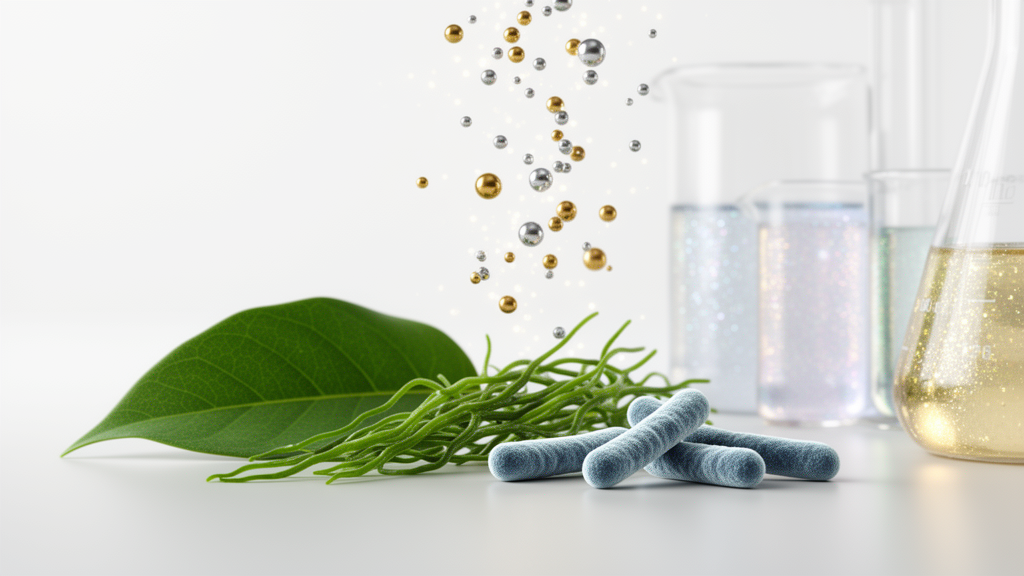
Metallic nanoparticles have quietly surrounded humanity for centuries, hidden in the ruby and green hues of the Roman Lycurgus Cup, the stained glass of medieval church windows and the legendary blades of Damascus steel. Yet only in recent decades have researchers learned to build such materials deliberately, and the dominant recipes still lean on toxic solvents or energy-hungry machinery. A new review from engineers at Tecnologico de Monterrey in Mexico, published in Frontiers in Biomaterials Science, argues that a third way deserves far more attention: biogenic synthesis, in which biomolecules from plants, algae, bacteria and fungi replace hazardous chemical reducing agents to assemble metallic and metal-based nanomaterials from the bottom up.
The authors frame the problem by contrasting the two conventional approaches to nanomaterial fabrication. Top-down physical methods, including milling, laser ablation, lithography and sputter deposition, break macroscopic bulk material down to the nanoscale. They deliver high purity, relatively uniform products and scale well industrially, but they demand large energy inputs and specialized equipment, and milling smaller particles simply costs more energy. Bottom-up chemical methods, by contrast, grow nanomaterials from precursor salts such as silver nitrate or chloroauric acid using a reducing agent, often with a stabilizing or capping agent to prevent particles from clumping back into bulk matter. These routes are cheaper, more versatile and offer finer control over size and shape, but they frequently rely on toxic solvents; silver nanoparticle synthesis, for example, has used ethylene glycol, sodium borohydride, sodium citrate and oleyl amine, all of which can harm human health or the environment.
Biogenic synthesis follows the same bottom-up logic as conventional wet chemistry, but swaps the laboratory reductant for biological resources. Biomolecules from plant tissues, microbial cultures, algal biomass and fungal extracts reduce metal ions from a precursor salt to zero-valent atoms, then stabilize the growing particles. In many cases the same biomolecules form an organic coating on the finished particle surface, a so-called biogenic corona, which keeps the nanomaterial from agglomerating. The review situates this approach within the twelve principles of green chemistry articulated by Anastas and Warner, which call for waste prevention, safer solvents, energy efficiency, renewable feedstocks and inherently safer processes. Because biogenic routes use renewable resources, operate at milder temperatures and avoid specialized equipment, the authors present them as a more sustainable and less toxic alternative, though not one without drawbacks of its own.
Quantitatively, the review finds that biogenic methods can match conventional synthesis on speed and operating conditions while producing particles in the same useful size range. Silver nanoparticles made with Morus alba leaf extract measured 10 to 16 nanometers after just 10 minutes at 25 degrees Celsius, compared with 10 to 50 nanometers from sodium borohydride reduction requiring 30 minutes at 70 degrees Celsius. Bacterial synthesis using supernatants from Brazilian stingless bees yielded silver particles of 8.5 to 25.2 nanometers over 24 hours at room temperature. Copper oxide nanoparticles produced with a cell-free extract of the bacterium Stenotrophomonas sp. BS95 reached 43.68 nanometers in 20 minutes at 121 degrees Celsius, while platinum nanoparticles synthesized by the alga Halymenia dilatata measured 15 nanometers after one hour at 60 degrees Celsius. The main quantitative difference the authors identified was colloidal stability: biogenic particles generally showed slightly lower zeta potentials in suspension, and a value of roughly 30 millivolts is typically needed for stable nanoparticle suspensions, with platinum being an exception at around 20 millivolts.
Plant extracts remain the most common biogenic resource, valued for their degradability and safety. Leaves, roots, seeds and stems supply alkaloids, aldehydes, amino acids, flavonoids, ketones, proteins, phenolics, polysaccharides and vitamins that act as reducing or capping agents. The review describes the underlying chemistry in detail: phenols, with their hydroxyl groups attached to aromatic rings, form intermediate complexes as they reduce the metallic precursor and are oxidized to quinones, which then coat the nanoparticle surface and prevent aggregation. Flavonoids follow a similar path, donating electrons to reduce metal ions and being converted into ketone groups that serve as capping agents. Amino acids and proteins mainly act as stabilizers, binding through hydroxyl and carbonyl groups. Plant-based synthesis avoids the need to culture or lyse microorganisms, but extraction itself can be dirty business; one cited study needed n-hexane, dichloromethane and sulphuric acid plus overnight maceration to obtain neem leaf extract for silver nanoparticle synthesis. As a remedy, the authors highlight pressurized hot water extraction, which keeps water liquid under pressure above its normal boiling point, cutting extraction times, costs and toxic solvent use.
Algae offer a different balance of advantages. Rich in carbohydrates, oils, fatty acids and antioxidant compounds, they can reduce metal precursors through intracellular or extracellular pathways. In intracellular synthesis, metal ions cross the cell surface aided by amino acids, carboxylic acids and phosphates, then are reduced to zero-valent seeds inside the cell before aggregation and termination. Extracellular approaches either boil algal biomass in a solvent to release proteins, enzymes and nucleic acids, or exploit the extracellular matrix of cell walls, glycoprotein coverings and polysaccharides directly. Extracellular routes give researchers more control, because the reducing agent can be quantified and optimized through design of experiments, and the resulting particles are easier to purify. One cited study dissolved marine algal extracts in water at 50 degrees Celsius, added titanium(IV) butoxide, incubated for two hours and recovered titanium dioxide nanoparticles by drying and calcining the resulting gel. The limitations, however, are significant: algal synthesis can take days, shows variable yield, purity and particle size, and its mechanisms remain far less studied than conventional bottom-up chemistry.
Bacteria bring their own evolutionary toolkit to the task. Because metallic ions are inherently toxic to them, bacteria have developed defense mechanisms based on oxidation and reduction reactions carried out by enzymes and metabolites. The key players are reductases, which transfer electrons from donors such as NADH to dissolved metal ions, converting them to zero-valent nanoparticles. In extracellular synthesis, bacteria secrete these enzymes into their surroundings, where they interact with metal ions alongside functional groups on the cell wall; alternatively, reductases can be harvested from cell lysates. In intracellular synthesis, transport proteins carry metal ions into the cytoplasm for reduction, but this requires cell lysis and purification steps that add complexity. Proteins, lipids and peptides then regulate surface charge, biocompatibility, stability and size distribution. The review notes that few studies have quantitatively optimized bacterial synthesis for size control, leaving outcomes unpredictable and hindering industrial scalability, and that biomass purification extends the overall process.
The optical properties of biogenic nanomaterials reveal both promise and compromise. Localized surface plasmon resonance arises when incident photons couple to conducting electrons on a metallic nanoparticle surface, generating plasma oscillations and an electric field extending roughly 300 nanometers into the surrounding sample. This property underpins biosensing: when biomolecules bind to the metallic surface, the changed refractive index shifts the resonance in proportion to the analyte present. Biogenic particles, however, tend to be larger and more morphologically varied than their chemically synthesized counterparts, producing broader, less defined, blue-shifted absorption peaks. In one cited comparison, fungal synthesis of silver nanoparticles with Aspergillus niger produced absorption peaks between 400 and 500 nanometers with extended tails out to 800 nanometers, reflecting a mixture of spherical and non-spherical particles; increasing fungal biomass concentration shifted the product toward the spherical morphology of chemically made particles. Yet performance can excel: silver nanoparticles made with plant extracts showed a sensing sensitivity of 39.1 nanometers per millimolar, well above the 7.4 and 14.8 nanometers per millimolar reported for conventionally prepared particles, and gold nanoparticles made with green tea extract delivered a 25-fold sensitivity increase over a biofunctionalized optical fiber sensor. Photothermal efficiency, meanwhile, rises directly with gold nanoparticle size across 5, 40, 60 and 80 nanometer particles.
Catalysis and colloidal stability complete the property picture. Biogenic nanoparticles have catalyzed the degradation of synthetic dyes such as rhodamine B, methylene blue, Congo red and methyl orange in wastewater, with gold nanoparticles made using banana peel extract accelerating electron transfer from borohydride to the dye molecules. But the biogenic corona cuts both ways: it can enhance activity, yet it can also block active sites on the metal surface, as demonstrated by palladium nanoparticles reduced with coffee that showed no catalytic activity at all, prompting the authors to urge quantification of biogenic reducing agents before catalytic deployment. On stability, long-chain biomolecules provide steric hindrance while ionizable functional groups such as carboxylate, hydroxyl and amine generate electrostatic repulsion, a combined effect known as electrosteric stabilization. Agglomeration matters in practice: one study of composite gold-silica-carbon nanoparticles for solar absorption recorded efficiency losses of 3.57, 4.19, 22.21 and 28.89 percent across four increasing levels of agglomeration. Starch has been shown to stabilize copper oxide nanocubes, with higher starch concentrations yielding better colloidal stability after 72 hours, though excess capping agent can hinder reactivity.
The review concludes that biogenic synthesis addresses real weaknesses of conventional methods, eliminating specialized equipment, lowering reaction temperatures and replacing toxic reductants with renewable biomolecules, while yielding particles whose sizes and applications in antimicrobial treatment, drug delivery, sensing and catalysis remain comparable. Its antibacterial and anticancer effects stem from the ability of nanomaterials to generate reactive oxygen species, damaging DNA and denaturing proteins in target cells. What the field still lacks, the authors emphasize, is a deeper mechanistic understanding and systematic optimization of reaction temperature, time and reductant concentration for each target material. Until those gaps close, biogenic synthesis remains a promising green alternative rather than a wholesale replacement, but the centuries-old marriage between metals and living matter is clearly entering a new, deliberately engineered phase.
Subject of Research: Green, biogenic synthesis methods for metallic and metal-based nanomaterials using plant, algal and bacterial resources
Article Title: Biogenic synthesis: an alternative method for metallic and metal-based nanomaterials
Article References: Flores-Otero, J. F., Ramos-de-la-Peña, A. M., & Aguilar, O. (2026). Biogenic synthesis: an alternative method for metallic and metal-based nanomaterials. Frontiers in Biomaterials Science, 5, Article 1858048. https://doi.org/10.3389/fbiom.2026.1858048
Image Credits: AI Generated
DOI: 10.3389/fbiom.2026.1858048
Keywords: biogenic synthesis, metallic nanoparticles, nanomaterials, green chemistry, bottom-up synthesis, plant extracts, algae, bacteria, localized surface plasmon resonance, catalysis, colloidal stability, biogenic corona
News Source: Charles Cole. (October 23, 2026). Plants, Algae and Bacteria Offer a Greener Route to Metal Nanomaterials. Scienmag.