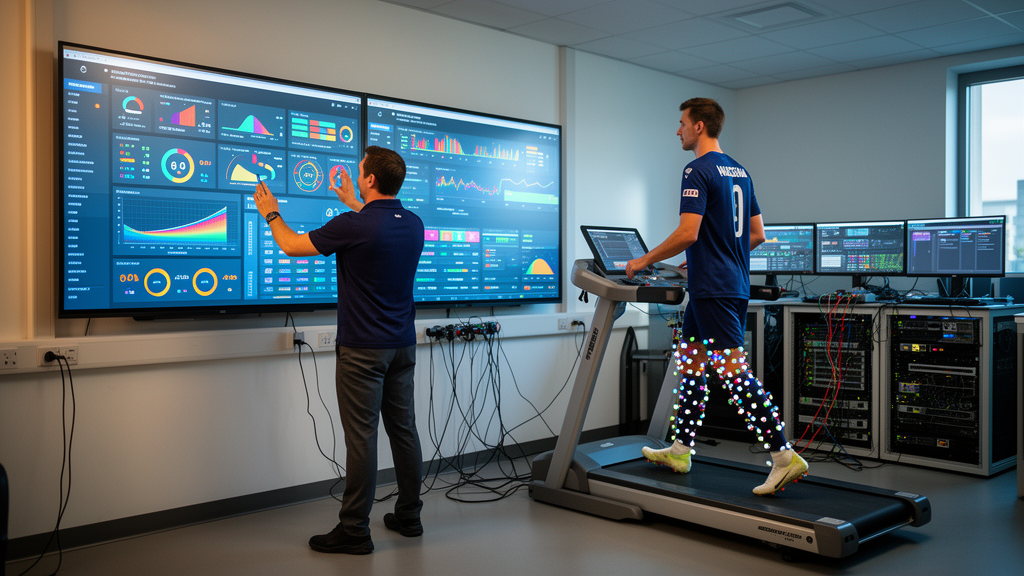
Artificial intelligence has swept into sports medicine with remarkable speed, and a new bibliometric analysis has now mapped just how fast the field has grown. Published on 23 October 2026 in Discover Artificial Intelligence, the study analyzed 809 publications on AI applications for predicting and preventing sports injuries, together with closely related performance research. Scientific output rose from just 13 publications in 2018 to 204 by 2025, a fifteenfold increase in seven years. Led by K. Moorthi and colleagues, the analysis is the first to systematically chart the intellectual structure of a literature that had previously been scattered across sports science, biomechanics, sports medicine, data science, and engineering. The authors emphasize that their findings describe the composition and trajectory of the published literature rather than the demonstrated effectiveness of AI tools in real-world sports settings.
The rapid growth reflects a fundamental problem in injury research that conventional statistics have struggled to solve. Traditional approaches typically rely on a limited number of risk factors and standard statistical models, and they have shown restricted predictive accuracy, in part because injury arises from complex, non-linear, and dynamic interactions among biomechanical, physiological, workload, and contextual variables. AI and machine learning systems, by contrast, can learn from data, recognize intricate patterns, generate predictions, and process large and heterogeneous datasets with limited human intervention. Contemporary sport generates unprecedented volumes of information from competition, training, and monitoring systems, and wearable devices, GPS tracking, and biomechanical sensors now enable continuous, near-real-time data collection. Because injury risk is tightly interwoven with how athletes perform, train, and are monitored, performance prediction, performance analysis, and athlete monitoring form an integral part of this literature.
To build the map, the team searched the Scopus database on 11 July 2026 with no restriction on publication year, combining three conceptual blocks: AI-related terms such as machine learning, deep learning, and neural networks; sport- and athlete-related terms; and injury prediction, prevention, and related performance terms. The search returned 1,048 records, restricted to English-language journal articles and reviews. After title and abstract screening, 239 records were excluded as off-topic, including 137 concerning non-sport clinical or medical injury contexts, 42 involving vehicle and traffic injury, 34 involving occupational and industrial injury, and 26 other off-topic records. The final corpus comprised 809 documents, 694 articles and 115 reviews, spanning 1997 to 2027. The analyses were performed using the Bibliometrix R-package through the Biblioshiny interface and VOSviewer version 1.6.18, following a systematic science-mapping workflow; co-citation and bibliographic coupling analyses were not performed in the study.
The annual production trend tells a story of near-dormancy followed by explosive acceleration. From 1997 to 2015, output remained very low, with fewer than four publications in most years. Growth then began steadily: seven publications in 2016, 13 in 2018, 18 in 2019, 29 in 2020, 55 in 2021, and 83 in 2022. A pronounced surge followed, with 86 publications in 2023, 150 in 2024, and 204 in 2025. Because the search was conducted in July 2026, the 147 records dated 2026 and 2027 corresponded to advance-access and in-press publications and were excluded from the annual trend, which is therefore based on the 662 documents published in complete years from 1997 to 2025. All other indicators in the study were calculated on the full corpus of 809 documents.
The corpus is broad and highly cited. The 809 documents were drawn from 371 sources and authored by 3,226 researchers, accumulating 13,295 citations, an average of 16.4 citations per document. At the author level, Liu Y led with 13 publications, followed by Li Y and Wang Z with 12 each, and Wang X, Wang Y, and Zhang Y with 10 each. The authors caution that several of the most common surnames are widespread, so despite disambiguation using Scopus Author Identifiers and manual checking of affiliations, some residual ambiguity may remain. The most productive journals were Scientific Reports with 25 articles, Sensors with 23, and MCB Molecular and Cellular Biomechanics with 22. The distribution broadly followed Bradford’s law, the principle that a small number of core journals account for a disproportionate share of a field’s output, underscoring the multidisciplinary spread of the literature.
Geographically, research output was concentrated in a limited number of countries. Using affiliation-based full counting, China with 477 and the United States with 467 were the leading contributors, with closely comparable output, followed at a considerable distance by the United Kingdom with 112, Spain with 92, Canada with 90, Italy with 86, France with 85, Australia with 71, India with 67, and Portugal with 65, out of 73 countries represented. Because a single multi-country publication contributes to the count of each contributing country, these totals exceed the 809 documents and should be read as affiliation-based productivity indicators. The co-authorship network revealed a bipolar structure: China’s collaborations concentrate along an Asian and Middle Eastern axis, most strongly with South Korea, the densest bilateral link in the network, extending to Malaysia, Iran, Turkey, India, and Saudi Arabia, while the United States anchors an Anglophone cluster with the United Kingdom, Australia, Canada, New Zealand, and Qatar. A third cluster centers on continental Europe but is not geographically bounded, since Japan, Brazil, and Chile cluster there rather than with regional neighbors, suggesting that partnerships follow established research relationships rather than proximity. Notably, the China–USA tie is weak relative to each country’s ties within its own cluster, meaning the field’s two dominant producers are advancing along separate, parallel collaborative tracks rather than an integrated one.
Citation analysis identified the field’s most influential works, which predominantly concern machine learning approaches to injury prediction and prevention in team sports; a small number of highly cited records in adjacent areas, such as general human activity recognition and wearable engineering, were retained in the dataset but fall outside this specific focus. Claudino and colleagues topped the list with 319 citations, followed by Van Eetvelde and colleagues with 290 and Rossi and colleagues with 269. The conceptual architecture of the field emerged from keyword co-occurrence analysis: of 2,152 author keywords, 44 met the minimum occurrence threshold of eight, forming six clusters connected by 320 links with a total link strength of 761. Machine learning was the most frequent and central keyword, followed by artificial intelligence and deep learning. One cluster centered on machine learning applied to team sports, linking football, soccer, injury, prevention, prediction, training load, and classification. Another grouped deep learning with computer-vision and movement-analysis techniques, including motion capture, pose estimation, kinematics, biomechanics, inertial measurement units, and neural networks. A third comprised injury prediction with athlete monitoring, predictive modelling, wearable technology, random forest, and risk factors, while the remaining clusters linked artificial intelligence with sports and athletes, concussion with traumatic brain injury and wearable devices, and wearable sensors with sports analytics and data mining.
Thematic mapping positioned injury prevention, injury risk, and wearable technology as the field’s most well-developed and central theme, the motor theme driving its growth. Topics including artificial intelligence, sports medicine, machine learning, injury prediction, soccer, deep learning, biomechanics, and wearable sensors formed basic and transversal themes, strongly connected to other topics but comparatively less developed, while sports performance, sports analytics, and data mining appeared as well-developed but peripheral niche themes. Sports injury, concussion, and neural network fell in the emerging-or-declining quadrant, which the authors note cannot by itself distinguish growth from decline. Thematic evolution across three periods traced the field’s maturation: from 1997 to 2018, research was small and organized around soccer, concussion, machine learning, and injury prevention; from 2019 to 2022, substantial diversification brought random forest, computer vision, long short-term memory networks, and the Internet of Things alongside sport-specific topics; and from 2023 to 2025, themes consolidated around machine learning, football, injury prevention, athletes, neural networks, data science, and sports medicine, reflecting a shift toward applied sports analytics and athlete monitoring.
The authors stress that a bibliometric analysis evaluates the structure of a literature, not the accuracy, effectiveness, or clinical utility of the AI models reported in the underlying studies. Several limitations apply: the analysis relied on a single database, Scopus, so relevant work indexed only in Web of Science, PubMed, or IEEE Xplore may have been missed; only English-language publications were included; recent publications have had less time to gather citations; the years 2026 and 2027 were incomplete at the search date; the corpus scope is defined by the specific search string and the database’s indexing decisions; title and abstract screening was performed by a single reviewer, which may increase the possibility of selection error; and all documents meeting the inclusion criteria were treated equally regardless of study design, sample size, or reported model performance. The authors also note that keyword- and citation-based analyses cannot distinguish between studies proposing AI methods and studies implementing or validating them in applied sports settings. Looking ahead, the literature points to the need for greater transparency, interpretability, and generalizability of AI models in sports, with developments in explainable AI potentially helping practitioners interpret model outputs and multimodal data integration supporting more comprehensive assessment of injury risk. The authors call for high-quality primary and intervention research to determine whether such systems improve outcomes in practice, positioning this map as a framework for researchers navigating a field that is now growing faster than ever.
Subject of Research: A bibliometric analysis of artificial intelligence research in sports injury prediction and prevention
Article Title: A bibliometric analysis of artificial intelligence in sports injury prediction and prevention
Article References: Moorthi, K., Sivachandiran, S., Chakravarthy, A., Uvais, M. O., & Ajmal, P. M. (2026). A bibliometric analysis of artificial intelligence in sports injury prediction and prevention. Discover Artificial Intelligence, 6(1), Article 1616. https://doi.org/10.1007/s44163-026-02572-7
Image Credits: AI Generated
DOI: 10.1007/s44163-026-02572-7
Keywords: artificial intelligence, machine learning, sports injuries, injury prediction, injury prevention, bibliometric analysis, wearable technology, athlete monitoring, sports analytics, biomechanics, deep learning, Scopus
News Source: Blake Davidson. (October 23, 2026). AI research on sports injury prediction has exploded, a new map shows. Scienmag.