• HOME
  • NEWS
  • EXPLORE
    • CAREER
      • Companies
      • Jobs
    • EVENTS
    • iGEM
      • News
      • Team
    • PHOTOS
    • VIDEO
    • WIKI
  • BLOG
  • COMMUNITY
    • FACEBOOK
    • INSTAGRAM
    • TWITTER
Wednesday, June 24, 2026
BIOENGINEER.ORG
No Result
View All Result
  • Login
  • HOME
  • NEWS
  • EXPLORE
    • CAREER
      • Companies
      • Jobs
        • Lecturer
        • PhD Studentship
        • Postdoc
        • Research Assistant
    • EVENTS
    • iGEM
      • News
      • Team
    • PHOTOS
    • VIDEO
    • WIKI
  • BLOG
  • COMMUNITY
    • FACEBOOK
    • INSTAGRAM
    • TWITTER
  • HOME
  • NEWS
  • EXPLORE
    • CAREER
      • Companies
      • Jobs
        • Lecturer
        • PhD Studentship
        • Postdoc
        • Research Assistant
    • EVENTS
    • iGEM
      • News
      • Team
    • PHOTOS
    • VIDEO
    • WIKI
  • BLOG
  • COMMUNITY
    • FACEBOOK
    • INSTAGRAM
    • TWITTER
No Result
View All Result
Bioengineer.org
No Result
View All Result
Home NEWS Science News

Plant probes make sense for sustainable farming

Bioengineer by Bioengineer
September 6, 2025
in Science News
Reading Time: 2 mins read
0
IMAGE
Share on FacebookShare on TwitterShare on LinkedinShare on RedditShare on Telegram

A method for making ultrathin sensors for monitoring the health of crops could help farmers grow more food without putting extra demands on the land.

Intensive agriculture is already contributing to widespread biodiversity loss and climate change, yet growing populations continue to put pressure on farmers to produce more food. The challenge now lies in increasing agricultural output without clearing more land or applying excessive fertilizers. Precision farming is a promising solution that involves real-time monitoring of plant needs and responding to them with just the right amount of water, light or nutrients.

“Precision farming typically relies on soil-based sensors or drones fitted with special cameras,” says Ph.D. student Abdullah Bukhamsin, “but they cannot capture changes in the plant early enough to enable intervention.” Previous research has shown that measuring bioimpedance — how easily an electrical current passes through organic tissues — can reveal physiological information about a plant, from its nitrogen and water content to the presence of fungal infections or metal contaminants.

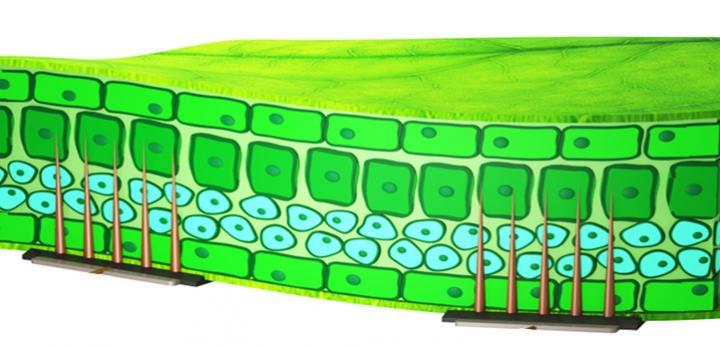
Plants, however, have a thick outer layer that blocks electrical signals, and bioimpedance sensors must pierce the surface without affecting the properties they wish to measure. It remains difficult to manufacture instruments tiny and thin enough to do this job.

Now, an efficient method for making silicone molds that can be used to manufacture such ultrathin microneedles has been developed by Bukhamsin and a multidisciplinary team of KAUST researchers led by Khaled Salama. These delicate needles can be released intact by submerging the mold in trichloromethane. “The swelling causes the mold to expand ever so slightly, thereby gently pushing the trapped structure out,” says Bukhamsin.

The reusable molds could enable cost-effective, mass-production of microneedles in various plant-friendly polymers. When the team tested their microneedle on an Arabidopsis thaliana leaf, the puncture hole sealed within four days and the plant was not harmed.

“In our tests, the impedance measurements were closely related to how much light a plant has been exposed to and how dehydrated it is,” says Bukhamsin. “This bioimpedance data could be used alongside shading technologies and an irrigation system that responds to the actual needs of the crops, thereby avoiding overwatering.” Unexpectedly, this relationship was almost identical in other crops, including date palm and barley. “This is promising as it highlights the versatility of the approach and its potential applicability across different plants,” he adds.

“Next, we will explore what other environmental factors affect the impedance of plants,” says Salama, “and how we can use electrochemical measurements to quantify hormone levels in different plant species.” Such detailed data could feed into even more finely tuned precision farming in the future.

###

Media Contact
Michael Cusack
[email protected]

Original Source

https://discovery.kaust.edu.sa/en/article/1143/plant-probes-make-sense-for-sustainable-farming

Related Journal Article

http://dx.doi.org/10.1002/advs.202101261

Tags: Agricultural Production/EconomicsBioinformaticsBiomedical/Environmental/Chemical EngineeringBiotechnologyChemistry/Physics/Materials SciencesElectrical Engineering/ElectronicsMaterialsPlant Sciences
Share13Tweet8Share2ShareShareShare2

Related Posts

Light-Based Imaging Advances Promise Enhanced Thyroid Cancer Diagnosis and Fewer Surgeries

June 24, 2026
Water-Activated PVA Film Transforms from Bioplastic to High-Performance Wood Adhesive — Chemistry

Water-Activated PVA Film Transforms from Bioplastic to High-Performance Wood Adhesive

June 24, 2026

Copal Tree Genetics Reveal Tropical Forest Connectivity

June 24, 2026

Fourier Pixels Enable Bidirectional Light Control

June 24, 2026
Please login to join discussion

POPULAR NEWS

  • Saying Goodbye to PGY-6: Pediatric Fellowship Realities

    103 shares
    Share 41 Tweet 26
  • Multi-Hospital Study Reveals Long Covid Burden Is Twice as High as Current Estimates

    92 shares
    Share 36 Tweet 23
  • Detection of EDCs in Breast Milk and Infant Urine Up to Six Months Highlights Early Exposure Risks

    77 shares
    Share 31 Tweet 19
  • New Drug Candidate Developed at McMaster Shows Potential for Treating Brain Cancer

    58 shares
    Share 23 Tweet 15

About

We bring you the latest biotechnology news from best research centers and universities around the world. Check our website.

Follow us

Recent News

Light-Based Imaging Advances Promise Enhanced Thyroid Cancer Diagnosis and Fewer Surgeries

Water-Activated PVA Film Transforms from Bioplastic to High-Performance Wood Adhesive

Copal Tree Genetics Reveal Tropical Forest Connectivity

Subscribe to Blog via Email

Enter your email address to subscribe to this blog and receive notifications of new posts by email.

Join 82 other subscribers
  • Contact Us

Bioengineer.org © Copyright 2023 All Rights Reserved.

Welcome Back!

Login to your account below

Forgotten Password?

Retrieve your password

Please enter your username or email address to reset your password.

Log In
No Result
View All Result
  • Homepages
    • Home Page 1
    • Home Page 2
  • News
  • National
  • Business
  • Health
  • Lifestyle
  • Science

Bioengineer.org © Copyright 2023 All Rights Reserved.