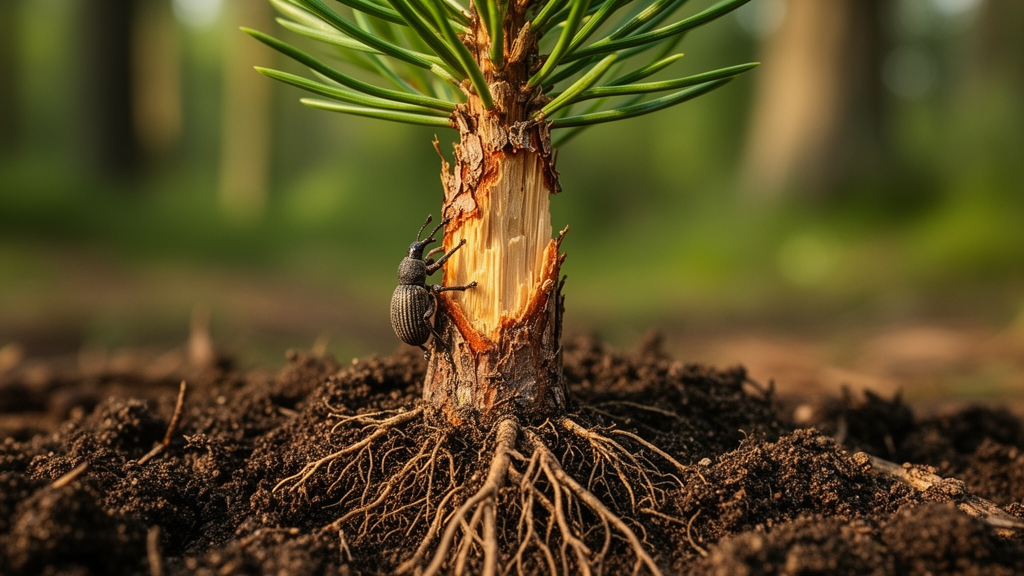
The large pine weevil is one of the most damaging pests of conifer regeneration in Europe, killing newly planted seedlings and causing substantial economic losses. Seven days of feeding by the beetles cut the concentration of soluble carbohydrates in the seedlings’ roots by 31 percent, yet it left the concentrations of phenolic defense compounds in the needles almost untouched and produced no clear shift in the non-volatile metabolomic profile of the undamaged foliage.
The research, conducted during the summer of 2023 at the Czech University of Life Sciences in Prague, was designed to test whether bark feeding by Hylobius abietis triggers systemic physiological responses that extend beyond the wounded stem tissue. The question matters because the bark and the phloem beneath it form the transport system that carries photoassimilates and signaling molecules between the parts of a tree, coordinating growth, metabolism and defense. Damage to those tissues could, in principle, alter carbon availability and chemical defenses in distant, undamaged organs, and earlier work had shown that pine weevil feeding induces systemic volatile emissions from undamaged shoots of Scots pine.
To find out how deep those systemic effects run, the team used two-year-old Scots pine seedlings from two local Czech provenances with contrasting ecological strategies: a lowland pioneer ecotype from the Třeboň region, which grows rapidly in open habitats, and a montane climax ecotype from the Děčín region, which regenerates under canopy cover and tolerates competition. The experiment involved 16 plastic boxes arranged in four replicates, each box holding 12 seedlings, six from each provenance, for a total of 192 seedlings evaluated. In the treated boxes, 12 adult pine weevils, one per seedling, were allowed to feed freely for seven days; control boxes contained no insects. The feeding window was deliberately short, because adult weevils can strip large areas of bark quickly, and the researchers wanted meaningful damage without extensive stem girdling or high seedling mortality.
After the feeding period, the researchers quantified the damage by counting feeding scars and measuring the total debarked area with transparent millimeter paper, and they measured stem diameter for each seedling. Soluble sugars were quantified in both roots and needles, phenolic compounds and untargeted non-volatile metabolomic profiles were analyzed in needles, and volatile organic compound profiles were examined in both organs. All concentration data were log-transformed and analyzed with linear mixed-effects models in which beetle treatment, provenance and spatial replication were fixed effects and box and box-by-origin terms were random effects, so that the box-level treatment was tested against the appropriate between-box variation. Beetle-exposed seedlings that received no visible feeding were excluded from treatment comparisons.
The damage assessment showed that feeding scars correlated strongly with total debarked area, and that the two provenances did not differ in either the number of scars or the area of bark consumed. Larger seedlings received more feeding scars, although the debarked area itself did not scale significantly with stem diameter. When the chemical results came in, the clearest signal was in the roots: total soluble sugar concentrations fell by 31 percent in damaged seedlings compared with controls, a statistically significant difference, while needle sugar concentrations showed no detectable response to feeding.
Analysis of individual carbohydrates revealed that the root response was not a uniform depletion. Fructose and glucose concentrations in damaged seedlings were each 45 percent lower than in controls, and sucrose was 31 percent lower, but trehalose and raffinose moved in the opposite direction, rising by 34 percent and 42 percent respectively. The authors interpret this pattern as a reorganization of root carbohydrate metabolism rather than simple sugar loss, noting that increases in trehalose and raffinose are commonly reported in plants under stress, where these sugars are associated with osmotic adjustment and protection against oxidative damage. Total root sugars also declined as the debarked area increased, and among the individual sugars only sucrose showed a significant relationship with the extent of bark damage, which the researchers see as supporting a link between the severity of phloem injury and the carbohydrate supply reaching belowground tissues.
The secondary metabolism story was strikingly different. Total phenolic concentrations in the needles, calculated as the sum of ten quantified compounds including ferulic acid, syringic acid, caffeic acid, quercetin and rutin, did not change significantly after feeding, and there was no difference between the two provenances. Only one compound responded: ferulic acid dropped by 57 percent in damaged seedlings, a selective effect the authors note has a parallel in insect-damaged Masson pine, where ferulic acid also behaved differently from other phenolic acids. Multivariate principal component analysis of 114 non-volatile needle compounds, 283 volatile needle compounds and 82 volatile root compounds found no separation between damaged and control seedlings or between provenances, with the first two principal components explaining only 26 percent, 22 percent and 27 percent of the variation in those datasets respectively.
The authors are careful about what these null results do and do not mean. The absence of broad changes in the measured phenolic and metabolomic profiles should not be read as evidence that chemical defenses were not induced, they write, because the study focused on systemic responses in intact organs after only seven days of feeding. Localized or transient defense responses at the wound site, or changes in metabolites outside the measured panels, could have gone undetected. Similarly, unchanged needle carbohydrate concentrations do not prove that photosynthesis was unaffected, since concentrations reflect the balance between production, transport, storage and consumption. The root sugar decline is consistent with impaired assimilate transport caused by damage to the bark and phloem, which may reduce the delivery of recently assimilated carbon from needles to belowground sinks, but the study measured only soluble sugars and cannot distinguish between reduced carbon supply to the roots and increased carbohydrate consumption within them.
One of the more sobering findings for forest genetics is what the two provenances did not show. Despite their contrasting ecological and growth strategies, the Třeboň and Děčín seedlings did not differ in damage intensity, soluble carbohydrate concentrations, phenolic composition or metabolomic profiles, and both reacted similarly to feeding. The authors caution that this should not be taken as evidence that provenance is irrelevant to resistance; differences among neighboring local provenances are often limited because much of the genetic variation occurs within populations, and provenance effects might emerge over longer periods or after subsequent herbivore attacks, since trees can develop induced resistance over extended timescales.
The practical implications reach into forest regeneration, where restrictions on chemical insecticides are pushing managers toward alternative ways of protecting seedlings. The authors call for longer experiments with direct measurements of carbon transport, a broader range of Scots pine provenances, and tests across more environments to determine whether these short-term changes translate into lasting consequences for seedling recovery and tolerance. For now, the study offers a precise snapshot: a week of weevil feeding quietly rewrites the carbon ledger of a young pine’s roots while its needles, at least by the chemical measures applied here, carry on largely as before.
Subject of Research: Effects of pine weevil bark feeding on carbohydrate and secondary metabolism in Scots pine seedlings
Article Title: Pine weevil (Hylobius abietis L.) bark feeding reduces root carbohydrates without broad metabolic changes in Scots pine (Pinus sylvestris L.) seedlings
Article References: Dvořáková, B., Holuša, J., Čepl, J., Kalyniukova, A., Hradecký, J., & Stejskal, J. (2026). Pine weevil (Hylobius abietis L.) bark feeding reduces root carbohydrates without broad metabolic changes in Scots pine (Pinus sylvestris L.) seedlings. Annals of Forest Science, 83(1), Article 51. https://doi.org/10.1186/s13595-026-01369-z
Image Credits: AI Generated
DOI: 10.1186/s13595-026-01369-z
Keywords: pine weevil, Hylobius abietis, Scots pine, Pinus sylvestris, root carbohydrates, soluble sugars, phenolic compounds, metabolomics, phloem damage, seedling defense, forest regeneration, plant physiology
News Source: Alan Morgan. (October 28, 2026). Pine Weevil Bark Feeding Drains Root Sugars in Scots Pine Seedlings. Scienmag.