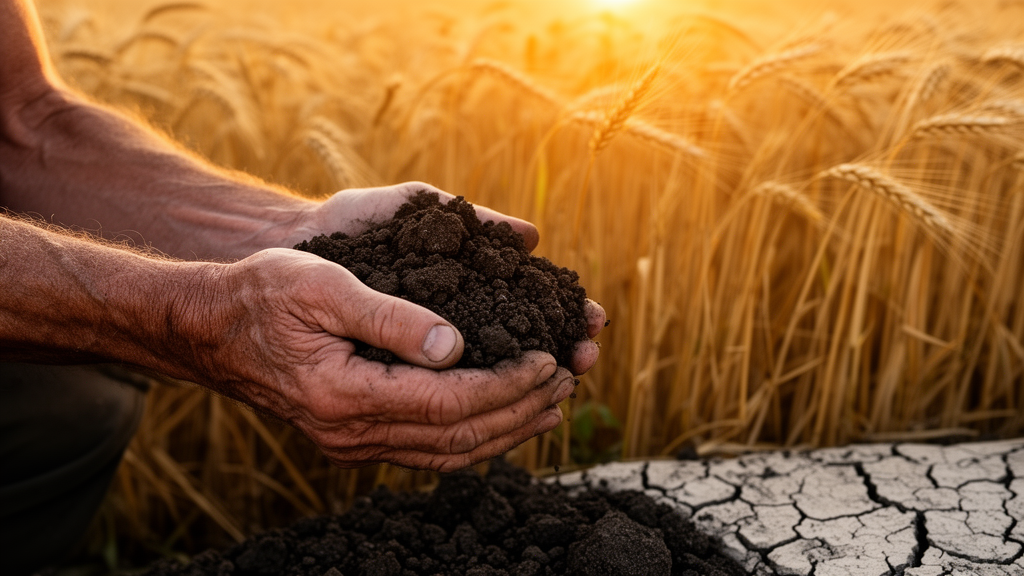
Drought is an increasing threat to the soil microbiomes that underpin crop production, but a new long-term field experiment suggests that how a soil has been farmed for decades leaves a deeper imprint on its microbial functions than even a severe water deficit. In a 44-year long-term trial comparing organic and conventional cropping systems, the researchers imposed a field-scale drought and assessed the functional potential of the wheat rhizosphere microbiome using shotgun metagenomics.
The headline result concerns which force dominates the microbial gene landscape. Agricultural management legacy was the primary driver of the rhizosphere functional gene composition, accounting for 24 to 32 percent of total variation across gene ontologies. Drought, by contrast, explained only 3 to 6 percent of the variation.
That does not mean drought left the microbiome unchanged. Across every management system, drought-stressed communities enriched a common set of metagenomic toolkits for core drought endurance. These included genes for cell membrane modification, endospore formation, osmolyte accumulation, antioxidant production, and DNA repair—functions that map directly onto the physiological challenges of drying soil, from maintaining membrane integrity to coping with reactive oxygen species and repairing damaged genetic material.
Alongside those enrichments, the researchers observed a relative depletion of genes associated with ribosomal hibernation, a dormancy strategy, and of genes involved in exopolysaccharide synthesis. The authors interpret this pattern as suggesting a reliance on plant root exudates rather than endogenous genomic investment: under drought, the microbes appear to draw on carbon and energy supplied through the roots instead of building their own dormancy and protective polymer machinery.
The metabolic potential of the communities shifted in a parallel, consistent direction. Drought-stressed rhizospheres showed an enriched capacity for inorganic phosphorus and iron scavenging, alongside a relative depletion of genes involved in degrading complex organic matter.
Although communities across all systems shared this common functional core for stress survival and metabolic adaptation, the analysis also revealed nuanced, system-specific metagenomic strategies. Conventional systems receiving synthetic inputs showed an enrichment of sporulation-related genes, while manure-fertilized systems were marked by programmed-cell-death pathways.
The magnitude of the drought-induced shift in functional potential was similar across all systems, and drought-stressed communities in each system remained distinct from one another. The authors conclude that no cropping system conferred superior metagenomic resistance to drought. Yet each system preserved its distinct metagenomic identity under severe water deficit, which the researchers describe as highlighting the enduring legacy of agricultural management.
The study frames agricultural management as playing a dual role: profoundly shaping the functional potential of the soil microbiome while exerting only limited influence on the core metagenomic toolkit for drought adaptation, with subtle nuances between systems. Rather than driving broad system-specific shifts, drought stress consistently enriched metagenomic functions associated with osmotic stress tolerance, cellular maintenance, and nutrient scavenging across all management regimes. Because the work was carried out in a single long-term trial on wheat and reported through shotgun metagenomic profiles of functional potential, the findings describe the genetic capacity of these communities rather than measured activity in the field, and the published version is an early-release article subject to further edits before the final Version of Record.
Subject of Research: Functional gene responses of the wheat rhizosphere microbiome to experimental drought in long-term organic and conventional cropping systems.
Article Title: How agricultural legacy shapes the drought response of the wheat rhizobiome
Article References: Kost, E., Kundel, D., Mueller, R. C., Conz, R. F., Müller, C. R., Symanczik, S., Mäder, P., Krause, H.-M., Six, J., Mayer, J., & Hartmann, M. (2026). How agricultural legacy shapes the drought response of the wheat rhizobiome. Environmental Microbiome. https://doi.org/10.1186/s40793-026-00976-7
Image Credits: AI Generated
DOI: 10.1186/s40793-026-00976-7
Keywords: soil microbiome, rhizosphere, drought, wheat, organic farming, conventional agriculture, shotgun metagenomics, functional genes, long-term field trial, agricultural legacy, phosphorus scavenging, osmolyte accumulation
News Source: Alan Morgan. (October 28, 2026). Farming legacy outlasts drought in wheat soil microbes. Scienmag.