Researchers at Keele University have built a deepfake image detector that treats the brightness of a photograph like a physical field, borrowing mathematical ideas from fluid dynamics to expose synthetic faces. The system, called FDIP-NET, reached mean held-out test accuracies of 98.654 percent on a face-manipulation dataset, 98.952 percent on a large composite deepfake collection, and 99.669 percent on a set of GAN-generated faces, according to a study published in Frontiers in Imaging. On the widely used FaceForensics++ benchmark under c23 compression, the model achieved 91.00 percent frame-level accuracy on the official independent test partition.
The detector’s central idea is to give a convolutional neural network more to look at than ordinary color. FDIP-NET converts each image’s luminance into a scalar field and derives three gradient-based descriptors from it: a divergence-like second-order response, a gradient magnitude, and a kinetic-energy-like quadratic response. The name comes from Fluid-Dynamics Inspired Processing, an analogy in which the luminance image is treated like a potential whose spatial gradient defines a flow-like vector field. The authors are explicit that this is a formal analogy rather than physics: no fluid motion is modeled, the Navier-Stokes equations are never solved, and the descriptors do not represent measured fluid quantities. What the construction actually provides is a jointly normalized set of first-order, second-order, and nonlinear quadratic luminance responses, fused with the three RGB channels into a six-channel input tensor.
Each FDIP map is normalized using the 1st and 99th percentile values of the image rather than its absolute extrema, a robust scaling that prevents isolated noise, edges, or artifacts from dominating the dynamic range. The three normalized FDIP channels are concatenated with normalized RGB channels in the order D, S, K, R, G, B, producing a 6 by 320 by 320 tensor for a ResNet-like backbone whose first convolution accepts six channels. Training uses the AdamW optimizer with weight decay of 10 to the minus 4, Focal Loss with parameters alpha 0.5 and gamma 2.0 for hard-example focusing, Mixup regularization with a Beta parameter of 0.4, and an Exponential Moving Average of the weights. At evaluation time, the same preprocessed image is passed through the network four times and the logits are averaged, a procedure the authors distinguish from conventional test-time augmentation because no additional transformations are applied between passes.
Calibration is a deliberate design goal rather than an afterthought. Modern neural networks are known to produce poorly calibrated outputs, and most existing detectors rely on fixed decision thresholds, often 0.5 based on sigmoid outputs. FDIP-NET instead fits a scalar temperature parameter by minimizing binary cross-entropy on validation logits, then selects a decision threshold through a dense grid search that minimizes a predefined asymmetric risk objective in which false negatives are weighted three times as heavily as false positives. In the reported configuration this shifts the operating point toward catching more fakes at the cost of more false alarms. On the DFRI dataset, for example, the validation-selected threshold reduced false negatives from 162 to 120 on the independent test partition while false positives rose from 95 to 155, lowering the risk objective from 87,757 to 67,225. The authors caution that a reduction in this objective can coincide with an increase in total errors and should not be read as a demonstrated improvement in deployment reliability.
The experiments covered three publicly available facial-image datasets with different characteristics. DFRI contains 70,001 real and 70,001 fake images based on standard face-swap manipulation, where visible artifacts such as blur, compression, and texture inconsistencies may remain informative. DF-wild is a large, class-imbalanced composite benchmark with about 219,470 fake images and 42,690 real ones, introduced for the IEEE Signal Processing Cup 2025. RFF-140K, drawn from a Kaggle collection of 100,000 real and fake faces, contrasts genuine photographs with fully synthetic GAN-generated identities that exhibit high resolution and photorealistic appearance. For the within-dataset experiments, each collection was repartitioned into fixed stratified 70/15/15 train, validation, and test splits, and model training was repeated with three random seeds, 42, 123, and 2026, so that reported variability reflects stochastic training rather than changes in test composition.
Across the three seeds, the complete six-channel model produced mean ROC-AUC values of 0.998522 on DFRI, 0.998261 on DF-wild, and 0.999664 on RFF-140K, with correspondingly high Average Precision. At the seed-42 operating point, DF-wild showed the model’s main class-specific weakness: the minority real class achieved 97.90 percent precision but only 95.25 percent recall, while the majority fake class reached 99.08 percent precision and 99.60 percent recall, yielding a balanced accuracy of 97.43 percent. Because the test partition is 83.71 percent fake, the authors supplement overall accuracy with class-wise metrics, macro-F1, and separate false-positive and false-negative counts. On FaceForensics++, built from 1,000 original and 4,000 manipulated videos with ten frames extracted per video, FDIP-NET reached 91.00 percent frame-level accuracy and 93.05 percent video-level accuracy, with FDIP-only input achieving the highest mean video-level accuracy at 93.33 percent.
A component-wise ablation complicates any simple story about the physics-inspired channels. The researchers tested RGB-only, FDIP-only, the full six-channel fusion, and pairwise combinations of RGB with each individual descriptor. On DFRI, RGB plus the divergence-like descriptor alone yielded the lowest mean total errors at 277.0, better than the complete fusion’s 282.7, while the full fusion achieved the best AUROC and Average Precision. On DF-wild, RGB plus the kinetic-energy descriptor produced the lowest mean total errors at 408.3. On RFF-140K, RGB plus the divergence descriptor was strongest across all reported metrics, cutting mean total errors from 59.7 for RGB-only to 43.3. Exact paired McNemar tests with Holm correction across nine pre-specified comparisons found that most differences were not consistently significant across all three training seeds, and in some cases the direction of a significant effect flipped between seeds. The authors conclude that the evidence supports dataset-dependent complementarity among the FDIP components rather than a universal ordering of representations.
The most sobering results come from the zero-shot cross-dataset experiments. Models trained on DFRI were transferred without any adaptation to the unseen DF-wild and RFF-140K test partitions. The RGB-plus-FDIP configuration achieved an in-domain AUROC of 0.9986, but this collapsed to 0.4968 on DF-wild and 0.5645 on RFF-140K, a mean unseen AUROC of 0.5307 that is barely above chance. A second training regime adding paired clean-and-degraded consistency learning raised the mean unseen AUROC only to 0.5334, and RGB-only input actually achieved the highest mean unseen AUROC under both regimes. The paper states plainly that these results do not demonstrate a consistent cross-dataset transfer advantage for FDIP fusion and that strong within-dataset performance should not be interpreted as evidence of a domain-invariant representation.
A statistical analysis of the FDIP kinetic-energy maps across all 100,000 RFF-140K images found small but significant distributional differences between real and GAN-generated faces. GAN images showed a slightly lower median coefficient of variation, 2.5514 versus 2.6062, and a slightly lower median Laplacian variance, 0.4831 versus 0.4956, both significant after false-discovery-rate correction. However, the corresponding Cliff’s delta effect sizes of minus 0.068 and minus 0.055 are negligible, and the univariate separability values remained close to chance, between 0.501 and 0.537. The authors explicitly reject the stronger interpretation that overly smooth kinetic-energy maps are a general characteristic of GAN imagery, noting that the analysis is restricted to a single dataset and may reflect its specific real-image collection or generation process.
A post-hoc error analysis also revealed dataset-dependent patterns in where the detector fails. On DFRI, 74.8 percent of false positives and 82.5 percent of false negatives fell in the dataset-relative very-blur category, and low-contrast images accounted for 54.2 percent of both error types. On DF-wild, errors were more spread out, with bright images forming the largest brightness category for both error types. On RFF-140K the pattern inverted: 75.0 percent of false positives and 55.6 percent of false negatives were sharp images, and high-contrast images dominated both error categories. The researchers stress these are descriptive associations computed with dataset-specific percentile thresholds, not evidence that blur, brightness, or contrast causes misclassification. On efficiency, the full pipeline, including image loading, CPU-based FDIP construction, and four-pass inference, ran at 31.25 to 29.10 images per second on an NVIDIA L40 GPU for two datasets and 17.19 images per second for the third, supporting near-real-time image-level screening on that hardware but not establishing general real-time capability across platforms or video streams. The authors note that the image-level splits do not verify identity- or video-level independence, that source collections had been used in earlier method-development experiments under different splits, and that cross-dataset robustness and calibration transfer to unseen domains remain unresolved requirements for future work.
Subject of Research: A physics-inspired deepfake image detection framework that fuses luminance-gradient descriptors with RGB features and calibrated CNN decision-making
Article Title: FDIP-NET: a physics-inspired deepfake image detector leveraging FDIP luminance dynamics and calibrated CNNs
Article References: Maghsoudi, S., Sangeeta, S., & Kanwal, N. (2026). FDIP-NET: a physics-inspired deepfake image detector leveraging FDIP luminance dynamics and calibrated CNNs. Frontiers in Imaging, 5, Article 1935077. https://doi.org/10.3389/fimag.2026.1935077
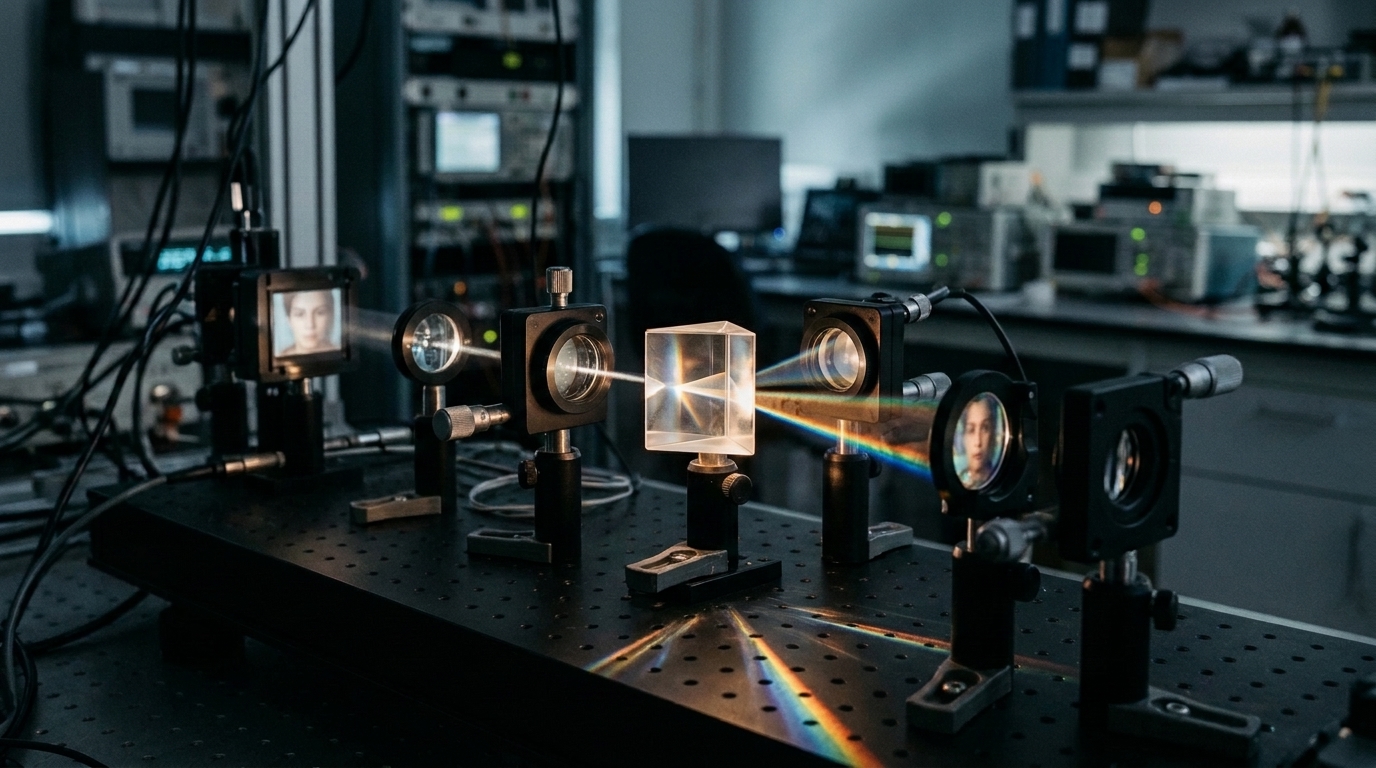
Image Credits: AI Generated
DOI: 10.3389/fimag.2026.1935077
Keywords: deepfake detection, FDIP-NET, luminance gradients, CNN calibration, GAN-generated faces, FaceForensics++, cross-dataset generalization, temperature scaling, risk-aware threshold, image forensics, fluid dynamics analogy, ResNet backbone
News Source: Katie Riggs. (November 5, 2026). Physics-inspired deepfake detector hits 99% accuracy but fails to transfer across datasets. Scienmag.