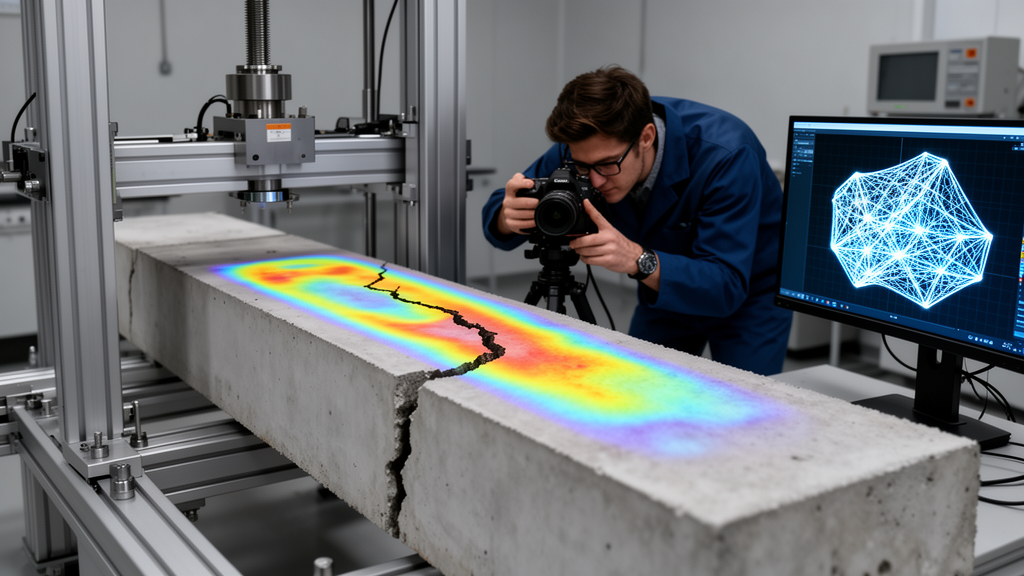
Engineers have long struggled to measure fracture parameters in concrete quickly, because the material’s quasi-brittle behaviour creates a complex, non-linear Fracture Process Zone that resists simple analysis. A new open-access study published in Discover Applied Sciences on 27 October 2026 proposes a hybrid physics-informed deep learning framework designed to extract these quantitative parameters directly from full-field stress images, offering a faster alternative to traditional iterative finite element inverse analysis.
The framework, developed by Winsyahputra Ritonga, Ahmad Andi Solahuddin, Budiman Nasution and Habibi Azka Nasution, integrates a physics-based loss function into a convolutional neural network. The loss enforces the relationship between the strain energy release rate and the stress intensity factor, expressed as G = K_I² / E′, so that the model’s predictions remain consistent with thermodynamic and physical constraints. Unlike conventional physics-informed neural networks, which still depend on mesh-dependent forward PDE solutions, the proposed model acts as a surrogate that maps stress images straight to fracture parameters.
The model was trained on a dataset of idealized finite element simulations and then evaluated on more complex test cases. Against the finite element ground truth, it achieved an unscaled test Mean Absolute Error of 0.0851 MPa√m. With a baseline fracture toughness of approximately 1.0 MPa√m, this corresponds to an error margin of roughly 3.9 percent. The framework also recorded an R² of 0.9565, indicating strong physical consistency between predictions and the underlying physics.
Speed is a central claim of the work. Iterative finite element solvers used in inverse analysis are described as computationally prohibitive for real-time applications, whereas the trained network provides a significant reduction in computational latency during inference. The authors position this efficiency as a bridge between idealized simulations and potential real-world Structural Health Monitoring applications, where rapid assessment of concrete structures could matter. Because the article is being shared early as a peer-reviewed accepted manuscript, it remains subject to further edits before the final Version of Record appears, and the reported performance reflects evaluation against simulated ground truth rather than field measurements.
Subject of Research: A hybrid physics-informed deep learning framework that extracts quantitative fracture parameters in concrete from full-field stress images.
Article Title: A hybrid physics-informed deep learning framework for quantitative parameter extraction in concrete fracture
Article References: Ritonga, W., Solahuddin, A. A., Nasution, B., & Nasution, H. A. (2026). A hybrid physics-informed deep learning framework for quantitative parameter extraction in concrete fracture. Discover Applied Sciences. https://doi.org/10.1007/s42452-026-09772-x
Image Credits: AI Generated
DOI: 10.1007/s42452-026-09772-x
Keywords: concrete fracture, physics-informed deep learning, fracture process zone, stress intensity factor, convolutional neural network, finite element method, structural health monitoring, inverse analysis, fracture toughness, surrogate model, hybrid, physics-informed
News Source: Katie Riggs. (October 28, 2026). Physics-informed AI extracts concrete fracture parameters from stress images. Scienmag.