• HOME
  • NEWS
  • EXPLORE
    • CAREER
      • Companies
      • Jobs
    • EVENTS
    • iGEM
      • News
      • Team
    • PHOTOS
    • VIDEO
    • WIKI
  • BLOG
  • COMMUNITY
    • FACEBOOK
    • INSTAGRAM
    • TWITTER
Monday, October 5, 2026
BIOENGINEER.ORG
No Result
View All Result
  • Login
  • HOME
  • NEWS
  • EXPLORE
    • CAREER
      • Companies
      • Jobs
        • Lecturer
        • PhD Studentship
        • Postdoc
        • Research Assistant
    • EVENTS
    • iGEM
      • News
      • Team
    • PHOTOS
    • VIDEO
    • WIKI
  • BLOG
  • COMMUNITY
    • FACEBOOK
    • INSTAGRAM
    • TWITTER
  • HOME
  • NEWS
  • EXPLORE
    • CAREER
      • Companies
      • Jobs
        • Lecturer
        • PhD Studentship
        • Postdoc
        • Research Assistant
    • EVENTS
    • iGEM
      • News
      • Team
    • PHOTOS
    • VIDEO
    • WIKI
  • BLOG
  • COMMUNITY
    • FACEBOOK
    • INSTAGRAM
    • TWITTER
No Result
View All Result
Bioengineer.org
No Result
View All Result
Home NEWS Science News Chemistry

Physics could answer questions about breast cancer spreading to bones

Bioengineer by Bioengineer
June 5, 2019
in Chemistry
Reading Time: 3 mins read
0
IMAGE
Share on FacebookShare on TwitterShare on LinkedinShare on RedditShare on Telegram

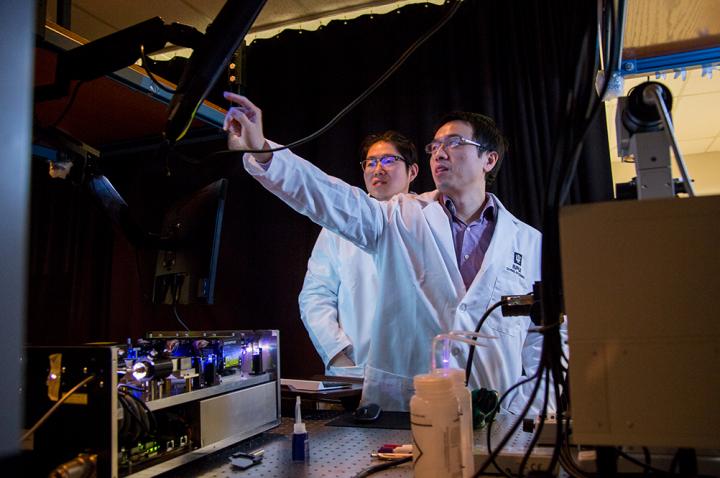
IUPUI researchers hope to learn how cancer cells generate enough force to move from a tumor site through the body and then settle into bones
IMAGE

Credit: Brooke Littell | School of Science at IUPUI

INDIANAPOLIS — To fully understand why breast cancer spreads, or metastasizes, you must also consider the how.

That’s what researchers in a biophysics and imaging laboratory in the School of Science at IUPUI did as they studied the mechanics of cell migration, which can possibly explain how cancer cells generate enough force to move from the primary tumor site through the body and then settle into bones, said Jing Liu, an assistant professor in the school’s Department of Physics, a Purdue University program. Nearly 30 percent of breast cancer metastasizes to other organs, with bones being among the most frequent sites.

A paper with the researchers’ findings was recently published in the journal Scientific Reports. Liu and Hiroki Yokota, a professor of biomedical engineering at IUPUI, are co-corresponding authors of the paper.

“From a physics point of view, all the cell migration is driven by force,” Liu said. “We really want to discover the force architecture of a cell and deliver the biomechanical and biophysical explanations toward cellular activities. The major focus of our lab is developing imaging methods to physically interpret cancer biology.”

“We are working with mathematicians and engineers to develop a mathematical model and physical model of the cell migration,” Liu said.

A Forster resonance energy transfer-based tension, or FRET, sensor was used to monitor the force dynamics during cell movement. The sensor, equipped with FRET molecules, acts like a spring to measure the tiny amount of force that is generated by the cancer cell through focal adhesion and that drives the cell to move. As the cancer cell moves, the spring expands; researchers measure the force by monitoring the change of FRET interactions.

The team at IUPUI monitored the mobility of the cancer cells and found that when a cancer cell interacts with and gets very close to a bone cell, it exhibits low tensions and slow mobility, Liu said. The researchers hope this finding might lead to clues for how to control — and eventually stop — cell migration.

“This gives us a more precise measurement of how fast the cell is moving and where the cell will go to,” Liu said. It will also provide feedback to cancer biologists, showing the impact of a drug or other treatment on the movement of the cells.

“The basic idea is to use imaging as a method to see some of the physical parameters in cancer biology,”Liu said. “Instead of only being able to look at millions of cells at time, technology has enabled us to examine a single cell. When the system is going smaller and smaller, the physical parameters inside the biological system become more and more useful and more and more important.”

###

See a video about the research: https://youtu.be/HvDZGyCVmwg

As one of seven Indiana University campuses, IUPUI (Indiana University-Purdue University Indianapolis) is known as Indiana’s premier urban research and health sciences institution and is dedicated to advancing the intellectual growth of the state of Indiana and its residents through research and creative activity, teaching, learning, and community engagement. Nationally ranked by U.S. News & World Report, Forbes and other notable publications, IUPUI has nearly 30,000 students enrolled in 18 schools, which offer more than 250 degrees. IUPUI awards degrees from both Indiana and Purdue universities.

Media Contact
Candace Gwaltney
[email protected]

Original Source

https://science.iupui.edu/2019/06/physics-could-answer-questions-about-breast-cancer-spreading-bones

Related Journal Article

http://dx.doi.org/10.1038/s41598-019-42132-x

Tags: Biomechanics/BiophysicsBiotechnologyBreast CancercancerChemistry/Physics/Materials SciencesMedicine/HealthTechnology/Engineering/Computer Science
Share12Tweet8Share2ShareShareShare2

Related Posts

Polymers move from sunscreen helpers to the heart of UV protection

Polymers move from sunscreen helpers to the heart of UV protection

October 5, 2026
Optica Elects Delfyett as 2027 Vice President, Adds Backus and Vanholsbeeck to Board

Optica Elects Delfyett as 2027 Vice President, Adds Backus and Vanholsbeeck to Board

October 5, 2026

New HPLC Method Simultaneously Tracks Three Diabetes Drugs in One Pill

October 5, 2026

Tiny Cellulose Rods Keep Pea Starch Gels Fresh by Locking Up Water

October 5, 2026
Please login to join discussion

POPULAR NEWS

  • Alloys That Shrink Their Own Grains: New PIX Mechanism Refines Metals With Heat Alone

    Alloys That Shrink Their Own Grains: New PIX Mechanism Refines Metals With Heat Alone

    29 shares
    Share 12 Tweet 7
  • Endurance Exercise Reshapes the Liver in Males and Females Through Distinct Molecular Routes

    29 shares
    Share 12 Tweet 7
  • Single Transcription Factor PU.1 Rapidly Converts Fibroblasts into Macrophage-Lineage Cells

    29 shares
    Share 12 Tweet 7
  • New Scale Measures How Ready Nurse Educators Really Are for the AI Era

    29 shares
    Share 12 Tweet 7

About

We bring you the latest biotechnology news from best research centers and universities around the world. Check our website.

Follow us

Recent News

Alloys That Shrink Their Own Grains: New PIX Mechanism Refines Metals With Heat Alone

Endurance Exercise Reshapes the Liver in Males and Females Through Distinct Molecular Routes

Single Transcription Factor PU.1 Rapidly Converts Fibroblasts into Macrophage-Lineage Cells

Subscribe to Blog via Email

Success! An email was just sent to confirm your subscription. Please find the email now and click 'Confirm' to start subscribing.

Join 85 other subscribers
  • Contact Us

Bioengineer.org © Copyright 2023 All Rights Reserved.

Welcome Back!

Login to your account below

Forgotten Password?

Retrieve your password

Please enter your username or email address to reset your password.

Log In
No Result
View All Result
  • Homepages
    • Home Page 1
    • Home Page 2
  • News
  • National
  • Business
  • Health
  • Lifestyle
  • Science

Bioengineer.org © Copyright 2023 All Rights Reserved.