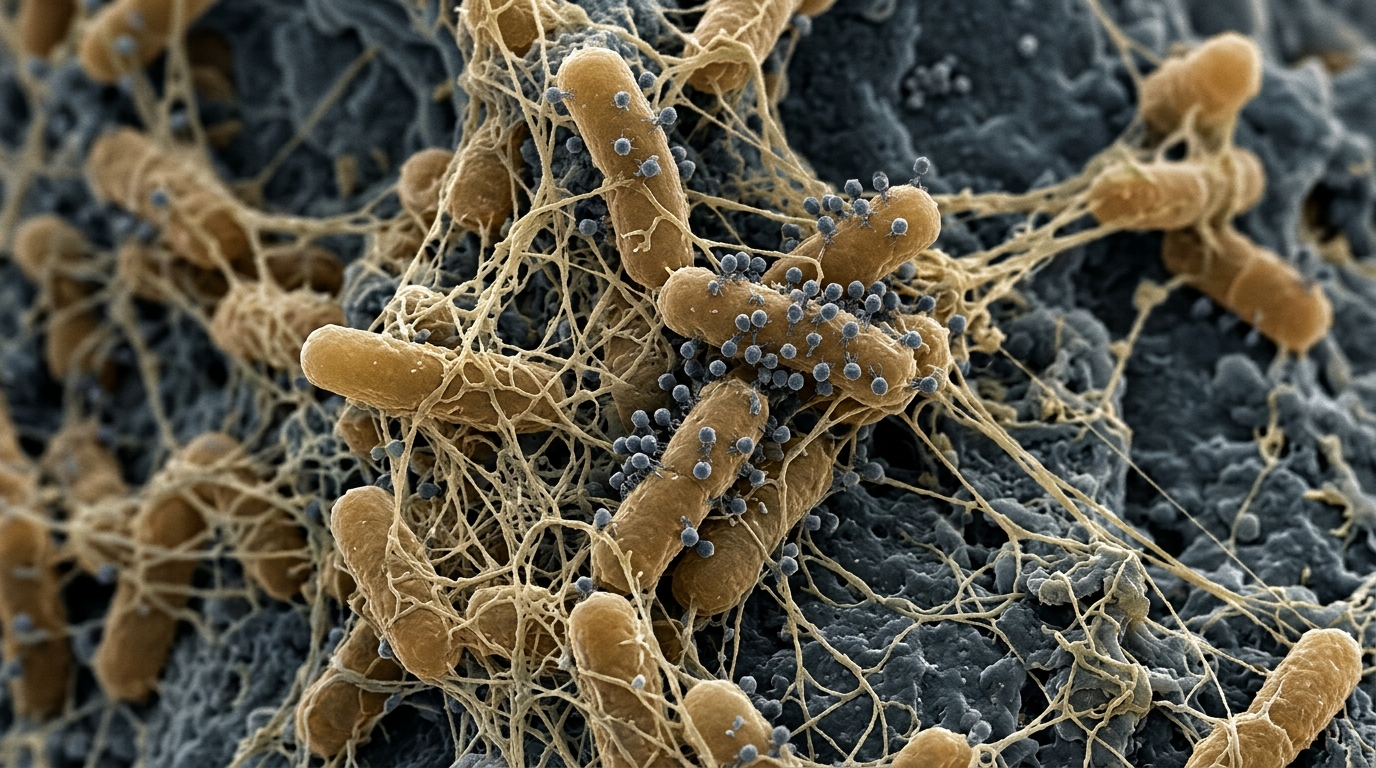
A newly isolated bacteriophage combined with meropenem exhibits significant, maturity-dependent antibiofilm activity against multidrug-resistant Klebsiella pneumoniae, demonstrating robust synergistic destruction in young biofilms that diminishes to an additive interaction as the bacterial structures mature. In an extensive investigation published in International Microbiology, researchers isolated and characterised the lytic siphovirus vB_KpnS_Tech and evaluated its performance alongside meropenem against preformed biofilms at twenty-four and forty-eight hours of growth. The laboratory study revealed that biofilm maturity profoundly alters the efficacy and mathematical interaction of combination therapy, challenging the assumption that antimicrobial synergy observed in early-stage cultures remains constant over time. While the dual regimen produced notable reductions in attached biomass, viable bacterial counts, and extracellular matrix components across both developmental stages, its capacity to achieve genuine synergy was restricted to less mature biofilms. These findings underscore the critical importance of evaluating phage-antibiotic combinations across distinct physiological stages rather than relying on standard planktonic assays or arbitrary single-timepoint biofilm models.
The opportunistic Gram-negative pathogen Klebsiella pneumoniae represents an escalating threat in hospital and community settings, responsible for severe pneumonia, bloodstream infections, urinary tract infections, and wound complications. The widespread dissemination of multidrug-resistant and carbapenem-resistant lineages has progressively compromised frontline therapeutics, elevating carbapenem-resistant Enterobacterales to an urgent research priority worldwide. Therapeutic failure is frequently compounded by the pathogen’s propensity to assemble robust biofilms on abiotic medical hardware and living tissues. Within these sessile communities, bacterial cells secrete a protective extracellular matrix rich in polysaccharides, proteins, and extracellular DNA, which severely impedes antibiotic penetration. As biofilms develop from nascent attachments into stratified mature layers, internal gradients of oxygen and nutrients emerge, generating slow-growing or metabolically dormant bacterial subpopulations. These physiological adaptations substantially reduce bacterial susceptibility to conventional cell-wall synthesis inhibitors like carbapenems, enabling persistent survival despite high-dose therapeutic exposure and underscoring the urgent necessity for novel therapeutic paradigms capable of disrupting structured bacterial matrices.
To explore alternative biocontrol options, the research team isolated the lytic bacteriophage vB_KpnS_Tech from an environmental water sample collected from the River Chelt, using the clinical wound isolate Klebsiella pneumoniae Kp-BCU4 as the enrichment host. Transmission electron microscopy identified the isolate as a member of the class Caudoviricetes exhibiting a classic siphovirus morphotype, featuring an isometric capsid measuring approximately one hundred and twenty nanometres and a long, flexible, non-contractile tail measuring roughly one hundred and forty nanometres in length and five nanometres in width. Replication kinetics conducted at an optimal multiplicity of infection of 0.01 revealed rapid host adsorption, with 79.1 percent of phage particles bound within two and a half minutes, 92.5 percent within five minutes, and 98.8 percent within seven and a half minutes, accompanied by an adsorption rate constant of 5.7 multiplied by ten to the negative ninth millilitres per minute. Following an estimated latent period of approximately thirty minutes, intracellular viral amplification yielded an average burst size of approximately one hundred and sixty-five plaque-forming units per infected host cell.
Stability evaluations established that vB_KpnS_Tech retains structural integrity and lytic viability across a broad window of physical conditions. The phage exhibited near-complete survival of ninety-eight to one hundred percent between 4 and 37 degrees Celsius, maintaining ninety-one percent viability at 45 degrees Celsius before declining sharply to sixty-seven percent at 55 degrees, sixteen percent at 65 degrees, and total inactivation at 75 degrees Celsius. In hydrogen ion exposure experiments, viral recovery remained between ninety and ninety-eight percent from pH 5 through pH 8, peaking near neutral pH 7, while infectivity fell to forty-two percent at pH 4, thirty-two percent at pH 12, and undetectable levels at extreme pH 3 and 13. Host range profiling across clinical isolates showed that the phage was strictly restricted to Klebsiella pneumoniae, productively lysing five of seven additional tested strains with efficiency of plating values ranging between 0.36 and 0.69 relative to the primary isolation host, while completely sparing Klebsiella aerogenes, Enterobacter cloacae, and Escherichia coli.
Whole-genome sequencing of the phage revealed a linear double-stranded DNA genome comprising 49,562 base pairs with a guanine-plus-cytosine content of 51.1 percent and an absence of transfer RNA genes. Bioinformatic annotation catalogued eighty-six predicted protein-coding sequences, of which forty-one were assigned functional roles while forty-five remained hypothetical proteins. Functional modules were clearly demarcated for viral DNA replication, structural assembly, packaging, and host lysis, with the lysis cassette encoding an endolysin, a putative holin, and an Rz-like spanin component, though an accompanying Rz1 outer-membrane counterpart was not identified. Exhaustive screening against the Comprehensive Antibiotic Resistance Database, the Virulence Factor Database, and the PhageLeads platform detected no recognised antimicrobial resistance genes, toxin sequences, or lysogeny-associated markers such as integrases or repressors. Phylogenetic and intergenomic distance calculations placed vB_KpnS_Tech within the family Drexlerviridae and genus Webervirus, demonstrating 98.93 percent nucleotide identity and 98.4 percent intergenomic similarity to its closest relative, Klebsiella phage vB_Kpn_K2069PH1, confirming it represents an established Webervirus species cluster.
To evaluate combinatory effects against structured communities, researchers established preformed biofilms of the clinical Kp-BCU4 strain on microtitre plates for either twenty-four or forty-eight hours before introducing twenty-four-hour exposures of phage and meropenem across checkerboard matrices. In twenty-four-hour biofilms, meropenem monotherapy achieved a maximum biomass reduction of 33.2 percent at 512 micrograms per millilitre, while phage monotherapy alone cleared at most 20.6 percent of biomass. In striking contrast, simultaneous combination therapy markedly enhanced clearance, reaching a peak reduction of 66.0 percent. Replicate checkerboards evaluated by the Bliss independence model generated global synergy scores averaging 10.53, safely above the predefined synergy threshold of 10.0. However, when tested against forty-eight-hour biofilms, maximum combination biomass reduction dropped to 44.3 percent, and the mean global Bliss score fell to 3.37, shifting the biological interaction entirely into the additive or independent category. This pronounced shift demonstrated that progressive biofilm maturation substantially dampens the collaborative killing dynamics observed in earlier developmental phases.
Parallel microbiological counts of recoverable sessile bacteria confirmed that reductions in physical biomass reflected genuine antimicrobial suppression rather than superficial stripping of the matrix. Before antimicrobial exposure, baseline viable burdens measured 6.10 log10 colony-forming units per millilitre in twenty-four-hour biofilms and 7.17 log10 colony-forming units per millilitre in forty-eight-hour biofilms. Over the subsequent twenty-four-hour test window, untreated control biofilms expanded to 7.17 and 8.30 log10 units, respectively. Treatment with the chosen experimental combination of ten to the ninth plaque-forming units per millilitre of vB_KpnS_Tech and 256 micrograms per millilitre of meropenem suppressed viable counts to 4.57 log10 units in twenty-four-hour biofilms and 6.60 log10 units in forty-eight-hour biofilms. These values represented net reductions of 1.53 and 0.57 log10 colony-forming units per millilitre below the original pre-treatment baselines, confirming active bacterial eradication rather than simple growth inhibition. Factorial analysis of variance established significant main effects for treatment and biofilm age alongside a significant treatment-by-age interaction.
Biochemical interrogation of the residual biofilm matrix demonstrated that the selected phage-meropenem combination substantially depleted major structural macromolecules compared with single-agent exposures. In twenty-four-hour biofilms, combined treatment reduced recoverable extracellular polysaccharide-associated carbohydrates by 64.13 percent, significantly exceeding the modest 25.27 percent and 17.37 percent reductions produced by phage or meropenem monotherapy. In forty-eight-hour biofilms, combination treatment still reduced carbohydrate levels by 29.63 percent, outperforming the single agents which achieved only 11.43 percent and 7.37 percent clearance. Extracellular protein concentrations decreased from 220.07 to 96.67 micrograms per millilitre in twenty-four-hour biofilms and from 281.30 to 151.00 micrograms per millilitre in forty-eight-hour biofilms. Spectrophotometric measurements of extracellular nucleic acids similarly dropped from 174.0 to 46.2 nanograms per microlitre and from 226.1 to 89.2 nanograms per microlitre across the two respective biofilm ages. Qualitative widefield fluorescence microscopy using SYPRO Ruby matrix staining corroborated these quantitative declines, showing that treated coverslip biofilms transitioned from continuous, confluent sheets into fractured, highly discontinuous microcolonies.
The therapeutic potential of the phage-meropenem pairing extended beyond the initial propagation strain to five additional clinical multidrug-resistant Klebsiella pneumoniae isolates. In twenty-four-hour biofilms formed by these diverse strains, the combination regimen achieved viable count reductions ranging from 1.37 to 2.60 log10 colony-forming units per millilitre, though efficacy dropped to between 0.29 and 1.65 log10 units when treating forty-eight-hour biofilms. Crucially, the degree of biofilm eradication across isolates did not correlate directly with plaque-forming efficiency on agar lawns, illustrating that planktonic infectivity metrics fail to capture the complex architectural and physiological barriers encountered inside biofilms. Mechanistically, investigators proposed that meropenem-induced disruption of peptidoglycan synthesis weakens cell-envelope integrity, potentially sensitising bacteria to holin- and endolysin-mediated phage lysis, while viral replication disrupts localized matrix architecture to facilitate deeper antibiotic diffusion. However, because direct molecular interactions were not formally dissected, these complementary actions remain unproven working hypotheses requiring targeted empirical validation in future biophysical investigations.
Despite these encouraging in vitro observations, several experimental and pharmacological constraints qualify the translational interpretation of the data. Most notably, the 256 microgram per millilitre meropenem concentration required for optimal biofilm suppression represents an experimental benchmarking exposure that far exceeds drug levels achievable through routine intravenous administration in human clinical practice. The findings illustrate in vitro synergistic principles rather than a clinically ready systemic dosing schedule or an antibiotic dose-sparing regimen. Furthermore, static microtitre well models lack the shear stresses, hydrodynamic flow, nutritional flux, and immune system components characteristic of human clinical infections. Methodological limitations also include the reliance on non-specific ultraviolet absorbance for nucleic acid quantification and the absence of a formal chemical carryover neutralization step during bacterial plating. Future investigations must explore whether local delivery modalities, such as phage-loaded hydrogels, or dynamic pharmacokinetic models can reproduce this maturity-dependent antibiofilm efficacy using clinically viable antibiotic concentrations.
Subject of Research: Synergistic and maturity-dependent antibiofilm activity of bacteriophage vB_KpnS_Tech combined with meropenem against multidrug-resistant Klebsiella pneumoniae
Article Title: Phage–meropenem synergy against multidrug-resistant Klebsiella pneumoniae biofilms: phenotypic and genomic characterisation of vB_KpnS_Tech
Article References: Haq, K., Figgitt, M., Lee, D., & Nadeem, H. (2026). Phage–meropenem synergy against multidrug-resistant Klebsiella pneumoniae biofilms: phenotypic and genomic characterisation of vB_KpnS_Tech. International Microbiology. https://doi.org/10.1007/s10123-026-00922-0
Image Credits: AI Generated
DOI: 10.1007/s10123-026-00922-0
Keywords: Klebsiella pneumoniae, Bacteriophages, Meropenem, Biofilms, Antimicrobial Resistance, Synergy, Webervirus, Microbiology, Phage, against, multidrug-resistant, Klebsiella
News Source: Drew Townsend. (November 6, 2026). Phage and Meropenem Synergize Against Young Klebsiella Biofilms but Wane with Maturity. Scienmag.