


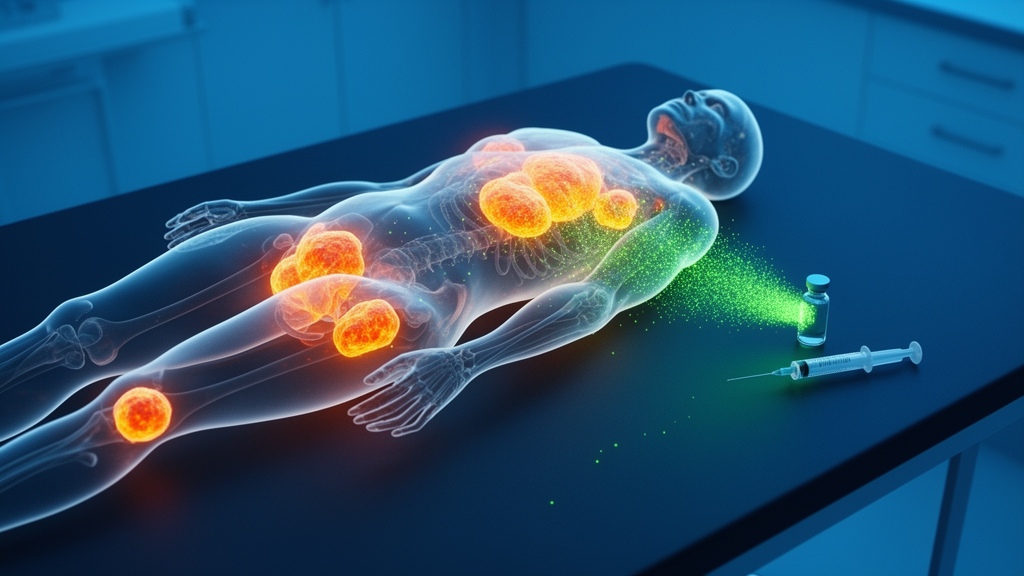
A letter published in EJNMMI Reports argues that two widely used PET biomarkers, tumour SUVmean and tumour volume, are best understood as imperfect surrogates of a more fundamental quantity: the radiation absorbed dose delivered to the tumour during systemic radiopharmaceutical therapy. The author, Yung Hsiang Kao, reaches this conclusion by reinterpreting, from a radiobiologic perspective, the findings of a recent meta-analysis of PSMA PET biomarkers in metastatic castration-resistant prostate cancer.
The meta-analysis in question, by Kiani and colleagues, examined the prognostic value of PSMA PET biomarkers for response to lutetium-177 PSMA therapy. It found SUVmean and tumour volume to be significant prognostic biomarkers. For overall survival, SUVmean carried a hazard ratio of 0.93, with a 95 percent confidence interval of 0.90 to 0.96, while tumour volume carried a hazard ratio of 1.37, with a 95 percent confidence interval of 1.27 to 1.48. In practical terms, better survival was directly related to higher SUVmean but inversely related to tumour volume.
The letter then walks through a chain of proportional reasoning. Because SUVmean is simply a ratio describing the relative biodistribution of systemically injected radioactivity into the tumour, a survival association proportional to SUVmean can be re-expressed as a survival association proportional to tumour radiation energy. Meanwhile, since tumour volume is directly proportional to tumour mass, a survival association inversely proportional to tumour volume can be folded into the same expression.
Combining the two relationships yields a statement that survival is proportional to tumour radiation energy divided by tumour mass. By definition, energy absorbed per unit mass is the radiation absorbed dose, measured in gray. The letter concludes that survival is therefore proportional to tumour radiation absorbed dose, and that Kiani and colleagues have, in effect, shown the key prognostic metric in systemic radiopharmaceutical therapy to be the radiation absorbed dose expressed in gray.
From this vantage point, the author suggests, today’s tangled web of PET metrics can be seen as imperfect surrogates of the radiation absorbed dose rather than as independent biological signals. SUVmean captures how much injected radioactivity concentrates in the tumour relative to its biodistribution, while tumour volume captures how much mass that radioactivity is distributed across. Together, they implicitly encode the dose delivered, which is why both emerge as prognostic markers in meta-analyses of radionuclide therapy response.
The letter draws a practical consequence for how radiopharmaceutical therapy should be prescribed and reported. Rather than focusing on cycles of empirically prescribed radioactivity measured in becquerels, the author argues that work on systemic radiopharmaceutical therapy should focus on the personalized radiation absorbed dose delivered in fractions. This reframing shifts attention from the activity injected to the energy actually absorbed by the tumour, the quantity that the proportional reasoning places at the centre of prognosis.
As an example of an existing solution, the letter points to rapid predictive dosimetry for systemic radiopharmaceutical therapy that the author describes as clinically validated, implemented, and freely available, citing related publications from 2024, 2025 and 2026. The claim is offered as evidence that personalized dose-based workflows are already feasible in clinical practice rather than a distant aspiration.
A few caveats frame the argument. The letter is an editorial perspective built on proportional reasoning rather than a new clinical study, and its quantitative anchor is a meta-analysis of prognostic associations in metastatic castration-resistant prostate cancer patients undergoing lutetium-177 PSMA therapy. Hazard ratios describe associations with survival in that setting; they do not by themselves establish that manipulating absorbed dose will change outcomes. Even so, the argument offers a compact unifying lens: if SUVmean and tumour volume both predict response, it may be because they jointly approximate the dose in gray that the tumour actually receives.
Subject of Research: The relationship between PET tumour metrics and radiation absorbed dose in radiopharmaceutical therapy
Article Title: Tumour SUVmean and volume relates to its radiation absorbed dose
Article References: Kao, Y. H. (2026). Tumour SUVmean and volume relates to its radiation absorbed dose. EJNMMI Reports, 10(1), Article 32. https://doi.org/10.1186/s41824-026-00319-2
Image Credits: AI Generated
DOI: 10.1186/s41824-026-00319-2
Keywords: SUVmean, tumour volume, radiation absorbed dose, PSMA PET, lutetium-177, prostate cancer, radiopharmaceutical therapy, dosimetry, meta-analysis, prognostic biomarkers, EJNMMI Reports, Tumour
News Source: Nathaniel Bowman. (October 29, 2026). PET Tumour Metrics Reflect Radiation Absorbed Dose in Radiopharmaceutical Therapy. Scienmag.



