• HOME
  • NEWS
  • EXPLORE
    • CAREER
      • Companies
      • Jobs
    • EVENTS
    • iGEM
      • News
      • Team
    • PHOTOS
    • VIDEO
    • WIKI
  • BLOG
  • COMMUNITY
    • FACEBOOK
    • INSTAGRAM
    • TWITTER
Monday, July 6, 2026
BIOENGINEER.ORG
No Result
View All Result
  • Login
  • HOME
  • NEWS
  • EXPLORE
    • CAREER
      • Companies
      • Jobs
        • Lecturer
        • PhD Studentship
        • Postdoc
        • Research Assistant
    • EVENTS
    • iGEM
      • News
      • Team
    • PHOTOS
    • VIDEO
    • WIKI
  • BLOG
  • COMMUNITY
    • FACEBOOK
    • INSTAGRAM
    • TWITTER
  • HOME
  • NEWS
  • EXPLORE
    • CAREER
      • Companies
      • Jobs
        • Lecturer
        • PhD Studentship
        • Postdoc
        • Research Assistant
    • EVENTS
    • iGEM
      • News
      • Team
    • PHOTOS
    • VIDEO
    • WIKI
  • BLOG
  • COMMUNITY
    • FACEBOOK
    • INSTAGRAM
    • TWITTER
No Result
View All Result
Bioengineer.org
No Result
View All Result
Home NEWS Science News Health

Peptides+antibiotic combination may result in a more effective treatment for leishmaniasis

Bioengineer by Bioengineer
October 16, 2020
in Health
Reading Time: 2 mins read
0
IMAGE
Share on FacebookShare on TwitterShare on LinkedinShare on RedditShare on Telegram

IMAGE

Credit: UAB

Leishmaniasis is caused by the protozoan Leishmania parasites which are transmitted by the bite of an infected sandfly. Although in rich countries this disease mainly affects dogs, in other countries it can wreak havoc on the health of humans, causing anything from ulcers to damage to the bone marrow, liver or spleen, all which could be fatal. The WHO estimates that there are currently over one billion people living in areas in which leichmaniasis is endemic and that there are over one million new cases each year. There is therefore an urgent need to find new, efficient and selective alternatives to leishmaniasis chemotherapy which can reduce the adverse side effects of existing drugs such as paromomycin and miltefosine.

Lecturers Rosa Maria Ortuño and Ona Illa from the UAB Department of Chemistry were in charge of coordinating a multidisciplinary research into finding new anti-Leishmania therapies. Also involved in the study were the groups of lecturer Jean-Didier Maréchal, from the same department, and of lecturer Carme Nogués, from the UAB Department of Cell Biology, Phyisology and Immunology, as well as researchers Luis Rivas from the CIB Margarita Salas – CSIC (Madrid) and Míriam Royo from the IQAC – CSIC (Barcelona).

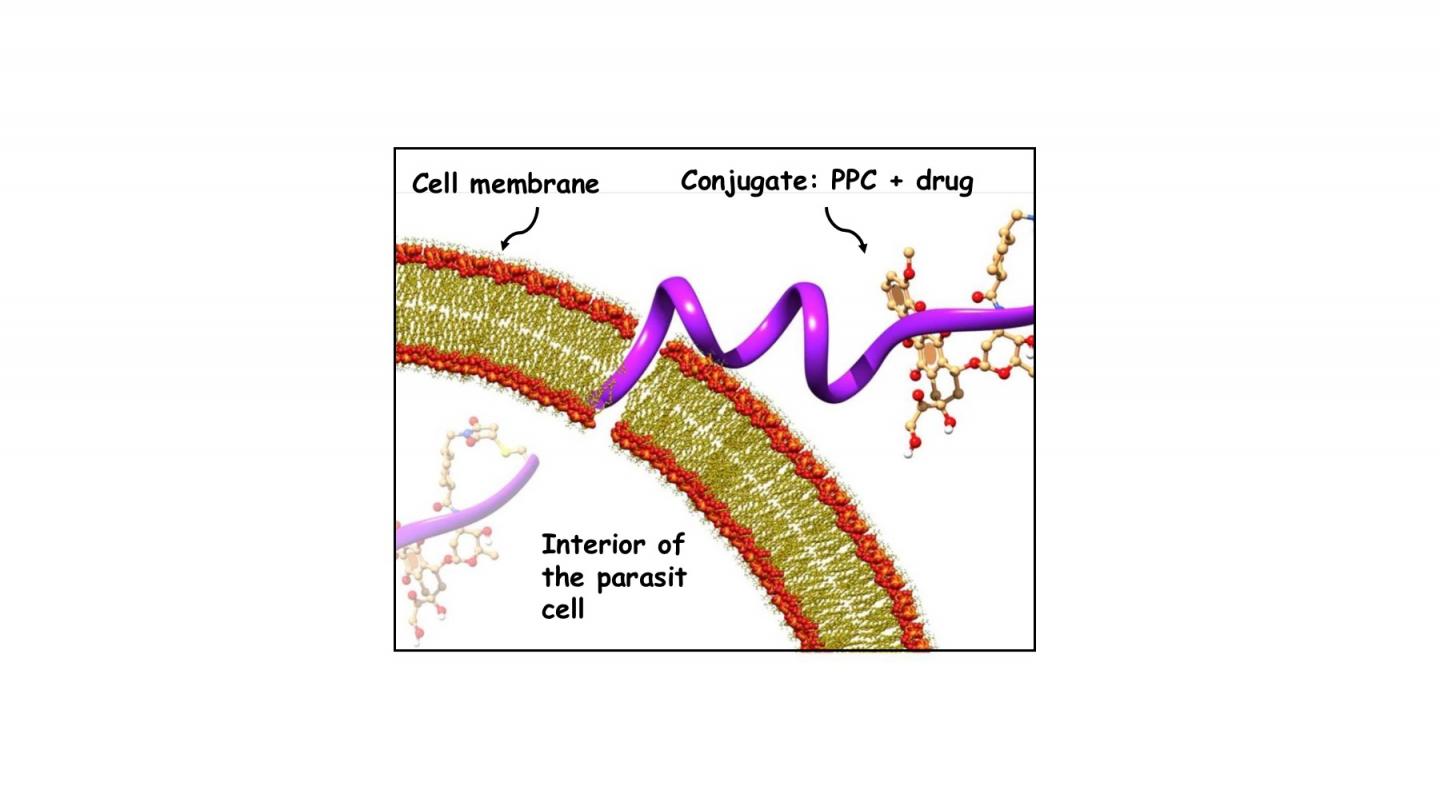
The study consisted in the preparation and biological evaluation of new cell-penetrating peptides (CPPs) which, with an antibiotic conjugation, serve as a vehicle or vector for the drug, enabling it to enter the parasite’s cell membrane and be released inside, thus causing its death. The result is greater effectiveness, while at the same time a lower number of oral doses of the drug are needed. In addition, the synthesised CPPs are not toxic for mammal cells, but are for the Leishmania. “Although the idea of using CPPs in the treatment of leishmaniasis is not unknown, the importance of this study lies in its high cell-penetrating capacity and the selectivity (mammal vs parasite cells) of the new synthesised and studied peptides”, explains Rosa Maria Ortuño.

In particular, the research has served to study peptides made up of non-protein amino acids with a covalent conjugate of doxorubicin (Dox), a drug which is also used in cancer treatments. While Dox in its free form is not active when incubated with Leishmania because it is not capable of penetrating its interior, the Dox-PPC conjugate has demonstrated to be toxic in very low concentrations. Its cell-penetrating capacity has been rationalised through molecular modelling studies. The results are highly promising, and “a great deal of research is still needed before thinking about new drugs, but we are now a little bit closer of our objective”, concludes Ortuño.

###

Media Contact
Rosa Ortuño
[email protected]

Related Journal Article

http://dx.doi.org/10.3390/ijms21207502

Tags: Infectious/Emerging DiseasesMedicine/Health
Share12Tweet8Share2ShareShareShare2

Related Posts

Flame retardant BDE-209 targets molecularly linked to ulcerative colitis

July 6, 2026

Kidney transplant outcomes in older adults studied by German researchers

July 6, 2026

Salmonella protein SopB curbs early inflammation to slow disease progression

July 6, 2026

Multi-metal cooperation drives lung cancer chemoresistance, reversed by MiADMSA

July 6, 2026
Please login to join discussion

POPULAR NEWS

  • Detection of EDCs in Breast Milk and Infant Urine Up to Six Months Highlights Early Exposure Risks

    77 shares
    Share 31 Tweet 19
  • New Drug Candidate Developed at McMaster Shows Potential for Treating Brain Cancer

    58 shares
    Share 23 Tweet 15
  • Saying Goodbye to PGY-6: Pediatric Fellowship Realities

    103 shares
    Share 41 Tweet 26
  • KTU Researchers Explore Ultrasound’s Role in Enhancing Blood Flow Beyond Diagnostics

    53 shares
    Share 21 Tweet 13

About

We bring you the latest biotechnology news from best research centers and universities around the world. Check our website.

Follow us

Recent News

Flame retardant BDE-209 targets molecularly linked to ulcerative colitis

Ultra-high frequency particle impacts mimic rockbursts to shatter hard rock

Kidney transplant outcomes in older adults studied by German researchers

Subscribe to Blog via Email

Enter your email address to subscribe to this blog and receive notifications of new posts by email.

Join 83 other subscribers
  • Contact Us

Bioengineer.org © Copyright 2023 All Rights Reserved.

Welcome Back!

Login to your account below

Forgotten Password?

Retrieve your password

Please enter your username or email address to reset your password.

Log In
No Result
View All Result
  • Homepages
    • Home Page 1
    • Home Page 2
  • News
  • National
  • Business
  • Health
  • Lifestyle
  • Science

Bioengineer.org © Copyright 2023 All Rights Reserved.