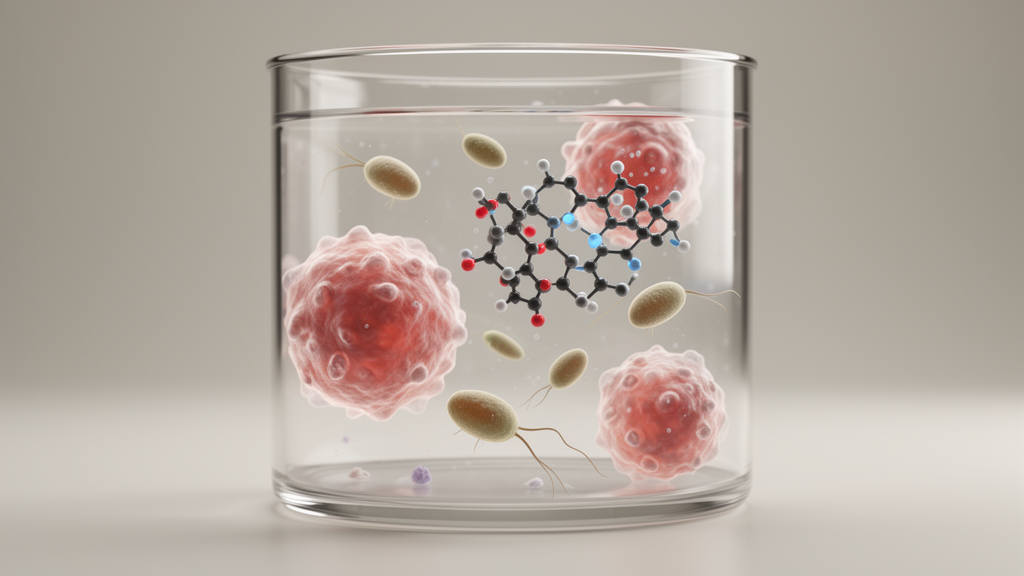
A critical narrative review concludes that pentalinonsterol, a plant-derived steroidal compound, has demonstrated both parasite-directed activity and host-cell-modulating effects in experimental models of leishmaniasis. The compound, also known as PEN, was originally isolated from the Mayan medicinal plant Pentalinon andrieuxii. Experimental studies report activity against Leishmania promastigotes and intracellular amastigotes, alongside ultrastructural injury to the parasites. However, no molecular target in the parasite has been validated, and the available evidence does not establish whether changes in host-cell responses are necessary for parasite clearance.
The review describes PEN as a cholestane-type steroidal ketone and evaluates the preclinical evidence for its potential as a natural-product antileishmanial agent. Its observed effects span several biological processes, including NF-κB and AP-1 signalling, antigen presentation, co-stimulatory markers, dendritic-cell production of IL-12, T-cell responses involving IFN-γ, MAPK–cPLA₂ signalling, and Nrf2-associated transcriptional and redox responses. These results indicate that PEN can influence host-cell signaling, but they do not demonstrate that any of these responsive pathways is required for the compound to eliminate Leishmania parasites or that parasite-directed activity and host immunomodulation are causally linked.
Some animal evidence reviewed in the article points toward an effect on disease burden. Liposomal PEN reduced parasite burdens in an experimental model of visceral leishmaniasis. That result supports further investigation of PEN as a possible dual-action compound, but the formulation has not yet been shown to provide advantages in pharmacokinetics, tissue delivery, safety or efficacy over free PEN. The studies summarized remain preclinical, and the review emphasizes unresolved questions about molecular targets, the relative contributions of direct and host-mediated effects, the causal interdependence of the two activities, and the sequence in which parasite and host responses occur.
The findings should therefore be interpreted as evidence of experimental promise rather than an established treatment. Available leishmaniasis therapies face limitations including toxicity, administration burden, variable efficacy, cost and drug resistance, creating a continuing need for better characterized candidates. Yet the review finds no basis for claiming that PEN has already overcome those limitations in humans. Human clinical efficacy, clinical safety, dosing, pharmacokinetic performance and superiority over existing therapies are not established by the preclinical evidence summarized. The authors accordingly characterize PEN as a putative dual-action antileishmanial natural product whose proposed mechanism still requires direct experimental validation.
Subject of Research: Preclinical evidence for pentalinonsterol’s parasite-directed and host-modulating activities against Leishmania
Article Title: Pentalinonsterol at the Host–Parasite Interface: Antileishmanial Activity, Host Immunomodulation, and Unresolved Mechanisms
Article References: Amin, A., Nawaz, T., Ullah, N., & Niaz, S. I. (2026). Pentalinonsterol at the Host–Parasite Interface: Antileishmanial Activity, Host Immunomodulation, and Unresolved Mechanisms. Acta Parasitologica, 71(6), Article 239. https://doi.org/10.1007/s11686-026-01425-8
Image Credits: AI Generated
DOI: 10.1007/s11686-026-01425-8
Keywords: pentalinonsterol, leishmaniasis, Leishmania, natural products, immunomodulation, host–parasite interface, antiparasitic activity, preclinical research, visceral leishmaniasis, liposomal delivery, Host, Parasite
News Source: Drew Townsend. (October 20, 2026). Pentalinonsterol shows dual antileishmanial effects in preclinical evidence. Scienmag.