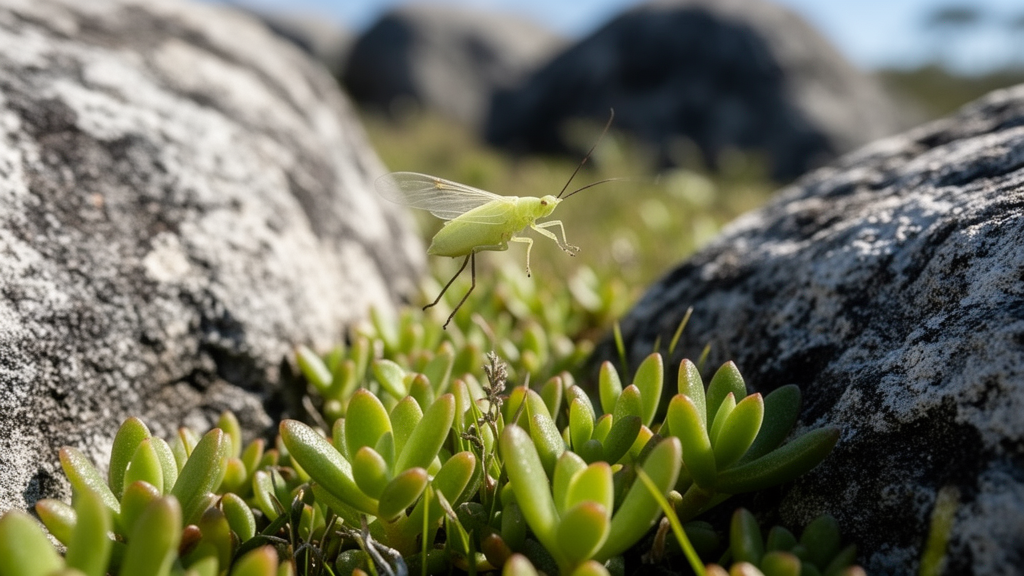
A new species of jumping plant lice, or psyllids, has been formally described from the rock fields of Brazil’s Serra do Espinhaço mountain range. Named Mitrapsylla rupestris, the insect was found living in the folded leaflets of Poiretia bahiana, a legume restricted to rocky habitats in the range. The discovery was based on a morphological study of adults and early-stage nymphs collected at Morro do Pai Inácio in Palmeiras, Bahía, and establishes Poiretia as a previously unknown host plant for psyllids in the genus Mitrapsylla.
The study characterizes a genus with 51 described species, making Mitrapsylla the largest genus in the subfamily Ciriacreminae of the family Psyllidae. Before the new description, 40 species had been reported from Brazil. The genus extends from the southern United States to northern Argentina, but its Brazilian members are morphologically similar, with differences among species often small and requiring detailed examination of structures such as the male terminalia, forewing spinules and proportions of the head and antennae.
Adult M. rupestris measure about 2.0–2.2 mm in males and 2.2–2.4 mm in females, with the body length measured from the front margin of the head to the tips of the folded forewings. Their coloration ranges from orange to brown, with fine whitish lines and dots on the head and thorax. The head is inclined at an angle of 30 degrees from the body’s longitudinal axis, and the forewings are transparent, either colorless or slightly yellowish, with small dark-brown dots associated with radular spinules in several cells.
Identification was based on the authors’ measurements and comparison with the key developed in a 2020 revision of Brazilian Mitrapsylla. The new species resembles M. aeschynomenis, M. aurantia, M. cubana and M. didyma in the form of the male paramere and the unipartite dorsal lobe of the distal aedeagus. It differs in the placement of lateral tubercles on the ventral aedeagal process, the outline and narrowly rounded apex of the female proctiger, and other proportional and forewing characters. The sclerotized ridge on the paramere also bears two small teeth in dorsal view, unlike the single large posterior tooth found in M. cubana and M. didyma.
The type series comprises one male holotype and 11 paratypes—five males and six females—collected on 23 April 2021 at 1,110 meters above sea level. The specimens were deposited in the Naturhistorisches Museum Basel in Switzerland and the Coleção Entomológica Padre Jesus Santiago Moure at the Federal University of Paraná in Brazil. Four additional first- and second-instar immatures from the same site were preserved in ethanol but excluded from the formal type series. Because only the first two immature stages were available, the fifth-instar form remains unknown.
Direct observations showed that the immature psyllids develop within the folds of still-partially doubled leaflets of Poiretia bahiana. The host plant has glandular leaflets and grows in the rock habitats characteristic of the Espinhaço’s campos rupestres. This association fits the feeding biology previously documented for Mitrapsylla: among the 51 species known before this description, hosts had been recorded for 34, and each of those species feeds either on a single plant species or on several species within one host genus. Poiretia bahiana therefore represents both a new host genus for the psyllid community and a plant association not previously known within Mitrapsylla.
The available evidence suggests that M. rupestris is probably narrowly endemic, but the authors emphasize that its confirmed distribution is presently limited to the type locality in Bahía. Previous records of Mitrapsylla show why apparent endemism should be interpreted cautiously. Among 40 Brazilian species previously reported, 26 had relatively broad distributions, while 10 of the remaining species were known from only one municipality; available information cannot determine whether such single-municipality records represent true endemism or simply insufficient sampling. The new psyllid’s known host is itself endemic to the Espinhaço rock habitats, which makes a close relationship between the insect and plant plausible, although further fieldwork is required to establish the insect’s full range.
The Espinhaço Range extends through the Brazilian states of Bahía and Minas Gerais and is distinguished by exceptional plant richness and endemism. Around 10% of Brazil’s known angiosperm species occur there even though the range covers less than 1.5% of the country’s territory, and as many as one-third of its plants are endemic. Much of this diversity is concentrated in campos rupestres, or rupestrian fields, whose discontinuous distribution, severe environmental conditions and habitat heterogeneity are associated with unusually high plant diversity. Far less is known about the host-specific, plant-feeding insects inhabiting these environments.
The same survey that produced M. rupestris also uncovered four other undescribed psyllids in the Espinhaço rock fields: two species of Isogonoceraia associated with Chamaecrista, one Heteropsylla associated with Calliandra, and one Trioza associated with Eugenia. The researchers considered these insects probably host specific and potentially endemic to the campos rupestres, but they had not yet been formally described. The discoveries suggest that the psyllid fauna may mirror the high diversity and localized endemism of the plant communities on which it depends, while also showing that substantial gaps remain in the study of insects in threatened mountainous ecosystems.
Subject of Research: Description of a new psyllid species associated with an endemic legume in Brazil’s Serra do Espinhaço
Article Title: Mitrapsylla rupestris sp. nov., a psyllid ( Hemiptera , Psylloidea ) associated with Poiretia bahiana ( Fabaceae ) endemic to the Espinhaço mountain range (Brazil, Bahía)
Article References: Burckhardt, D., & Queiroz, D. L. (2021). Mitrapsylla rupestris sp. nov., a psyllid (Hemiptera, Psylloidea) associated with Poiretia bahiana (Fabaceae) endemic to the Espinhaço mountain range (Brazil, Bahía). Alpine Entomology, 5, 69-75. https://doi.org/10.3897/alpento.5.70640
Image Credits: AI Generated
Keywords: Mitrapsylla rupestris, jumping plant lice, Psylloidea, Espinhaço Range, Poiretia bahiana, campos rupestres, Brazilian biodiversity, species description, host specificity, Fabaceae, Mitrapsylla, rupestris
News Source: Gavin Prescott. (October 20, 2026). New jumping plant lice species discovered in Brazil’s Espinhaço rock fields. Scienmag.