Pennyroyal oil, the pungent essential oil distilled from Mentha pulegium, has been a staple of folk medicine for centuries, brewed as teas and tonics and even applied to stimulate menstruation. But a new study published in Molecular Biology Reports delivers one of the most complete mechanistic portraits yet of why this plant has also earned a reputation as a poison. A team of researchers at KLE College of Pharmacy in Hubballi, India, combined computational network pharmacology with a full reproductive and developmental toxicity study in rats, and the results paint a sobering picture: pulegone-rich pennyroyal oil damages the liver, scrambles sex hormone signaling, and impairs fertility and offspring survival at every dose tested.
The investigation began with chemistry. Using gas chromatography-mass spectrometry, the researchers confirmed that pulegone dominated the essential oil profile, accounting for 42.72 percent of the mixture. Pulegone is the monoterpene terpene long suspected of causing pennyroyal’s most notorious effects. In the human and animal body, liver enzymes convert pulegone into menthofuran, a proximate toxin that depletes glutathione and destroys hepatocytes, a metabolic pathway first mapped in detail in the 1980s. European regulators at the European Medicines Agency have already issued public statements restricting herbal products containing pulegone and menthofuran, but the precise molecular routes by which the compound harms both liver and reproductive organs have remained fragmented across the literature.
To connect those dots, the team turned to network pharmacology, an approach that maps the interactions between a compound’s chemical constituents and the protein targets encoded in the human or animal genome. By cross-referencing predicted targets of the oil’s constituents with disease pathways linked to hepatotoxicity and reproductive toxicity, the researchers identified 116 shared molecular targets. Among these, three hub genes emerged as the most connected and biologically significant nodes: CYP19A1, the gene encoding aromatase, the enzyme that synthesizes estrogens; ESR2, which encodes the estrogen receptor beta; and HSD11B1, which encodes 11-beta-hydroxysteroid dehydrogenase type 1, a gatekeeper of glucocorticoid action within tissues. All three sit squarely within the steroid hormone biosynthesis and estrogen signaling pathways.
Molecular docking then tested whether pulegone could physically bind these proteins. The simulations returned favorable binding affinities of minus 5.9, minus 6.0, and minus 6.6 kilocalories per mole for CYP19A1, ESR2, and HSD11B1 respectively, values consistent with meaningful ligand-receptor interactions. In other words, the computational analysis suggested that the dominant constituent of pennyroyal oil could directly interfere with the molecular machinery that governs estrogen production, estrogen reception, and intracellular steroid metabolism. This was the hypothesis the animal experiments would go on to test.
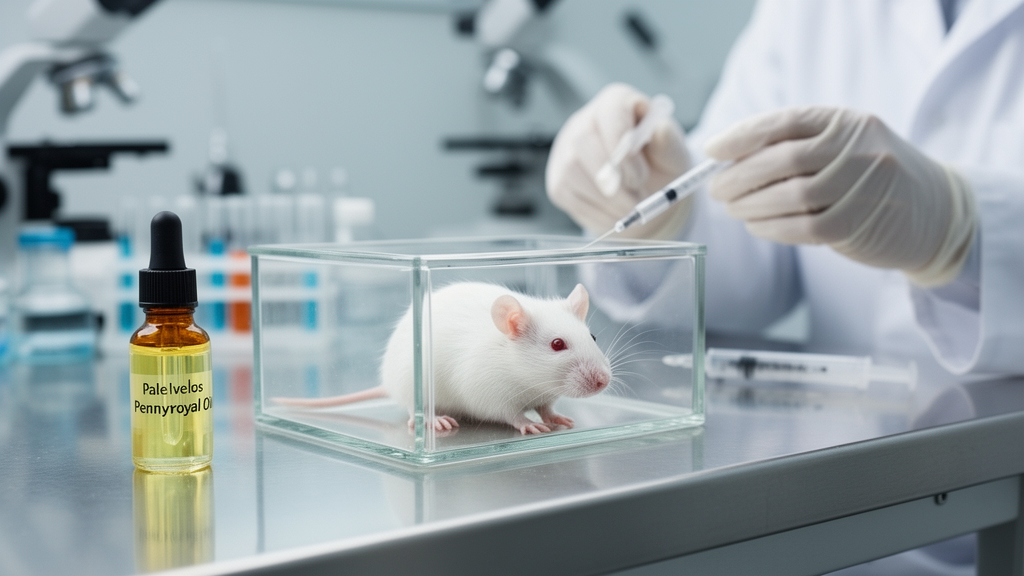
For the in vivo phase, the researchers followed OECD Guideline 421, the internationally standardized reproduction and developmental toxicity screening protocol. Wistar rats received pennyroyal essential oil at 100, 200, or 400 milligrams per kilogram of body weight throughout premating, mating, gestation, and lactation, covering the entire reproductive cycle. The design allowed the team to track effects from the earliest stages of gamete development through weaning, capturing both parental toxicity and consequences for the next generation.
The outcomes were dose-dependent and consistent across multiple endpoints. Exposed animals showed impaired fertility, reduced implantation rates, smaller litter sizes, lower pup survival, and slower growth in surviving offspring. Alongside these reproductive failures, the rats exhibited elevated markers of liver injury, evidence of oxidative stress, disrupted hormone levels, and histopathological damage in the liver, testes, and ovaries. The convergence of liver and reproductive harm in the same animals mirrored the computational prediction that a single compound, acting on a shared network of steroidogenic and estrogenic targets, could drive pathology in both organ systems simultaneously.
The mechanistic story that emerges is threefold. First, endocrine disruption: by binding aromatase and estrogen receptor beta, pulegone appears to interfere with the synthesis and signaling of the hormones that orchestrate ovulation, spermatogenesis, implantation, and pregnancy maintenance. Second, oxidative tissue injury: the metabolic activation of pulegone in the liver generates reactive intermediates that overwhelm antioxidant defenses, damaging hepatocytes and, by extension, the steroid-producing cells of the gonads, which are themselves highly vulnerable to oxidative stress. Third, downregulation of the steroid hormone biosynthesis signaling pathway, which the authors identify as the central pathway linking the computational targets to the observed in vivo damage.
The novelty of the work, the authors argue, lies in establishing the first multi-scale mechanistic link between specific computational targets and whole-animal toxicity outcomes for pennyroyal oil. Previous studies had documented pieces of the puzzle: earlier research in pregnant rats showed that Mentha pulegium extracts could induce abortion and fetal toxicity through modulation of pregnancy hormones and inflammatory signaling, and other work had characterized the antimicrobial and antioxidant properties of the oil. But no prior study had tied the network-level identification of CYP19A1, ESR2, and HSD11B1 as hub genes directly to fertility, developmental, hepatic, hormonal, and histopathological endpoints measured in the same experimental animals.
The implications extend beyond traditional medicine. Pulegone-containing oils are used as flavoring agents and fragrances, and regulatory agencies worldwide grapple with setting safe exposure limits for phytochemicals whose toxicity profiles are incompletely mapped. The dose-dependent nature of the effects observed here, spanning 100 to 400 milligrams per kilogram in rats, offers quantitative anchors for benchmark dose modeling and interspecies risk extrapolation. The study also demonstrates the value of integrating network pharmacology with guideline-compliant animal testing: the computational screen correctly predicted the pathways that the in vivo work confirmed, suggesting that such hybrid designs could make safety assessments of herbal actives faster and more targeted.
Caveats remain. The findings derive from a rat model at relatively high doses, and translation to human exposure scenarios, particularly the low doses typical of occasional culinary or aromatherapy use, requires careful benchmark dose analysis and toxicokinetic modeling. The oil’s composition also varies with plant chemotype, geography, and extraction method, meaning that pulegone content, and therefore risk, is not uniform across commercial products. Still, for a plant whose abortifacient reputation dates back to antiquity and whose lethal hepatotoxicity has been documented in case reports for decades, the new study provides something the historical record never could: a coherent, target-level mechanism connecting a single dominant molecule to the destruction of both liver tissue and reproductive function. For regulators, clinicians, and anyone tempted by pennyroyal’s folkloric appeal, the message is unambiguous. The oil’s chemistry is not benign, its targets are now known, and its dose-dependent harm to fertility and the liver has been demonstrated across the full reproductive life cycle in a standardized animal model.
Subject of Research: Hepato-reproductive toxicity of pulegone-rich Mentha pulegium essential oil in rats
Article Title: Mechanistic assessment of hepato-reproductive toxicity of Mentha pulegium L. essential oil in rats
Article References: Pattanashetti, L. A., Siddika, S. A., Swathi, D. S., Sumanth, B., Mishra, M., Kulkarni, G. G., Hiremath, S. I., & Patil, S. B. (2026). Mechanistic assessment of hepato-reproductive toxicity of Mentha pulegium L. essential oil in rats. Molecular Biology Reports, 53(1), Article 1691. https://doi.org/10.1007/s11033-026-12842-3
Image Credits: AI Generated
DOI: 10.1007/s11033-026-12842-3
Keywords: pennyroyal oil, Mentha pulegium, pulegone, hepatotoxicity, reproductive toxicity, endocrine disruption, oxidative stress, network pharmacology, molecular docking, OECD Guideline 421, CYP19A1, estrogen signaling
News Source: Drew Townsend. (October 9, 2026). Pennyroyal Oil Disrupts Hormones and Damages Liver and Fertility in Rats. Scienmag.