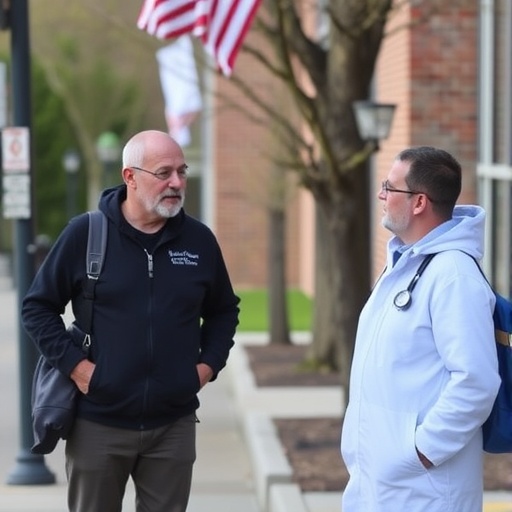
Penn State College of Medicine has secured a five-year, $2.5 million grant from the Human Resources and Services Administration to launch an innovative street medicine program aimed at delivering healthcare directly to unsheltered homeless populations in both urban and rural Southcentral Pennsylvania. This new initiative not only targets healthcare delivery to some of the most vulnerable groups but also introduces a specialized curriculum for internal medicine residents, integrating real-world clinical experience with academic training.
Street medicine operates by transcending traditional clinical boundaries, meeting individuals experiencing homelessness where they reside—whether under bridges, in encampments, or secluded rural areas. Healthcare professionals provide comprehensive primary care services onsite, including diagnosis and management of physical illnesses, mental health conditions, and substance use disorders, contingent upon patient consent. This approach dismantles the systemic barriers that exclude homeless populations from accessing conventional healthcare environments.
With Penn State’s leadership in health systems science—a discipline focusing on the complex interactions within healthcare environments—the program is structured to emphasize systems-based practice. This framework trains clinicians to identify social determinants of health as pivotal components affecting patient outcomes, fostering a deeper understanding of healthcare disparities and systemic failures.
The program’s clinical arm is slated to commence patient care operations by January 2027, initially focusing on Lebanon County’s urban areas, supported by existing community partnerships, before expanding into rural settings. Parallel to clinical operations, internal medicine residents will engage in a comprehensive curriculum blending classroom instruction with hands-on field experience. The educational content incorporates cutting-edge human-centered design principles, ensuring continuous program refinement centering on patient needs and provider adaptability.
In addition to direct patient impact, the street medicine program addresses physician burnout by reinvigorating residents’ sense of agency and purpose within a fragmented healthcare system. Prior research under American Medical Association-funded projects observed that residents participating in system improvement initiatives experienced reduced burnout, suggesting that engagement in transformative clinical models promotes professional resilience.
Notably, this program builds on Penn State’s pioneering efforts in street medicine education, which began with an undergraduate course in this domain. The inclusion of graduate medical education levels cements a continuum of learning, preparing medical professionals to confront and innovate solutions for health inequities throughout their careers.
The multidisciplinary grant team includes medical educators, clinicians, and program managers, ensuring a robust integration of clinical expertise and educational innovation. Penn State’s initiative exemplifies how targeted federal funding can catalyze novel healthcare delivery models and transformative medical training, crucial for addressing systemic inequities and advancing public health.
Subject of Research:
Article Title:
News Publication Date:
Web References:
References:
Image Credits:
Keywords: street medicine, homelessness, healthcare delivery, health disparities, internal medicine education, health systems science, social determinants of health, physician burnout, human-centered design
Tags: addressing social determinants of healthhealth systems science in medical educationhealthcare delivery to unsheltered homelesshealthcare disparities for homeless individualsinnovative programs for vulnerable populationsinterdisciplinary clinical experience for residentsmedical training for street medicinemental health and substance use treatment in street medicinePenn State healthcare outreach programsrural and urban street medicine initiativesstreet medicine for homeless populationssystemic barriers in homeless healthcare