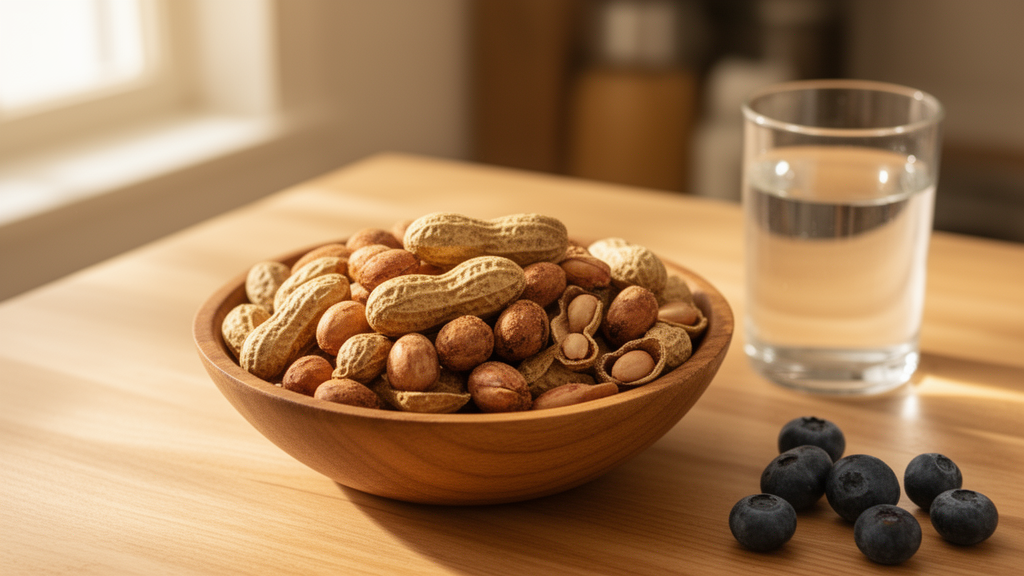
A study from the University of Barcelona and the German Institute of Human Nutrition Potsdam-Rehbruecke has found that eating peanuts was associated with favorable changes in blood lipids linked to a lower risk of type 2 diabetes. Published online in the peer-reviewed American Journal of Clinical Nutrition, the investigation evaluated how peanut consumption affects the circulating lipidome and how resulting changes associate with type 2 diabetes and cardiovascular disease. The research combined data from two primary sources: the ARISTOTLE randomized controlled clinical trial and the prospective, population-based European Prospective Investigation into Cancer and Nutrition Potsdam cohort. By integrating an intervention trial with a large prospective cohort, the researchers evaluated lipid alterations under controlled dietary intake and assessed their relation to incident disease.
The biological changes identified by the researchers largely involved a class of lipids called sphingolipids, which contained very long-chain saturated fatty acids. Unlike some other saturated fats, higher levels of very long-chain saturated fatty acids in the blood have been associated with lower type 2 diabetes risk, better heart health, and longevity in emerging research. Dr. Rosa M. Lamuela-Raventós, one of the lead researchers from the University of Barcelona, explained that the study aimed to characterize the effects of peanut consumption on the circulating lipidome and examine associations of the resulting changes with cardiovascular disease and type 2 diabetes. She emphasized that these results highlight peanuts as a source of dietary fats that may be linked to lower risk of type 2 diabetes.
The clinical trial component, designated as the ARISTOTLE trial, employed a three-arm, parallel-group randomized controlled design involving 63 healthy participants, consisting of 44 females and 19 males aged 18 to 33 years. These participants were mostly students recruited from the University of Barcelona in Spain. The intervention lasted for six months, during which participants consumed either 25 grams a day of roasted peanuts with skins, two tablespoons, equal to 32 grams, a day of peanut butter, or two tablespoons, equal to 32 grams, a day of a control butter. The control butter had a similar macronutrient composition as the roasted peanuts and peanut butter but was free of phenolic compounds and fiber. Consumption of the peanut products began after a two-week, peanut-free period in advance of the study.
Throughout the intervention, participants followed their regular diet and consumed the peanut products at any time of the day. Wine, grapes, dark chocolate with more than 70% cacao, and berries were excluded due to their high levels of resveratrol, an antioxidant present in peanuts.
To examine how these lipid changes related to long-term health outcomes, the researchers incorporated prospective data from the EPIC-Potsdam study. EPIC-Potsdam included case-cohort samples for type 2 diabetes, comprising 774 cases, and cardiovascular disease, comprising 547 cases. Plasma lipids were measured preintervention and postintervention in the ARISTOTLE trial and at baseline in EPIC-Potsdam. Linear mixed models identified within-class fatty acid sums responsive to peanut fat, pooling all participants in ARISTOTLE. These responsive fatty acid sums were then combined to derive a peanut lipidomic signature, abbreviated as PeLS, in EPIC-Potsdam. Multivariable Cox models were used to estimate hazard ratios for PeLS and individual lipids with incident type 2 diabetes and cardiovascular disease, while hypothesis-generating mediation by body mass index was assessed.
The researchers found that the six-month intervention resulted in changes in the blood lipid profile of participants, which included an increased circulation of very long-chain saturated fatty acids. In the larger population study, these peanut-related changes in blood lipids were associated with an 11% lower risk of developing type 2 diabetes. Body mass index appeared to explain much of this relationship, suggesting that weight management may play an important role in the connection between peanut consumption and metabolic health.
The investigation was conducted by Dr. Inés Domínguez-López and her team in the Department of Molecular Epidemiology at the German Institute of Human Nutrition Potsdam-Rehbruecke, alongside Dr. Rosa M. Lamuela-Raventós and her team at the University of Barcelona. The Barcelona investigators represented the Department of Nutrition, Food Sciences and Gastronomy, XIA, the School of Pharmacy and Food Sciences, the INSA-University of Barcelona, and CIBEROBN. The study appeared in The American Journal of Clinical Nutrition under the title Peanuts-derived plasma lipids and lower risk of type 2 diabetes: association mediated by body mass index—an intervention and case-cohort study.
The ARISTOTLE study was supported by funding from The Peanut Institute Foundation. In line with the study disclosures, the funding entity did not have a role in the study design, implementation, analysis or interpretation of the data, or the writing of the manuscript.
Subject of Research: Peanut consumption, circulating lipidomic alterations, and type 2 diabetes risk
Article Title: New Findings Explore How Peanuts May Help Lower Type 2 Diabetes Risk
Article References: New Findings Explore How Peanuts May Help Lower Type 2 Diabetes Risk. Original publication (Bibliographic details unavailable.)
Image Credits: AI Generated
DOI: Not provided
Keywords: Peanuts, Peanut Butter, Type 2 Diabetes, Circulating Lipidome, Sphingolipids, Very Long-Chain Saturated Fatty Acids, ARISTOTLE Trial, EPIC-Potsdam, Peanut Lipidomic Signature, Body Mass Index, Cardiovascular Disease, Dietary Fats, Metabolic Health, University of Barcelona, German Institute of Human Nutrition, Randomized Controlled Trial, Case-Cohort Study, Resveratrol
News Source: Daisy Hatcher. (November 11, 2026). Peanut Consumption Alters Circulating Lipids Linked to Lower Type 2 Diabetes Risk. Scienmag.