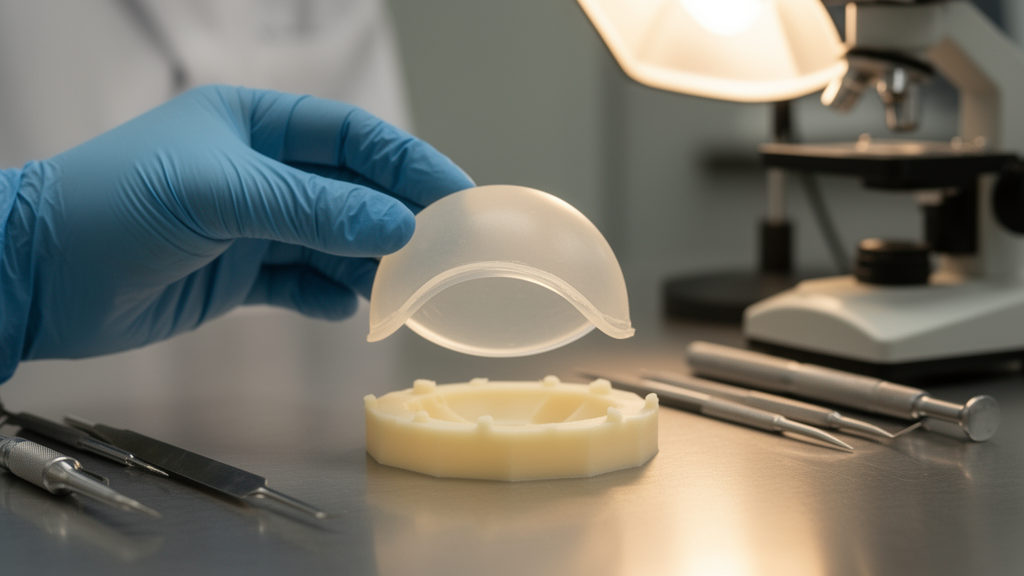
Silicone drug delivery implants have become a mainstay of long-acting therapy, yet making them consistently remains surprisingly difficult. Many laboratories rely on non-standardized, empirically tuned protocols that resist reproduction when a device design moves between research groups. A team led by Hyeonji Kim and Charles DeBoer, working with colleagues including Joseph M. DeSimone, has now published an open-access workflow in Discover Polymers that aims to change that. Their approach combines Digital Light Processing (DLP) 3D printing of molds, a parylene-C barrier coating that prevents silicone cure inhibition, spin-coating conditions that yield silicone walls thinner than 50 micrometers, and rheology-guided material selection, all validated with contact angle measurements, FT-IR spectroscopy, residue imaging, cross-sectional thickness analysis, and cell compatibility assays.
The device at the heart of the study is a C-shaped reservoir implant designed in the authors’ prior work to sit inside the lens capsule after cataract surgery. The curved profile follows the lens-capsule wall while leaving the central visual axis optically clear, and the C-shape allows smooth catheter injection without damaging the silicone reservoir. Because lens capsule volume varies across patients, the team aimed to maximize reservoir volume within the capsule’s capacity, which favors a thin-walled reservoir: the thinner the walls, the more internal space remains for drug. They therefore chose spin-coating as the fabrication method, planning to coat separate upper and lower molds with silicone and then align and assemble them into a hollow reservoir.
The molds themselves were printed on a Carbon M2 DLP printer using Loctite 3D IND147 photopolymer resin, selected for its high heat deflection temperature, dimensional stability, and good surface finish. Prints were made at a 25 micrometer layer height, washed, and post-cured under UV light. Several design iterations emerged from practical failures. A threaded hole intended for cracking the mold open proved unnecessary, since the mold could be broken apart by hand. More importantly, a central valve holder caused a problem during filling: air pressure prevented drug from reaching the distal end of the device. Relocating the valve and a sintered filter holder to the two ends of the C-shaped device created a fill-vent pair, in which drug delivered through the distal valve displaces air that exits through the proximal filter, ensuring full-length filling. A horizontal vent added to the mold also reduced contact with the printer’s stage plate and improved print fidelity.
Surface quality posed another challenge. Right after printing, 3D print lines were visible in the device cavity and transferred onto the device surface. Because increased surface roughness can promote unintended tissue interactions, the researchers applied a thin layer of uncured Loctite resin to the device cavity and performed an overnight UV exposure, producing a visibly smooth mold surface. But a deeper problem remained: the 3D-printed mold material interfered with platinum-catalyzed silicone cure, a phenomenon known as cure inhibition, likely caused by residual monomers or crosslinkers in the resin. The silicone simply did not cure properly on these surfaces. Commercial mold-release chemicals blocked the inhibition but discolored the silicone with a black tint and required multiple washing steps before any in vivo use could be contemplated.
The solution was parylene-C, a biocompatible polymer widely used in micro-electro-mechanical systems for in vivo applications. Using chemical vapor deposition, the team deposited a pinhole-free layer of approximately 5 micrometers on the mold surface in a single cycle with 8 grams of precursor. Because the layer is only micron-thick, it does not significantly disrupt mold architecture, while its continuity prevents uncured monomers from interacting with the silicone during or after curing. To verify that the coating actually improved mold performance, the researchers compared coated molds against uncoated printed molds with a battery of quantitative tests.
Static water contact angle measurements showed the coated surface was significantly more hydrophobic than the uncoated surface, at 90.32 degrees plus or minus 2.60 degrees versus 68.53 degrees plus or minus 12.24 degrees, a difference the authors report as statistically significant with p equal to 0.0350. The droplet on the uncoated mold spread into a flatter cap, while the droplet on the coated mold remained more spherical, and the coated samples showed a cleaner contact line with less pinning. FT-IR spectroscopy of silicone films cured on each surface told a complementary story. Both groups showed the characteristic silicone absorbance bands, but the Si-O-Si stretching region resolved into two bands near 1000 and 1100 per centimeter, associated with more linear and more densely networked siloxane structures respectively. Films cured on uncoated molds showed a relatively stronger 1000 per centimeter band, whereas films from coated molds showed a dominant 1100 per centimeter band, consistent with more extensive crosslinking on the coated surfaces.
Residue testing reinforced the picture. Silicone films cured on uncoated molds left substantial residue on a clean silicon wafer, while films from coated molds left no detectable residue, and image analysis confirmed that the background-corrected integrated density of residue was significantly higher for wafers contacted by films from uncoated molds. Rheological time-sweep measurements added quantitative support: samples cured on uncoated surfaces showed a slightly delayed curing onset and reached a lower final complex modulus of 0.81 megapascals, compared with 0.96 megapascals for control samples cured on coated surfaces, suggesting suppressed crosslinked network formation. Scanning electron microscopy likewise showed more surface irregularity in devices made with uncoated molds and a smoother, more uniform surface with the coated molds.
Material choice mattered as much as mold chemistry. The team compared two medical-grade silicones, MED-4210, a translucent crosslinked elastomer commonly used for implantable devices, and MED-6033, a clear, low-consistency silicone with a longer work time. Rheological testing at 0, 1, 2, and 3 hours after mixing showed that MED-4210 exhibits shear-thinning behavior with rapid viscosity build-up over time, indicating a progressively narrowing coating window, while MED-6033 behaved nearly Newtonian at early time points with only gradual structural evolution. However, process-relevant stepped oscillatory tests revealed that MED-6033 showed greater relaxation and viscous-dominant behavior under the low-frequency, post-spin conditions relevant to flow and leveling, which can cause gravity-dependent flow after spinning, thickening the cavity bottom and thinning the walls. MED-4210, with faster network formation, stronger elastic response, and more stable viscoelastic behavior, better suppressed post-spin flow and preserved pattern fidelity, and was therefore selected for device fabrication.
With parylene-C-coated molds and MED-4210 silicone, the researchers fabricated devices that matched the intended design: a hollow C-shaped structure with a silicone valve at one end and a stainless-steel filter at the other. Cross-sectional analysis showed reservoir wall thicknesses on the order of tens of micrometers, decreasing with increasing spin speed, consistent with expected spin-coating behavior. A second spin performed after placing the valve and filter frequently tilted the inserts and caused leakage, and higher speeds produced walls so thin they tore during demolding. The team therefore omitted the post-assembly spin and set the first spin to 6000 revolutions per minute, which gave the highest step-by-step fabrication success rates. Hexane extraction showed that residual extractable silicone content decreased with longer curing, with the 30-minute group higher than the 1-hour and 2-hour groups, and a 1-hour cure was selected to balance cure quality and throughput while preserving sufficient extensibility for handling and implantation.
The validation extended to biology. A live/dead assay using corneal epithelial cells showed high cell viability in contact with the device, which the authors report as indicating excellent cytocompatibility of the materials and process. Accelerated aging tests, in which devices were incubated for one week in phosphate-buffered saline at 67 degrees Celsius, detected no changes in device curvature, surface morphology, or integrity, suggesting robust shape retention under simulated physiological conditions. The authors are careful to frame what remains: future work will add multi-batch studies across laboratories, verify performance after sterilization and in vivo, and systematically characterize pharmaceutical release against filter porosity, membrane thickness, and curing conditions. For now, the published workflow offers other laboratories a transferable reference for making consistent thin-walled silicone implants, potentially extending beyond the eye to other implantation sites and even non-implantable thin-walled silicone devices.
Subject of Research: Fabrication of thin-walled silicone ocular drug delivery implants using parylene-C coated 3D-printed molds
Article Title: Fabrication techniques for thin-walled silicone ocular implants using parylene-C coated 3D-printed molds
Article References: Kim, H., Hong, W., Abdollahramezani, S., Raja, D., Wise, R., Coates, I., DeSimone, J. M., & DeBoer, C. (2026). Fabrication techniques for thin-walled silicone ocular implants using parylene-C coated 3D-printed molds. Discover Polymers, 3(1), Article 24. https://doi.org/10.1007/s44347-026-00063-7
Image Credits: AI Generated
DOI: 10.1007/s44347-026-00063-7
Keywords: silicone implants, ocular drug delivery, parylene-C, 3D-printed molds, spin-coating, cure inhibition, rheology, cytocompatibility, DLP printing, drug delivery reservoir, lens capsule, biocompatibility
News Source: Denise Maddox. (October 29, 2026). Parylene-C Coated 3D-Printed Molds Enable Thin-Walled Silicone Ocular Implants. Scienmag.