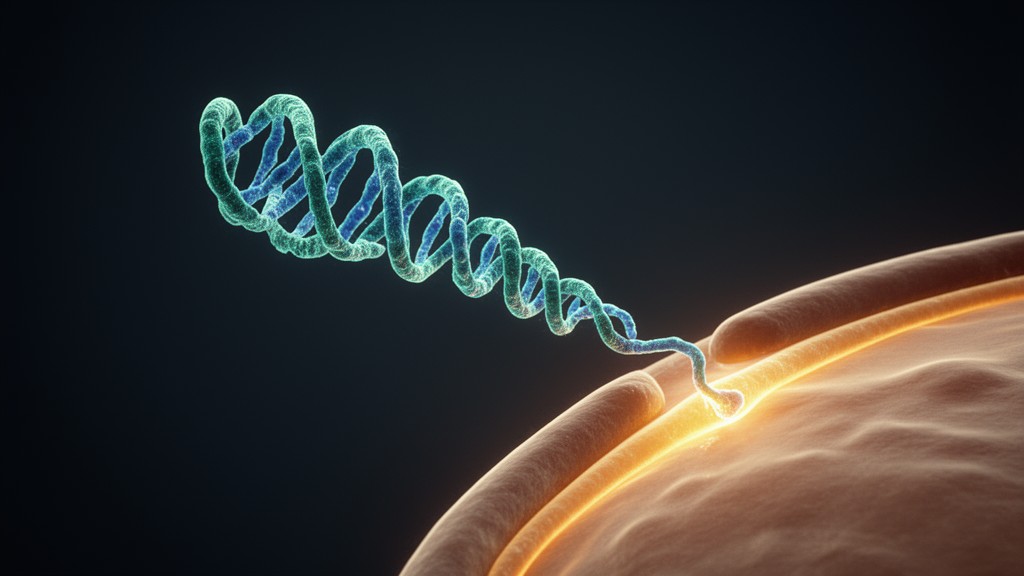
A tiny tail at one end of a parasite protein has turned out to be the linchpin of its entire molecular behavior, according to a new study published in PLOS Pathogens. The protein in question, alpha-1 giardin, belongs to a family of membrane-binding molecules found in Giardia lamblia, the single-celled intestinal parasite responsible for giardiasis, one of the most common diarrheal diseases worldwide. Researchers led by Dawid Warmus and Carmen Faso at the University of Bern, together with collaborators including Özlem Tastan Bishop, report that removing or altering the short N-terminal region of alpha-1 giardin disrupts both its ability to cluster into larger assemblies and its capacity to bind lipid membranes. Because alpha-1 giardin is already considered a leading vaccine candidate against giardiasis, understanding precisely how it works at the molecular level could shape the next generation of antiparasitic strategies.
Annexins, the protein family to which alpha-giardins belong, are a fascinating group of molecules conserved across nearly all eukaryotic life, from single-celled parasites to human cells. Their defining feature is a calcium-dependent ability to attach to phospholipid membranes, which allows them to participate in processes such as membrane repair, vesicle trafficking, and endocytosis. Unusually, annexins in many organisms also appear in unconventional protein secretion, a poorly understood pathway through which proteins lacking classical signal peptides still manage to reach the cell exterior. In Giardia, this phenomenon is particularly striking: the parasite’s annexins, called alpha-giardins, carry no signal sequences at all, yet they are reliably detected on the parasite surface and in its secretome, the full complement of proteins it releases into its environment.
Giardia lamblia possesses an unusually large annexin family for a single-celled organism, comprising twenty-one alpha-giardin proteins. This abundance raises an obvious question: why does a parasite with a streamlined genome devote so much of it to membrane-binding proteins? The new study suggests the answer lies in the specialized biology of the parasite’s endo-lysosomal system. The researchers found that alpha-giardins localize to peripheral endocytic compartments and peripheral vacuoles, abbreviated PECs-PVs, which are organelles positioned just beneath the parasite membrane where endocytosis, digestion, and possibly protein release converge. These compartments have long been suspected of playing a role in how Giardia exports proteins without the conventional secretory machinery that other eukaryotes use.
To probe what alpha-giardins actually do at these membranes, the team deployed a battery of complementary techniques. Lipid-binding assays revealed which membrane compositions the proteins prefer, while cross-linking mass spectrometry captured snapshots of the protein complexes they form in solution. Structural modelling filled in the three-dimensional context, showing how conserved calcium-binding sites and more divergent surface features might govern membrane engagement. A key finding to emerge from this systems-level view was that alpha-giardins participate in multiprotein complexes that are enriched in substrates of unconventional protein secretion, directly linking the parasite’s annexin family to the mysterious export pathway that has puzzled parasitologists for years.
The centerpiece of the study, however, is alpha-1 giardin itself. As a putative virulence factor and one of the most advanced vaccine candidates against giardiasis, this protein has attracted considerable attention, yet its basic molecular mechanics remained unresolved. The researchers combined site-directed mutagenesis, in which specific amino acids are deliberately changed, with confocal microscopy to watch where mutant versions of the protein travel inside living parasites, and with mass photometry, a sensitive technique that weighs individual protein assemblies in solution, to determine how the mutations affect oligomerization. The results converged on a single conclusion: the short N-terminal region, a stretch of amino acids preceding the conserved annexin core, is essential for both oligomer formation and membrane association.
This N-terminal dependence is notable because annexins are traditionally described as self-contained membrane-binding modules whose activity is regulated primarily by calcium. The new data suggest that in alpha-1 giardin, and possibly in other parasitic annexin orthologues, the N-terminus acts as a regulatory appendage that controls whether the protein exists as a monomer or an oligomer, and consequently how strongly it engages lipid bilayers. Mass photometry measurements showed that disrupting the N-terminus shifted the protein’s oligomeric state, while confocal imaging of mutant parasites revealed mislocalization away from the peripheral endocytic compartments where the wild-type protein accumulates. In other words, a relatively small piece of sequence at one end of the protein orchestrates its entire cellular address book.
To understand how this regulation might work in a dynamic, membrane-rich environment, the team integrated their experimental findings with molecular dynamics simulations. These computational models, which track the motion of individual atoms over time, revealed how the oligomeric state of alpha-1 giardin could influence its membrane occupancy at PECs-PV membranes. The picture that emerges is of a protein whose clustering and membrane binding are coupled: oligomerization may increase avidity for membranes, allowing alpha-1 giardin to accumulate at specific endo-lysosomal sites, while changes in the local environment could shift the equilibrium back toward dispersal. Such a mechanism would give the parasite a tunable way to control where its annexins act, and by extension, how proteins are routed through unconventional secretion.
The implications extend beyond basic cell biology. Giardiasis affects hundreds of millions of people, particularly children in regions with limited access to clean water, and drug resistance to existing therapies such as metronidazole is an increasing concern. Vaccines against Giardia have proven difficult to develop, partly because the parasite is a master of antigenic variation, constantly reshuffling the surface proteins it displays. Alpha-1 giardin has remained attractive as a vaccine target precisely because it is conserved and exposed at the parasite surface, and the new structural insights into how it oligomerizes and binds membranes could inform the design of immunogens that present the most vulnerable, functionally constrained surfaces of the protein to the immune system.
There is also a broader evolutionary story embedded in these findings. The fact that Giardia, an early-branching eukaryote, uses an annexin family in unconventional protein secretion hints that this export pathway may be ancient, predating the elaborate secretory machinery of more derived organisms. By defining the molecular rules that govern alpha-giardin behavior, including the pivotal role of the N-terminal region, the study provides a mechanistic foothold for exploring how unconventional secretion operates in other pathogens as well. The authors suggest that their combined experimental and computational framework, spanning lipid assays, cross-linking mass spectrometry, mass photometry, mutagenesis, imaging, and molecular dynamics, could serve as a template for dissecting annexin function in any organism where these enigmatic proteins operate outside the canonical rules.
What remains to be seen is whether the N-terminal mechanism identified in alpha-1 giardin generalizes across the other twenty alpha-giardins, each of which may have evolved distinct regulatory features suited to different membrane environments within the parasite. The study’s comparative analysis of conserved and divergent features among family members suggests that while the core annexin fold is shared, the peripheral elements that tune oligomerization and membrane affinity vary considerably. For now, the work stands as a detailed molecular portrait of a vaccine candidate in action, showing that even a short tail of amino acids can carry decisive weight in the life of a parasite protein, and that understanding such details may one day translate into better tools against one of humanity’s most persistent intestinal foes.
Subject of Research: The role of the N-terminus of alpha-1 giardin in oligomerization and lipid binding in Giardia lamblia
Article Title: The N-terminus of alpha-1 giardin, a parasitic annexin orthologue, is essential for oligomerization and lipid-binding activity
Article References: Warmus, D., Wirdnam, C. D., Balmer, E. A., Muronzi, T., Heller, M., Bishop, Ö. T., & Faso, C. (2026). The N-terminus of alpha-1 giardin, a parasitic annexin orthologue, is essential for oligomerization and lipid-binding activity. PLOS Pathogens, 22(10), e1014407. https://doi.org/10.1371/journal.ppat.1014407
Image Credits: AI Generated
DOI: 10.1371/journal.ppat.1014407
Keywords: Giardia lamblia, alpha-1 giardin, annexins, unconventional protein secretion, oligomerization, lipid binding, mass photometry, cross-linking mass spectrometry, molecular dynamics, vaccine development, giardiasis, parasitology
News Source: Kristina Jarvis. (October 14, 2026). Parasite Protein’s Tail Holds the Key to Membrane Binding and Vaccine Design. Scienmag.