Credit: William J. Baker
Characteristics of palm trees differ from those of other tropical trees in many ways. In a major new study led by scientists at Uppsala University, Sweden, and University of Campinas, Brazil, they have surveyed the actual numbers of palms in tropical rainforests around the globe. The proportion of palm trees is important to include in calculations of forests’ potential carbon storage and in estimates of forested areas’ sensitivity to climate change.
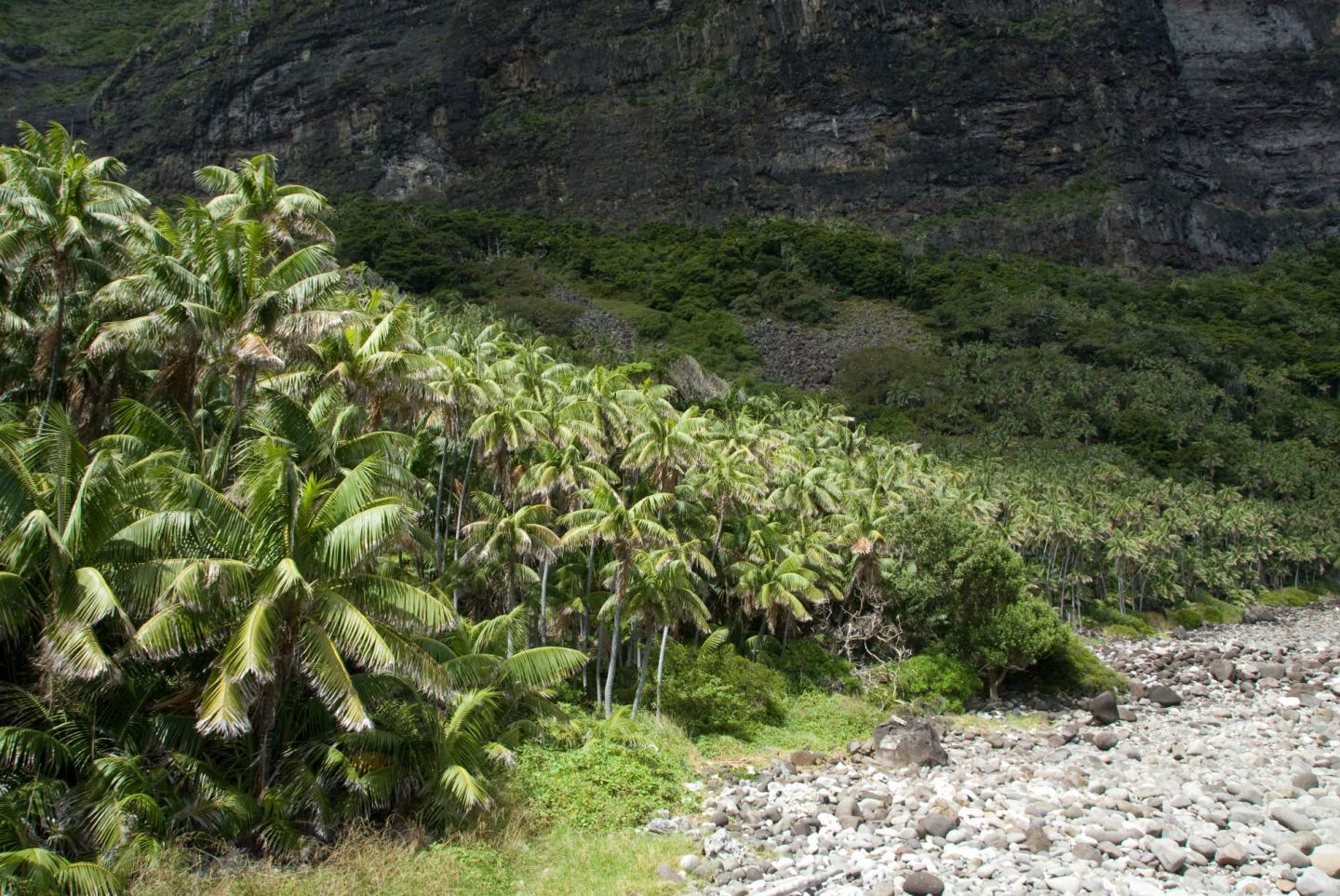
Palm trees are iconic tropical forest plants. However, postcard images of coconut palms leaning over white sandy beaches do not capture the stunning diversity of palms and their importance to humans and ecosystems. There are over 2,500 palm species and many are used by humans for food, shelter, medicine and crafts. In some areas, palms are also entirely dominant and form natural monocultures. Palms are among the most common tree species in the Amazon rainforest, but in some tropical areas they are unusual, or conspicuously absent.
Before, variation in numbers of palm trees among tropical regions had not been quantified. Now a study led by Bob Muscarella at Uppsala University in Sweden and Thaise Emilio at University of Campinas in Brazil has made the first global assessment of their numbers. Over 200 co-authors from 48 countries contributed to the scientific article.
“To get a better understanding of tropical forests and reduce uncertainty about carbon balance in these ecosystems during climate change, we summarised data to show how the number of palms vary around the world compared with other tree species,” Muscarella says.
Drawing from existing networks of forest plots (including forestplots.net, PPBio, Rainfor, AfriTRON), the researchers compiled a huge database of 2,548 plots and then quantified palm numbers relative to other tree species in the sample plots.
The study results show that in the Neotropical rainforests (such as Amazonia), palms are more than five times more numerous than in comparable Asian and African forests. Many palms were already known to prefer land with a good groundwater supply, and the new study confirmed that palm trees were more plentiful in wetter areas with less fertile soils and shallower groundwater.
Tropical rainforests are often seen as synonymous with biodiversity. However, this diversity is not evenly distributed, and most plants in a given area belong to only a handful of species. More than half of the total biomass in the Amazon rainforest is distributed among fewer than 300 tree species – including several species of palms.
“Understanding the dominant species in tropical forests is crucial to recognising how these forests function and how vulnerable they’re going to be to disturbances and climate change in the future,” Muscarella says.
Being monocotyledons (the seed produces only one first leaf, or cotyledon) palms are more closely related to grasses than to the deciduous trees of the tropics, for instance. Palms therefore differ in many fundamental ways, in anatomy and physiology, from other tropical trees. These differences may have far-reaching implications when it comes to estimating uptake and storage (sequestration) of carbon in tropical forests, as well as their resilience to climate change. The new study provides knowledge with a vital bearing on further research into both of these aspects.
“Impressive levels of palm abundance do not come as a surprise to many tropical forest researchers. Days of work may be necessary to measure all the palms of a single hectare in some places in the middle of Amazon. However, a fair representation of palms in studies of tropical forests functioning is yet to come. Showing where and when palms must be considered is a major contribution of our new study,” Emilio says.
###
Media Contact
Robert Muscarella
[email protected]
Related Journal Article
http://dx.