• HOME
  • NEWS
  • EXPLORE
    • CAREER
      • Companies
      • Jobs
    • EVENTS
    • iGEM
      • News
      • Team
    • PHOTOS
    • VIDEO
    • WIKI
  • BLOG
  • COMMUNITY
    • FACEBOOK
    • INSTAGRAM
    • TWITTER
Friday, May 15, 2026
BIOENGINEER.ORG
No Result
View All Result
  • Login
  • HOME
  • NEWS
  • EXPLORE
    • CAREER
      • Companies
      • Jobs
        • Lecturer
        • PhD Studentship
        • Postdoc
        • Research Assistant
    • EVENTS
    • iGEM
      • News
      • Team
    • PHOTOS
    • VIDEO
    • WIKI
  • BLOG
  • COMMUNITY
    • FACEBOOK
    • INSTAGRAM
    • TWITTER
  • HOME
  • NEWS
  • EXPLORE
    • CAREER
      • Companies
      • Jobs
        • Lecturer
        • PhD Studentship
        • Postdoc
        • Research Assistant
    • EVENTS
    • iGEM
      • News
      • Team
    • PHOTOS
    • VIDEO
    • WIKI
  • BLOG
  • COMMUNITY
    • FACEBOOK
    • INSTAGRAM
    • TWITTER
No Result
View All Result
Bioengineer.org
No Result
View All Result
Home NEWS Science News Biology

Oysters and clams can be farmed together

Bioengineer by Bioengineer
April 2, 2020
in Biology
Reading Time: 2 mins read
0
IMAGE
Share on FacebookShare on TwitterShare on LinkedinShare on RedditShare on Telegram

Rutgers study finds raising multiple species in the same area could benefit shellfish aquaculture
IMAGE

Credit: Michael Acquafredda/Rutgers University

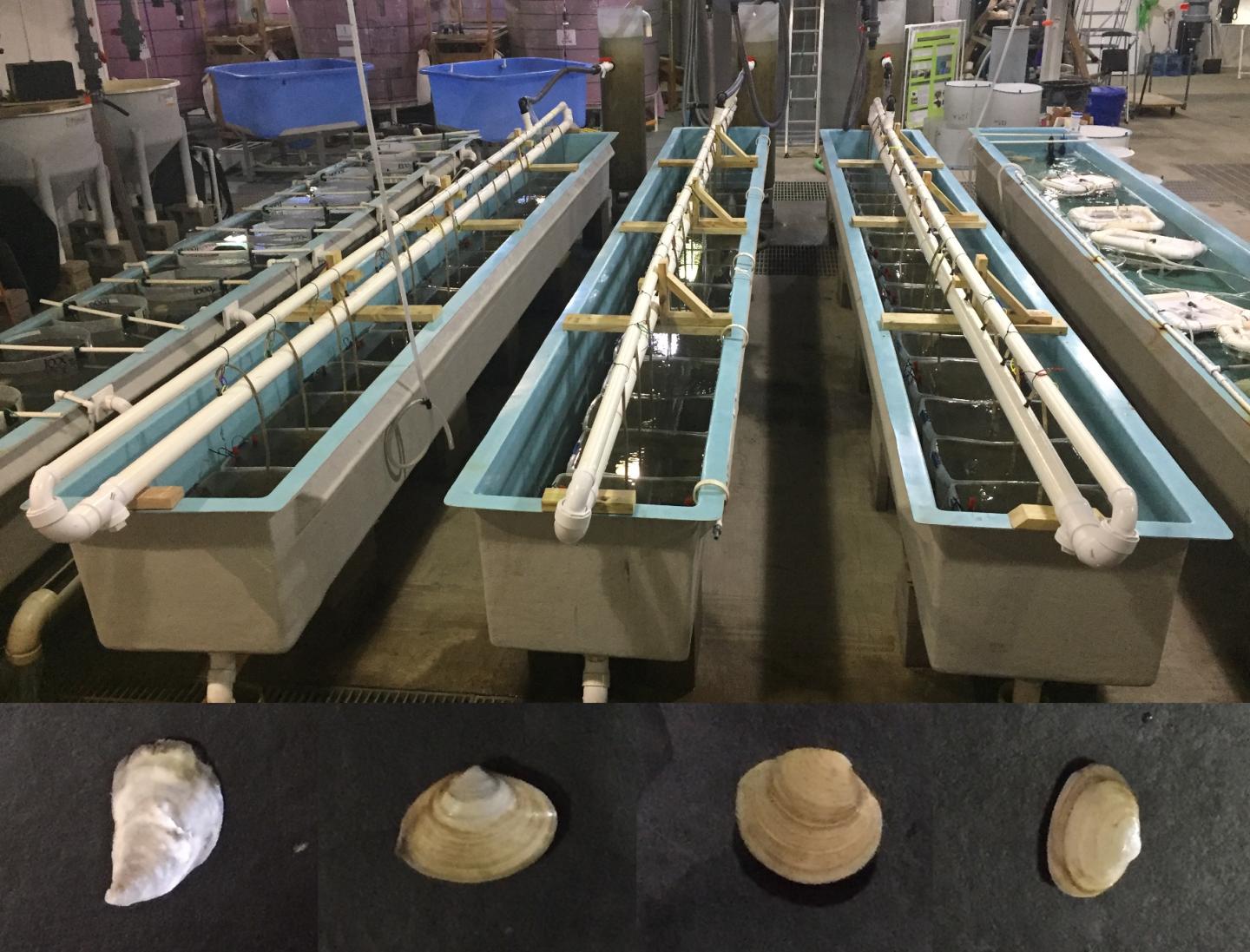
Eastern oysters and three species of clams can be farmed together and flourish, potentially boosting profits of shellfish growers, according to a Rutgers University-New Brunswick study.

Though diverse groups of species often outperform single-species groups, most bivalve farms in the United States and around the world grow their crops as monocultures, notes the study in the journal Marine Ecology Progress Series.

“Farming multiple species together can sustain the economic viability of farm operations and increase profitability by allowing shellfish growers to more easily navigate market forces if the price of each individual crop fluctuates,” said lead author Michael P. Acquafredda, a doctoral student based at Rutgers’ Haskin Shellfish Research Laboratory in Port Norris, New Jersey.

Farming mollusks such as clams, oysters and scallops contributes billions of dollars annually to the world’s economy. In the United States, more than 47 million pounds of farm-raised clam, oyster and mussel meat worth more than $340 million were harvested in 2016, the study says.

The study, which took place in a laboratory setting at Rutgers’ New Jersey Aquaculture Innovation Center in North Cape May, New Jersey, tested the feasibility of farming multiple bivalve species in close proximity to each another.

Mimicking farm conditions, the study examined the filtration rate, growth and survival of four economically and ecologically important bivalve species native to the northeastern United States. They are the Eastern oyster (Crassostrea virginica); Atlantic surfclam (Spisula solidissima); hard clam (Mercenaria mercenaria); and softshell clam (Mya arenaria).

When supplied with seawater containing naturally occurring algal particles, the groups that contained all four species removed significantly more particles than most monocultures. This suggests that each species prefers to filter a particular set of algal food particles.

“This shows that, to some degree, these bivalve species complement each other,” said co-author Daphne Munroe, an associate professor in the Department of Marine and Coastal Sciences in the School of Environmental and Biological Sciences. She is based at the Haskin Shellfish Research Laboratory.

The scientists also found virtually no differences in growth or survival for any of the four species, suggesting that when food is not an issue, these bivalves could be raised together without outcompeting each another.

“This study illustrates the benefits of diversifying crops on shellfish farms,” Acquafredda said. “Crop diversification gives aquaculture farmers protection from any individual crop failure, whether it’s due to disease, predation or fluctuating environmental conditions. In future studies, the feasibility of bivalve polyculture should be tested on commercial bivalve farms.”

###

Media Contact
Todd Bates
[email protected]

Original Source

https://www.rutgers.edu/news/oysters-and-clams-can-be-farmed-together

Related Journal Article

http://dx.doi.org/10.3354/meps13266

Tags: AgricultureDiet/Body WeightEcology/EnvironmentEnvironmental HealthFisheries/AquacultureFood/Food ScienceMarine/Freshwater BiologyNutrition/Nutrients
Share12Tweet8Share2ShareShareShare2

Related Posts

Single mother must adapt swiftly — the survival of her colony depends on it — Biology

Single mother must adapt swiftly — the survival of her colony depends on it

May 15, 2026
Why Are Nearly Everyone Right-Handed? It Might Be Linked to How We Learned to Walk — Biology

Why Are Nearly Everyone Right-Handed? It Might Be Linked to How We Learned to Walk

May 15, 2026

Excessive Neuronal Activity Initiates Severe Autoimmune Brain Disorder

May 15, 2026

Precision Anti-Aging Strategies Focus on Eliminating Harmful Senescent Cells While Preserving Beneficial Ones

May 15, 2026
Please login to join discussion

POPULAR NEWS

  • Research Indicates Potential Connection Between Prenatal Medication Exposure and Elevated Autism Risk

    843 shares
    Share 337 Tweet 211
  • New Study Reveals Plants Can Detect the Sound of Rain

    730 shares
    Share 291 Tweet 182
  • Salmonella Haem Blocks Macrophages, Boosts Infection

    62 shares
    Share 25 Tweet 16
  • Breastmilk Balances E. coli and Beneficial Bacteria in Infant Gut Microbiomes

    58 shares
    Share 23 Tweet 15

About

We bring you the latest biotechnology news from best research centers and universities around the world. Check our website.

Follow us

Recent News

Nurse Care Reduces Hospital Use in Multimorbid Patients

Epinephrine vs. Saline in Neonatal Resuscitation Study

Hepatitis C Elimination via Risk-Based Screening, Decentralized Care

Subscribe to Blog via Email

Enter your email address to subscribe to this blog and receive notifications of new posts by email.

Join 82 other subscribers
  • Contact Us

Bioengineer.org © Copyright 2023 All Rights Reserved.

Welcome Back!

Login to your account below

Forgotten Password?

Retrieve your password

Please enter your username or email address to reset your password.

Log In
No Result
View All Result
  • Homepages
    • Home Page 1
    • Home Page 2
  • News
  • National
  • Business
  • Health
  • Lifestyle
  • Science

Bioengineer.org © Copyright 2023 All Rights Reserved.