• HOME
  • NEWS
  • EXPLORE
    • CAREER
      • Companies
      • Jobs
    • EVENTS
    • iGEM
      • News
      • Team
    • PHOTOS
    • VIDEO
    • WIKI
  • BLOG
  • COMMUNITY
    • FACEBOOK
    • INSTAGRAM
    • TWITTER
Friday, June 12, 2026
BIOENGINEER.ORG
No Result
View All Result
  • Login
  • HOME
  • NEWS
  • EXPLORE
    • CAREER
      • Companies
      • Jobs
        • Lecturer
        • PhD Studentship
        • Postdoc
        • Research Assistant
    • EVENTS
    • iGEM
      • News
      • Team
    • PHOTOS
    • VIDEO
    • WIKI
  • BLOG
  • COMMUNITY
    • FACEBOOK
    • INSTAGRAM
    • TWITTER
  • HOME
  • NEWS
  • EXPLORE
    • CAREER
      • Companies
      • Jobs
        • Lecturer
        • PhD Studentship
        • Postdoc
        • Research Assistant
    • EVENTS
    • iGEM
      • News
      • Team
    • PHOTOS
    • VIDEO
    • WIKI
  • BLOG
  • COMMUNITY
    • FACEBOOK
    • INSTAGRAM
    • TWITTER
No Result
View All Result
Bioengineer.org
No Result
View All Result
Home NEWS Science News Chemistry

Over 14% efficiency for ternary organic solar cell with 300 nm thick active layer

Bioengineer by Bioengineer
September 18, 2019
in Chemistry
Reading Time: 2 mins read
0
IMAGE
Share on FacebookShare on TwitterShare on LinkedinShare on RedditShare on Telegram

IMAGE

Credit: ©Science China Press

Organic solar cells (OSCs) have drawn great attention due to their advantages of making large area and flexible solar panels through the low-cost solution coating methods. Recently, the single-junction OSCs with over 16% power conversion efficiency (PCE) have been reported. However, photovoltaic performance of these cells is very sensitive to the variation in the active layer thickness, which has been recognized as a big challenge for practical application of OSCs.

The photovoltaic performance of OSCs is determined by open-circuit voltage (VOC), short-circuit current density (JSC) and fill factor (FF). For the current high efficiency non-fullerene-based system, the efficiency of OSCs usually shows a sharp drop in FF upon increasing the thickness of the active layer. Such FF drops are generally caused by poor and imbalanced charge transport, which results in enhanced bimolecular charge recombination and the formation of space charge in thicker films.

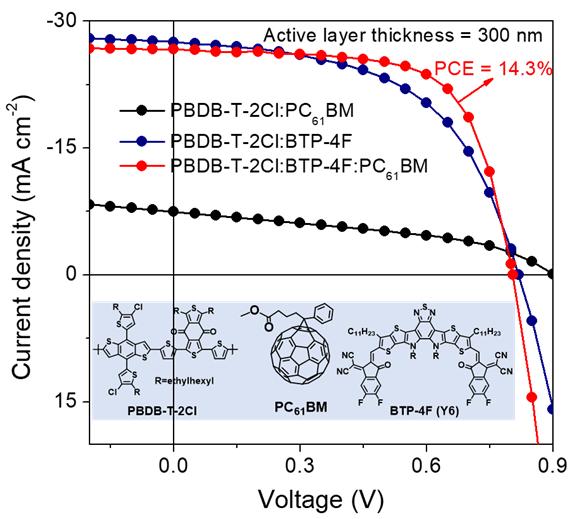
Very recently, Professor Jianhui Hou’s group in Institute of Chemistry Chinese Academy of Sciences demonstrated a thick-film (300 nm) ternary OSC with a power conversion efficiency of 14.3%. This excellent photovoltaic performance is achieved by introducing phenyl-C61-butyric-acid-methyl ester (PC61BM) into a PBDB-T-2Cl: BTP-4F host blend. They found that the addition of PC61BM is helpful for improving the hole and electron mobilities, and thus facilitates charge transport in the thick active layers, leading to the improved efficiencies of OSCs. Their results illustrate that introducing fullerene derivative as a third component is a facile and effective strategy to realize efficient thick-film OSCs.

###

This work was supported by the National Natural Science Foundation of China (21835006, 21704004, 91633301, 51673201), the Chinese Academy of Sciences (KJZD-EW-J01), the Innovation Project supported by Beijing National Laboratory for Molecular Sciences (BNLMS-CXXM-201903)

See the article: Ma L, Xu Y, Zu Y, Liao Q, Xu B, An C, Zhang S, Hou J. A ternary organic solar cell with 300 nm thick active layer shows over 14% efficiency. Sci. China Chem., 2019, 62, DOI: 10.1007/s11426-019-9556-7.

https://link.springer.com/article/10.1007/s11426-019-9556-7

Media Contact
Shaoqing Zhang
[email protected]

Related Journal Article

http://dx.doi.org/10.1007/s11426-019-9556-7

Tags: Chemistry/Physics/Materials Sciences
Share13Tweet8Share2ShareShareShare2

Related Posts

Copper Catalysts Enable Precise Pyrazole Arylation — Chemistry

Copper Catalysts Enable Precise Pyrazole Arylation

June 12, 2026
Dual-action catalyst harnesses single photon to convert CO₂ and biowaste simultaneously — Chemistry

Dual-action catalyst harnesses single photon to convert CO₂ and biowaste simultaneously

June 12, 2026

Adaptive Countermeasures: Tackling Future Black-Market Drugs Beyond Fentanyl

June 12, 2026

HKU Chemists Crack the Code to Creating Ultra-Tough, Highly Responsive “Smart” Materials

June 12, 2026
Please login to join discussion

POPULAR NEWS

  • ESMO 2025: mRNA COVID Vaccines Enhance Efficacy of Cancer Immunotherapy

    324 shares
    Share 130 Tweet 81
  • Saying Goodbye to PGY-6: Pediatric Fellowship Realities

    96 shares
    Share 38 Tweet 24
  • Multi-Hospital Study Reveals Long Covid Burden Is Twice as High as Current Estimates

    90 shares
    Share 36 Tweet 22
  • Common Food Preservatives Associated with Elevated Blood Pressure and Increased Heart Disease Risk

    58 shares
    Share 23 Tweet 15

About

We bring you the latest biotechnology news from best research centers and universities around the world. Check our website.

Follow us

Recent News

Modeling Child Growth Dynamics Using P-Splines

Industrial Overcapacity Boosts Seasonal Electricity Flexibility

Gut Phage Molecular Anchors: A New Frontier for Therapeutic Innovation

Subscribe to Blog via Email

Enter your email address to subscribe to this blog and receive notifications of new posts by email.

Join 82 other subscribers
  • Contact Us

Bioengineer.org © Copyright 2023 All Rights Reserved.

Welcome Back!

Login to your account below

Forgotten Password?

Retrieve your password

Please enter your username or email address to reset your password.

Log In
No Result
View All Result
  • Homepages
    • Home Page 1
    • Home Page 2
  • News
  • National
  • Business
  • Health
  • Lifestyle
  • Science

Bioengineer.org © Copyright 2023 All Rights Reserved.