• HOME
  • NEWS
  • EXPLORE
    • CAREER
      • Companies
      • Jobs
    • EVENTS
    • iGEM
      • News
      • Team
    • PHOTOS
    • VIDEO
    • WIKI
  • BLOG
  • COMMUNITY
    • FACEBOOK
    • INSTAGRAM
    • TWITTER
Monday, September 28, 2026
BIOENGINEER.ORG
No Result
View All Result
  • Login
  • HOME
  • NEWS
  • EXPLORE
    • CAREER
      • Companies
      • Jobs
        • Lecturer
        • PhD Studentship
        • Postdoc
        • Research Assistant
    • EVENTS
    • iGEM
      • News
      • Team
    • PHOTOS
    • VIDEO
    • WIKI
  • BLOG
  • COMMUNITY
    • FACEBOOK
    • INSTAGRAM
    • TWITTER
  • HOME
  • NEWS
  • EXPLORE
    • CAREER
      • Companies
      • Jobs
        • Lecturer
        • PhD Studentship
        • Postdoc
        • Research Assistant
    • EVENTS
    • iGEM
      • News
      • Team
    • PHOTOS
    • VIDEO
    • WIKI
  • BLOG
  • COMMUNITY
    • FACEBOOK
    • INSTAGRAM
    • TWITTER
No Result
View All Result
Bioengineer.org
No Result
View All Result
Home NEWS Science News Chemistry

Out of many COVID-19 tests, which one to choose?

Bioengineer by Bioengineer
December 1, 2020
in Chemistry
Reading Time: 3 mins read
0
IMAGE
Share on FacebookShare on TwitterShare on LinkedinShare on RedditShare on Telegram

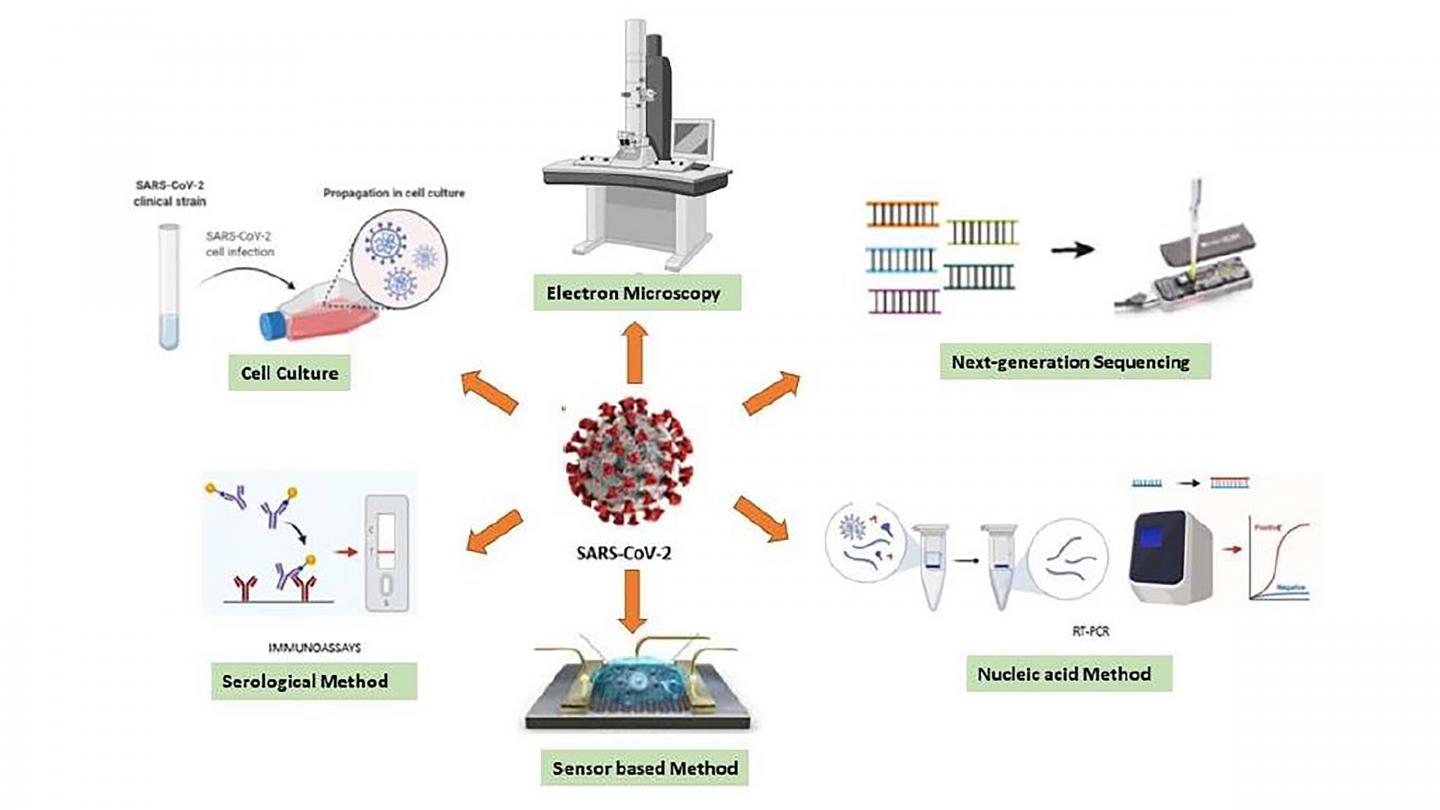
Different diagnostic techniques are appropriate at different stages of coronavirus infection. Using the right one is crucial for rapid diagnosis to help end the pandemic.
IMAGE

Credit: Saadet Alpdagtas and Elif Ilhan

WASHINGTON, December 1, 2020 — Until a vaccine is available, curbing the coronavirus pandemic relies heavily on how quickly a potentially exposed individual can be tested and quarantined. However, the current diagnostic techniques vary in reliability and relevance, so an understanding of which test is most appropriate for a given circumstance is necessary to avoid false reports.

Researchers from Van Yuzuncu Yil University, Marmara University, Yildiz Technical University, and Istanbul Yeni Yuzyil University evaluated the available diagnostic techniques and determined key steps required for better testing moving forward. They present their findings in the journal APL Bioengineering, from AIP Publishing.

“Rapid diagnosis and rapid isolation are the key factors for prevention of the pandemic,” said Oguzhan Gunduz, one of the authors.

Laboratory tests that target the virus’s genes — known as real-time reverse transcription-polymerase chain reaction assays — are currently the gold standard for testing. But according to the Food and Drug Administration, these could give false negatives.

These tests depend on the presence of antibodies, which may not have yet been developed in the early stages of infection. Since different antibodies appear at different stages, diagnostic tests must be chosen to target the appropriate immune response based on when an individual is believed to have been infected.

“There is not any available single test for the entire stage of the disease,” Gunduz said. “However, I think it may be possible to detect the attack at any stage of the disease with nano-based sensor technologies.”

The group emphasizes point-of-care testing as an urgent objective. These types of tests would help detect the virus on site without the need for laboratory equipment or specialized personnel, eliminating or reducing the wait time between testing and obtaining results.

“A quite sensitive test that can measure the existent tiny number of viral particles, or any parameter related to the particle — weight, structure, charge, diameter — can provide rapid and early diagnosis,” said Gunduz.

When asked about the potential for a more comfortable testing method, he stressed that this depends on the sampling method and its sensitivity. A fingertip blood test or a saliva test could potentially be underway, though these have their own drawbacks.

“There are such tests, but they come up with accuracy and specificity issues,” Gunduz said.

###

The article, “Evaluation of current diagnostic methods for COVID-19,” is authored by Saadet Alpdagtas, Elif Ilhan, Ebru Uysal, Mustafa Sengor, Cem Bülent Üstünda?, and Oguzhan Gunduz. The article will appear in AIP Bioengineering on Dec. 1, 2020 (DOI: 10.1063/5.0021554). After that date, it can be accessed at https://aip.scitation.org/doi/10.1063/5.0021554.

ABOUT THE JOURNAL

APL Bioengineering is an open access journal publishing significant discoveries specific to the understanding and advancement of physics and engineering of biological systems. See http://aip.scitation.org/journal/apb.

Media Contact
Larry Frum
[email protected]

Related Journal Article

http://dx.doi.org/10.1063/5.0021554

Tags: BiologyBiomechanics/BiophysicsChemistry/Physics/Materials SciencesDiagnosticsEpidemiologyInfectious/Emerging DiseasesMedicine/HealthVirology
Share12Tweet8Share2ShareShareShare2

Related Posts

Sponge-Powered Reactor Keeps Fish Farm Water Clean Without Water Exchanges

Sponge-Powered Reactor Keeps Fish Farm Water Clean Without Water Exchanges

September 27, 2026
Scientists Turn Chemistry Into a Single Number That Measures the Complexity of Chinese Baijiu Aroma

Scientists Turn Chemistry Into a Single Number That Measures the Complexity of Chinese Baijiu Aroma

September 27, 2026

Strontium-Doped Bioactive Glass Turns Everyday Friction Into a Water-Cleaning Powerhouse

September 27, 2026

Quantum Simulations Reveal the Hidden Electronic Architecture of Methisazone

September 26, 2026
Please login to join discussion

POPULAR NEWS

  • Trunk Control May Hold a Key to Balance and Fall Risk in Older Adults

    29 shares
    Share 12 Tweet 7
  • AI Tells Doctors When It Is Unsure About Cancer Treatment Success

    29 shares
    Share 12 Tweet 7
  • Engineered mini CRISPR enzyme gets a 60-fold power boost for gene editing

    29 shares
    Share 12 Tweet 7
  • When Autism Diagnoses Fade: Early Intervention and Milder Symptoms Mark Children Who Lose the Label

    29 shares
    Share 12 Tweet 7

About

We bring you the latest biotechnology news from best research centers and universities around the world. Check our website.

Follow us

Recent News

Trunk Control May Hold a Key to Balance and Fall Risk in Older Adults

AI Tells Doctors When It Is Unsure About Cancer Treatment Success

Engineered mini CRISPR enzyme gets a 60-fold power boost for gene editing

Subscribe to Blog via Email

Enter your email address to subscribe to this blog and receive notifications of new posts by email.

Join 85 other subscribers
  • Contact Us

Bioengineer.org © Copyright 2023 All Rights Reserved.

Welcome Back!

Login to your account below

Forgotten Password?

Retrieve your password

Please enter your username or email address to reset your password.

Log In
No Result
View All Result
  • Homepages
    • Home Page 1
    • Home Page 2
  • News
  • National
  • Business
  • Health
  • Lifestyle
  • Science

Bioengineer.org © Copyright 2023 All Rights Reserved.