• HOME
  • NEWS
  • EXPLORE
    • CAREER
      • Companies
      • Jobs
    • EVENTS
    • iGEM
      • News
      • Team
    • PHOTOS
    • VIDEO
    • WIKI
  • BLOG
  • COMMUNITY
    • FACEBOOK
    • INSTAGRAM
    • TWITTER
Saturday, February 7, 2026
BIOENGINEER.ORG
No Result
View All Result
  • Login
  • HOME
  • NEWS
  • EXPLORE
    • CAREER
      • Companies
      • Jobs
        • Lecturer
        • PhD Studentship
        • Postdoc
        • Research Assistant
    • EVENTS
    • iGEM
      • News
      • Team
    • PHOTOS
    • VIDEO
    • WIKI
  • BLOG
  • COMMUNITY
    • FACEBOOK
    • INSTAGRAM
    • TWITTER
  • HOME
  • NEWS
  • EXPLORE
    • CAREER
      • Companies
      • Jobs
        • Lecturer
        • PhD Studentship
        • Postdoc
        • Research Assistant
    • EVENTS
    • iGEM
      • News
      • Team
    • PHOTOS
    • VIDEO
    • WIKI
  • BLOG
  • COMMUNITY
    • FACEBOOK
    • INSTAGRAM
    • TWITTER
No Result
View All Result
Bioengineer.org
No Result
View All Result
Home NEWS Science News Chemistry

Origami powered by light

Bioengineer by Bioengineer
February 10, 2021
in Chemistry
Reading Time: 2 mins read
0
IMAGE
Share on FacebookShare on TwitterShare on LinkedinShare on RedditShare on Telegram

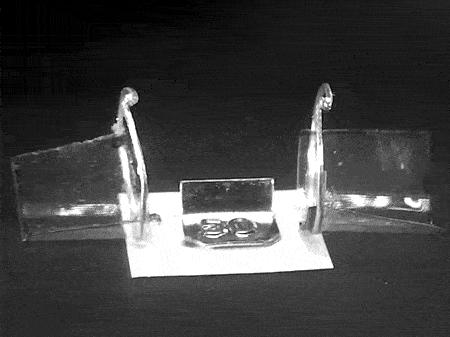
Pitt and CMU researchers develop high-torque light-powered actuator
IMAGE

Credit: Mahnoush Babaei

If you watch the leaves of a plant long enough, you may see them shift and turn toward the sunlight through the day. It happens slowly, but surely.

Some man-made materials can mimic this slow but steady reaction to light energy, usually triggered by lasers or focused ambient light. New research from the University of Pittsburgh and Carnegie Mellon University has discovered a way to speed up this effect enough that its performance can compete against electrical and pneumatic systems.

“We wanted to create machines where light is the only source of energy and direction,” explained M. Ravi Shankar, professor of industrial engineering and senior author of the paper. “The challenge is that while we could get some movement and actuation with light-driven polymers, it was too slow of a response to be practical.”

When the polymer sheet is flat, the light animates it slowly, curving or curling over time. The researchers found that by forming the polymer into a curved shape, like a shell, the bending action happened much more quickly and generated more torque.

“If you want to move something, like flip a switch or move a lever, you need something that will react quickly and with enough power,” said Shankar, who holds a secondary appointment in mechanical engineering and materials science. “We found that by applying a mechanical constraint to the material by confining it along on the edges, and embedding judiciously thought-out arrangements of molecules, we can upconvert a slow response into something that is more impulsive.”

The researchers used a photoresponsive azobenzene-functionalized liquid crystalline polymer (ALCP) film that is 50 micrometers thick and several millimeters in width and length. A shell-like geometry was created by confining this material along its edges to create a curve. Shining light on this geometry folds the shell at a crease that spontaneously nucleates. This folding occurs within tens of milliseconds and generates torque densities of up to 10 newton-meters per kilogram (10Nm/kg). The light driven response is magnified by about three orders-of-magnitude in comparison to the material that was flat.

“The outcomes of the project are very exciting because it means that we can create light powered actuators that are competitive with electrical actuators,” said Kaushik Dayal, coauthor and professor of civil and environmental engineering at CMU.

“Our approach towards scaling up the performance of light-driven polymers could reinvent the design of fully untethered soft robots with numerous technological applications,” added lead author and post-doctoral researcher at CMU Mahnoush Babaei.

###

The paper, “Torque-dense Photomechanical Actuation,” (DOI: 10.1039/D0SM01352H) was published in the journal Soft Matter.

Media Contact
Maggie Pavlick
[email protected]

Original Source

https://www.engineering.pitt.edu/News/2021/Shankar-Soft-Matter-Actuator/

Related Journal Article

http://dx.doi.org/10.1039/D0SM01352H

Tags: Chemistry/Physics/Materials SciencesMaterialsMechanical Engineering
Share13Tweet8Share2ShareShareShare2

Related Posts

blank

Breakthrough in Environmental Cleanup: Scientists Develop Solar-Activated Biochar for Faster Remediation

February 7, 2026
blank

Cutting Costs: Making Hydrogen Fuel Cells More Affordable

February 6, 2026

Scientists Develop Hand-Held “Levitating” Time Crystals

February 6, 2026

Observing a Key Green-Energy Catalyst Dissolve Atom by Atom

February 6, 2026
Please login to join discussion

POPULAR NEWS

  • Robotic Ureteral Reconstruction: A Novel Approach

    Robotic Ureteral Reconstruction: A Novel Approach

    82 shares
    Share 33 Tweet 21
  • Digital Privacy: Health Data Control in Incarceration

    63 shares
    Share 25 Tweet 16
  • Study Reveals Lipid Accumulation in ME/CFS Cells

    57 shares
    Share 23 Tweet 14
  • Breakthrough in RNA Research Accelerates Medical Innovations Timeline

    53 shares
    Share 21 Tweet 13

About

We bring you the latest biotechnology news from best research centers and universities around the world. Check our website.

Follow us

Recent News

Evaluating Pediatric Emergency Care Quality in Ethiopia

TPMT Expression Predictions Linked to Azathioprine Side Effects

Improving Dementia Care with Enhanced Activity Kits

Subscribe to Blog via Email

Success! An email was just sent to confirm your subscription. Please find the email now and click 'Confirm' to start subscribing.

Join 73 other subscribers
  • Contact Us

Bioengineer.org © Copyright 2023 All Rights Reserved.

Welcome Back!

Login to your account below

Forgotten Password?

Retrieve your password

Please enter your username or email address to reset your password.

Log In
No Result
View All Result
  • Homepages
    • Home Page 1
    • Home Page 2
  • News
  • National
  • Business
  • Health
  • Lifestyle
  • Science

Bioengineer.org © Copyright 2023 All Rights Reserved.