Credit: Lohe
Vertical stacks of different two-dimensional (2D) crystals, such as graphene, boron nitride, etc., held together by weak van der Waals forces are commonly referred to as "van der Waals heterostructures". Such sophisticated multilayer structures can be used as a versatile platform for the investigation of various phenomena at the nanoscale. In particular, mechanical superimposition of the 2D crystals generates 2D periodic potentials which impart to system unconventional physical and chemical properties.
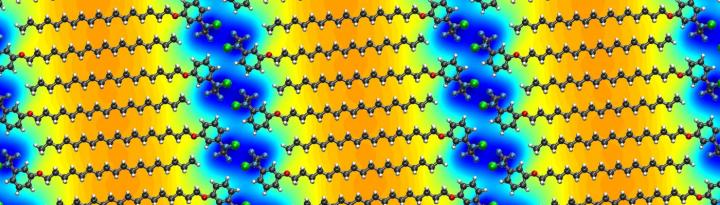
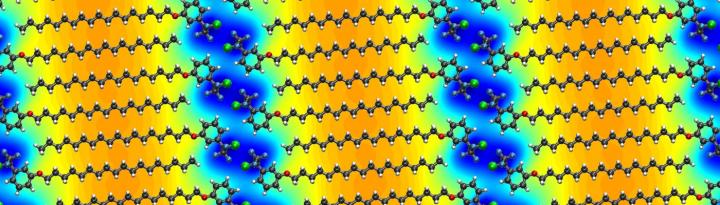
Here a team of European researchers applied a supramolecular approach to form self-assembled organic molecular lattices with a controlled geometry and atomic precision on top of graphene, inducing 1D periodic potentials in the resulting organic-inorganic hybrid heterostructures. For that purpose, molecular building blocks were carefully designed and synthesized. Those are equipped with (i) a long aliphatic tail, directing the self-assembly and the periodicity of the potential, and (ii) a photoreactive diazirine head group, whose dipole moment modulates the surface potential of the underlying graphene sheet. Upon irradiation with ultraviolet (UV) light before deposition on graphene, the diazirine moiety is cleaved and a reactive carbene species is formed. The latter is prone to react with solvent molecules, leading to a mixture of new compounds bearing different functionalities.
Scanning tunneling microscope (STM) imaging was used to characterize the nanoscale arrangement of the supramolecular lattices formed on graphite and graphene surfaces, which determines the periodicity and geometry of the induced potentials. Electrical characterization was then performed on graphene-based field-effect devices to assess the effect of the different self-assembled organic layers on the electrical characteristics of the 2D material. Computational simulations allowed to unravel the interactions of the molecular assembly with graphene; a theoretical analysis further confirmed that the origin of the doping effects can be fully attributed to the orientation of electrical dipoles in the head groups. Finally, a periodic potential with the same geometry but a different intensity could be generated from a supramolecular lattice prepared after UV irradiation of the molecular building block in a different solvent.
In this way, the researchers managed to demonstrate that organic supramolecular lattices are suitable to create controllable 1D periodic potentials on the surface of graphene. Interestingly, the periodicity, amplitude and sign of the induced potentials can be pre-programmed and adjusted by careful molecular design. This bottom-up supramolecular approach can be extended and applied to other inorganic 2D materials such as transition metal dichalcogenides, paving the way to more complex multilayer van der Waals heterostructures. These findings are of great importance for the realization of organic-inorganic hybrid materials with controllable structural and electronic properties featuring unprecedented electrical, magnetic, piezoelectric and optical functionalities.
###
Reference:
"Periodic potentials in hybrid van der Waals heterostructures formed by supramolecular lattices on graphene"
Marco Gobbi, Sara Bonacchi, Jian X. Lian, Yi Liu, Xiao-Ye Wang, Marc-Antoine Stoeckel, Marco A. Squillaci, Gabriele D'Avino, Akimitsu Narita, Klaus Müllen, Xinliang Feng, Yoann Olivier, David Beljonne, Paolo Samori?* & Emanuele Orgiu*
Nature Communications, 2017, 8, 14767
DOI: 10.1038/ncomms14767
Press Image Download at http://bit.ly/2otJ6dK
Media Inquiries:
Dr. Martin R. Lohe
cfaed Chair for Molecular Functional Materials at TU Dresden
Industry Project Coordinator
Phone: +49 (0) 351 463-40405 or -43255
E-Mail: [email protected]
Matthias Hahndorf
cfaed Communications Officer
Phone: +49 (0)351 463 42847
E-mail: [email protected]
cfaed
cfaed is a microelectronics research cluster funded by the German Excellence Initiative. It comprises 11 cooperating institutes in Saxony. About 300 scientists from more than 20 countries investigate new technologies for electronic information processing. These technologies are inspired by innovative materials such as silicon nanowires, carbon nanotubes or polymers or based on completely new concepts such as the chemical chip or circuit fabrication methods by self-assembling structures such as DNA-Origami. The orchestration of these new devices into heterogeneous information processing systems with focus on their resilience and energy-efficiency is also part of cfaed's research program which comprises nine different research paths.
http://www.cfaed.tu-dresden.de
Media Contact
Dr. Martin R. Lohe
[email protected]
49-035-146-340-405
@tudresden_de
http://tu-dresden.de/en
############
Story Source: Materials provided by Scienmag