• HOME
  • NEWS
  • EXPLORE
    • CAREER
      • Companies
      • Jobs
    • EVENTS
    • iGEM
      • News
      • Team
    • PHOTOS
    • VIDEO
    • WIKI
  • BLOG
  • COMMUNITY
    • FACEBOOK
    • INSTAGRAM
    • TWITTER
Tuesday, May 26, 2026
BIOENGINEER.ORG
No Result
View All Result
  • Login
  • HOME
  • NEWS
  • EXPLORE
    • CAREER
      • Companies
      • Jobs
        • Lecturer
        • PhD Studentship
        • Postdoc
        • Research Assistant
    • EVENTS
    • iGEM
      • News
      • Team
    • PHOTOS
    • VIDEO
    • WIKI
  • BLOG
  • COMMUNITY
    • FACEBOOK
    • INSTAGRAM
    • TWITTER
  • HOME
  • NEWS
  • EXPLORE
    • CAREER
      • Companies
      • Jobs
        • Lecturer
        • PhD Studentship
        • Postdoc
        • Research Assistant
    • EVENTS
    • iGEM
      • News
      • Team
    • PHOTOS
    • VIDEO
    • WIKI
  • BLOG
  • COMMUNITY
    • FACEBOOK
    • INSTAGRAM
    • TWITTER
No Result
View All Result
Bioengineer.org
No Result
View All Result
Home NEWS Science News Health

Organ regeneration is no longer a distant dream

Bioengineer by Bioengineer
July 12, 2018
in Health
Reading Time: 2 mins read
0
Share on FacebookShare on TwitterShare on LinkedinShare on RedditShare on Telegram
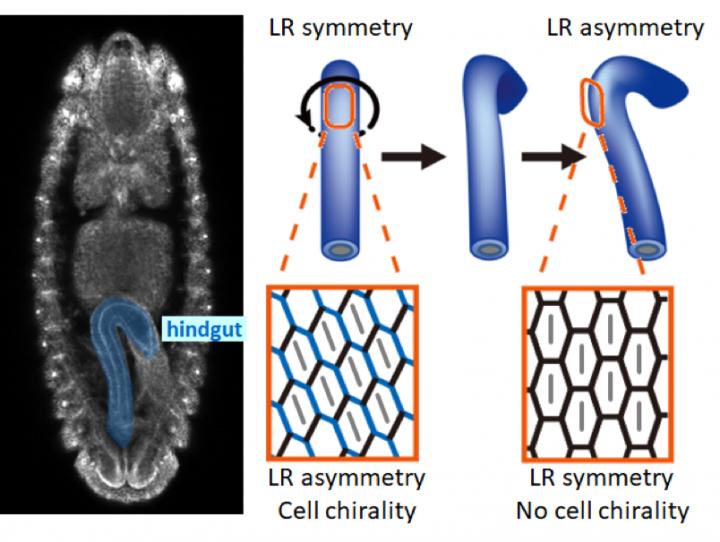
IMAGE

Credit: Osaka University

Many organs arise from simple sheets and tubes of cells. During development, these sheets bend and deform into the more complex final shape of the organ. This can be seen, for example, in the hindgut of fruit flies (Drosophila), which is an organ equivalent to our intestines.

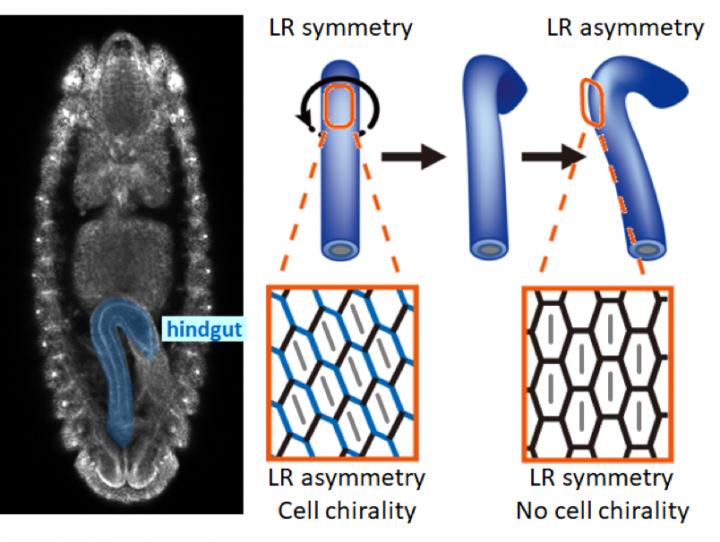
The Drosophila embryonic hindgut first forms as a bilaterally symmetric structure and then rotates 90°counterclockwise as viewed from the posterior to become asymmetric. Before the hindgut rotation, cells in the hindgut tilt leftward and are asymmetric. This structure cannot be superimposed on its mirror image, so this asymmetric structure is called 'cell chirality.'

As cell chirality disappears after the rotation, it was thought that cell chirality was related to this hindgut rotation. Previous studies, however, were performed using fixed samples, so the cellular dynamic mechanism by which cellular chirality was converted into an LR asymmetric organ remained unknown.

Researchers led by Kenji Matsuno at Osaka University used live imaging of the Drosophila embryonic hindgut and computer simulations to clarify that a novel cellular behavior called "cell sliding" was important for the LR asymmetric morphogenesis of the organ. Their research results were published in eLife.

Lead Author Mikiko Inaki said, "We found that when the hindgut rotated, the cells changed their position relative to the cells located below them (posterior in the embryo) by sliding leftward. We named this movement 'cell sliding.' In an inversion mutant showing inverted cell chirality and hindgut rotation, cell sliding occurred in the opposite direction to that found in the wild-type. Thus, we confirmed that cell sliding was important for the LR asymmetric rotation of the hindgut."

This group's achievements will deepen an understanding of the mechanism behind the morphogenesis of organs that have tubular structures, such as the digestive tracts and heart. It is also anticipated that their research results will be applied to the regeneration of organs in the future.

###

Osaka University was founded in 1931 as one of the seven imperial universities of Japan and now has expanded to one of Japan's leading comprehensive universities. The University has now embarked on open research revolution from a position as Japan's most innovative university and among the most innovative institutions in the world according to Reuters 2015 Top 100 Innovative Universities and the Nature Index Innovation 2017. The university's ability to innovate from the stage of fundamental research through the creation of useful technology with economic impact stems from its broad disciplinary spectrum.

Website: http://resou.osaka-u.ac.jp/en/top

Media Contact

Saori Obayashi
[email protected]
81-661-055-886
@osaka_univ_e

http://www.osaka-u.ac.jp/en

Original Source

http://resou.osaka-u.ac.jp/en/research/2018/20180611_1 http://dx.doi.org/10.7554/eLife.32506

Share12Tweet8Share2ShareShareShare2

Related Posts

New Frailty Model Aids Older Hemodialysis Patients

May 26, 2026

Aztreonam–Avibactam: Battling Metallo-β-Lactamase Resistance

May 26, 2026

Extracellular Vesicles and Mitochondria Alter Asthma Immunity

May 26, 2026

Quality of Life Predictors in Zoroastrian Elders

May 26, 2026
Please login to join discussion

POPULAR NEWS

  • ESMO 2025: mRNA COVID Vaccines Enhance Efficacy of Cancer Immunotherapy

    316 shares
    Share 126 Tweet 79
  • New Study Reveals Plants Can Detect the Sound of Rain

    734 shares
    Share 293 Tweet 183
  • Common Food Preservatives Associated with Elevated Blood Pressure and Increased Heart Disease Risk

    56 shares
    Share 22 Tweet 14
  • Research Indicates Potential Connection Between Prenatal Medication Exposure and Elevated Autism Risk

    847 shares
    Share 339 Tweet 212

About

We bring you the latest biotechnology news from best research centers and universities around the world. Check our website.

Follow us

Recent News

New Frailty Model Aids Older Hemodialysis Patients

A Century of Innovation: Optical Science’s Quest

Stability and Accuracy of Framingham Heart Risk Models

Subscribe to Blog via Email

Enter your email address to subscribe to this blog and receive notifications of new posts by email.

Join 82 other subscribers
  • Contact Us

Bioengineer.org © Copyright 2023 All Rights Reserved.

Welcome Back!

Login to your account below

Forgotten Password?

Retrieve your password

Please enter your username or email address to reset your password.

Log In
No Result
View All Result
  • Homepages
    • Home Page 1
    • Home Page 2
  • News
  • National
  • Business
  • Health
  • Lifestyle
  • Science

Bioengineer.org © Copyright 2023 All Rights Reserved.