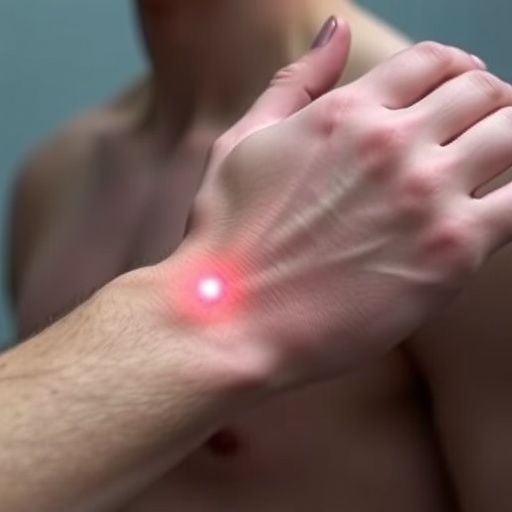
Invisible skin-mount sensors are moving wearable health monitoring out of the spotlight—and into everyday life. Conventional facial electrodes can feel intrusive, attract attention, and distort the very behavior researchers aim to measure. These “appearance artifacts” can alter self-consciousness and user interaction, undermining both comfort and data reliability.
A team led by the Institute of Industrial Science at The University of Tokyo reports ultrathin, stretchable on-skin electrodes designed to be effectively undetectable by sight and touch. The work, published in Science Advances, focuses on making electronics disappear into the background rather than demanding that wearers accommodate the device.
The core of the approach is a film-engineered electrode stack: an elastic layer roughly 200 nanometers thick paired with transparent conductive nanowires. By matching skin’s optical and tactile characteristics, the device reduces reflections and eliminates the glossy, conspicuous look typical of wearable prototypes. The result is a conformal interface intended to behave like part of the skin rather than a foreign attachment.
Performance matters as much as invisibility. The researchers showed that their electrodes can capture key biosignals used in neurotechnology and human–machine interaction. They recorded electrooculography from eye movements, electromyography from facial muscle activity, and electroencephalography from brain signals—all while keeping the electrodes visually and physically unobtrusive.
A standout technical advantage is interface impedance. The ultrathin, low-impedance skin contact improved signal quality for multiple modalities compared with traditional gel electrodes. Lower impedance can stabilize recordings and enhance the usable bandwidth for features such as saccades, muscle onset timing, and neural rhythms.
Comfort and breathability were also central to the design goals. In experiments, neither wearers nor outside observers could reliably detect the electrodes by sight or touch, and the devices remained suitable across a range of skin tones and surface features.
Beyond monitoring, the team envisions subtle inference of emotional and cognitive state using facial and ocular cues. In the longer term, invisible sensors could enable new control schemes for assistive technologies and virtual-reality systems without requiring bulky headsets or conspicuous face-mounted hardware.
More broadly, the study argues for a shift in wearable design philosophy: devices should adapt to people instead of demanding social compliance. If “invisibility” can be engineered without sacrificing data quality, health sensing may become both more accurate and more widely acceptable.
The article is titled “Reduction of appearance artifacts in wearable on-skin electronics” and appears in Science Advances.
Subject of Research: Wearable on-skin biosensing; appearance-artifact reduction
Article Title: Reduction of appearance artifacts in wearable on-skin electronics
News Publication Date: 15-Jul-2026
Web References: https://doi.org/10.1126/sciadv.aee6417
References: 10.1126/sciadv.aee6417
Image Credits: Institute of Industrial Science, The University of Tokyo
Keywords
on-skin electrodes; wearable biosensors; electrooculography; electromyography; electroencephalography; nanowires; ultrathin elastic film; appearance artifacts; bioimpedance; human–machine interaction
Tags: advanced materials for invisible wearable electronicsflexible skin sensorsflexible wearable health monitoring technologyinvisibleinvisible biomedical sensors for human–machine interactionminimal-impact health sensors for daily lifeskin-like electronic interfacesskin-mount biosignal recordingstretchable on-skin electrodestransparent nanowire biosensorsultrathin wearable health monitoring devicesunobtrusive neurotechnology sensors