• HOME
  • NEWS
  • EXPLORE
    • CAREER
      • Companies
      • Jobs
    • EVENTS
    • iGEM
      • News
      • Team
    • PHOTOS
    • VIDEO
    • WIKI
  • BLOG
  • COMMUNITY
    • FACEBOOK
    • INSTAGRAM
    • TWITTER
Thursday, May 14, 2026
BIOENGINEER.ORG
No Result
View All Result
  • Login
  • HOME
  • NEWS
  • EXPLORE
    • CAREER
      • Companies
      • Jobs
        • Lecturer
        • PhD Studentship
        • Postdoc
        • Research Assistant
    • EVENTS
    • iGEM
      • News
      • Team
    • PHOTOS
    • VIDEO
    • WIKI
  • BLOG
  • COMMUNITY
    • FACEBOOK
    • INSTAGRAM
    • TWITTER
  • HOME
  • NEWS
  • EXPLORE
    • CAREER
      • Companies
      • Jobs
        • Lecturer
        • PhD Studentship
        • Postdoc
        • Research Assistant
    • EVENTS
    • iGEM
      • News
      • Team
    • PHOTOS
    • VIDEO
    • WIKI
  • BLOG
  • COMMUNITY
    • FACEBOOK
    • INSTAGRAM
    • TWITTER
No Result
View All Result
Bioengineer.org
No Result
View All Result
Home NEWS Science News Cancer

Optimizing pulsed electric fields to target cancer with calcium ions

Bioengineer by Bioengineer
July 12, 2018
in Cancer
Reading Time: 2 mins read
0
Share on FacebookShare on TwitterShare on LinkedinShare on RedditShare on Telegram
IMAGE

Credit: Dr. Hamid Hosseini

Several different treatment methods are used against cancer and multiple promising approaches are currently under examination by various institutions around the world. In Japan, one method in particular, calcium electrotransfer, is being studied at Kumamoto University's Institute of Pulsed Power Science.

Pulsed electric fields (PEFs) have multiple applications in biology, ranging from DNA/drug delivery to the elimination of microorganisms in water. Their use against cancer is not new, but their basic effects on cells are still being clarified. Researchers at Kumamoto University's Bioelectrics Department recently identified the optimal PEF conditions for increasing the permeability of a cell membrane to calcium. This technique is appealing as a potential cancer treatment since cancer cells are particularly sensitive to an abnormal influx of calcium, it is comparatively cheap, and it has few side effects.

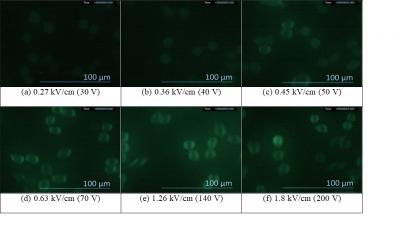
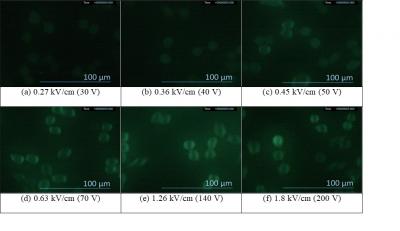
The researchers examined calcium intake in HeLa S3 cells via calcium (Ca2+) fluorescence. For each test, they used a fixed amount of energy but changed the PEF pulse count to assess the effects of electric field changes rather than that of total energy. Researchers found that membrane permeability continues for a short while after PEF is terminated because it takes time for the pores in the membrane to completely close. This gives a little more time for Ca2+ to diffuse into the cells.

Of the four electric fields examined, the two larger fields (1.8 and 1.26 kV/cm) produced a high Ca2+ intake rate during the first 10 ms that decreased significantly thereafter. On the other hand, the intake rate during the first 10 ms for the two smaller fields (0.63 and 0.45 kV/cm) was undetectable and gradually increased afterward. The rates for these two fields were very similar to one another until the end of the analysis.

"The optimal PEF levels for our in vitro tests turned out to be 100 pulses at 1 kHz and 0.45 kV/cm," said study leader Dr. Hamid Hosseini. "This setting should be nonlethal to normal cells but effectively kill cancer cells. We still have more work to determine if these results will hold up in in vivo settings, but we are optimistic that this method can produce a promising cancer therapy."

###

This research was published online in the journal Drug Delivery and Translational Research on 11 May 2018.

[Source]

Guionet, A., Moosavi Nejad, S., TeissiƩ, J., Sakugawa, T., Katsuki, S., Akiyama, H., & Hosseini, H. (2018). Spatio-temporal dynamics of calcium electrotransfer during cell membrane permeabilization. Drug Delivery and Translational Research. doi:10.1007/s13346-018-0533-5

Media Contact

J. Sanderson
[email protected]

http://ewww.kumamoto-u.ac.jp/en/news/

Related Journal Article

http://dx.doi.org/10.1007/s13346-018-0533-5
Share12Tweet8Share2ShareShareShare2

Related Posts

Innovative Tool Delivers High-Precision, Affordable Pediatric Leukemia Diagnostics

May 14, 2026

New JNCCN Analysis Reveals Effective Medication Strategies to Combat Cancer-Related Fatigue

May 14, 2026

Impact of Invitation Types on Breast Screening Attendance

May 14, 2026

New Study Finds Significant Weight Gain More Than Doubles Risk of Certain Cancers

May 13, 2026
Please login to join discussion

POPULAR NEWS

  • Research Indicates Potential Connection Between Prenatal Medication Exposure and Elevated Autism Risk

    842 shares
    Share 337 Tweet 211
  • New Study Reveals Plants Can Detect the Sound of Rain

    729 shares
    Share 291 Tweet 182
  • Salmonella Haem Blocks Macrophages, Boosts Infection

    62 shares
    Share 25 Tweet 16
  • Breastmilk Balances E. coli and Beneficial Bacteria in Infant Gut Microbiomes

    57 shares
    Share 23 Tweet 14

About

We bring you the latest biotechnology news from best research centers and universities around the world. Check our website.

Follow us

Recent News

Synchronous Climbing Fibers Drive Cerebellar Learning Signals

FAU’s CA-AI Awarded $2.2M U.S. Air Force Grant to Advance Next-Generation Autonomous Systems

Parkinson’s in Isolated Congenital Anosmia Case

Subscribe to Blog via Email

Enter your email address to subscribe to this blog and receive notifications of new posts by email.

Join 82 other subscribers
  • Contact Us

Bioengineer.org Ā© Copyright 2023 All Rights Reserved.

Welcome Back!

Login to your account below

Forgotten Password?

Retrieve your password

Please enter your username or email address to reset your password.

Log In
No Result
View All Result
  • Homepages
    • Home Page 1
    • Home Page 2
  • News
  • National
  • Business
  • Health
  • Lifestyle
  • Science

Bioengineer.org Ā© Copyright 2023 All Rights Reserved.