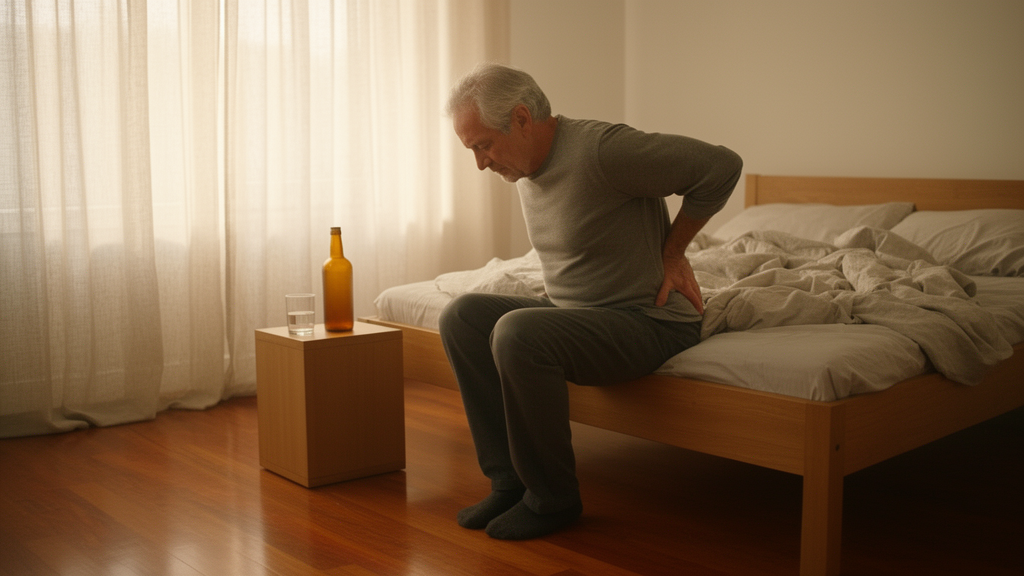
Older adults who use opioid pain medications for chronic low back pain exhibit substantially lower physical function, poorer balance, and slower walking speed compared to their non-using peers, according to a secondary analysis published in BMC Public Health.
To investigate these relationships, the research team conducted a secondary analysis utilizing data drawn from a previously conducted case-control study. The total cohort comprised 208 adult participants between 18 and 80 years of age, all living with diagnosed chronic low back pain. For analytical purposes, the researchers categorized the sample into three defined age groups: 85 younger adults aged 18 to 34 years (40.9 percent of the sample), 85 middle-aged adults aged 35 to 54 years (40.9 percent), and 38 older adults aged 55 to 80 years (18.3 percent).
Participants were formally classified according to whether they self-reported current use of opioid pain medications taken specifically for low back pain management. During the baseline evaluation, all participants completed a battery of demographic and pain-related questionnaires to capture their individual characteristics and symptom burdens. The team employed linear regression models and multivariate analysis of covariance (ANCOVA) to test independent associations as well as interaction effects between age categories and current opioid use.
The statistical analyses revealed that advancing age and current opioid use were each independently associated with significantly greater pain severity and reduced physical function, with all tests achieving statistical significance at p < .05. In addition to these independent relationships, the investigators discovered statistically significant age-by-opioid-use interactions across multiple functional domains, specifically total physical function, standing balance, and gait speed, with each interaction yielding significance at p ≤ .001. These interaction effects indicated that the functional disparity between opioid users and non-users varied systematically according to participant age.
The functional deficits associated with opioid use were concentrated dramatically within the oldest participant group, aged 55 to 80 years. Among these older adults, individuals reporting current opioid use recorded a mean total physical function score of 6.86 (standard error = 0.69), which was markedly lower than the mean score of 9.55 (standard error = 0.31) observed among age-matched peers who did not take opioids. Component testing revealed identical trends across specific subtests: older opioid users achieved a lower mean balance score of 3.18 (standard error = 0.17) compared to 3.84 (standard error = 0.08) for non-users, and a lower mean gait speed score of 2.34 (standard error = 0.30) compared to 3.57 (standard error = 0.14) for non-users, with all comparisons reaching p ≤ .001.
The study authors highlighted critical limitations, noting that because this investigation represents an observational secondary analysis of previously collected data rather than a prospectively registered clinical trial, these findings must be interpreted strictly as associations rather than evidence of a direct causal relationship. The researchers concluded that further targeted research is necessary to elucidate the specific mechanisms driving age-related differences in physical function and mobility among adults reporting active opioid therapy for chronic back pain.
Subject of Research: Association of age and opioid use with physical function in chronic low back pain
Article Title: Age, current self-reported opioid use, and physical function in adults living with chronic low back pain: A secondary analysis of a case-control study
Article References: Taylor, T. L., Rumble, D. D., Allen-Watts, K., Antoine, L., Sims, A., Overstreet, D., Jaiswal, J., McCrear, Z., Quinn, T., Buford, T. W., & Goodin, B. R. (2026). Age, current self-reported opioid use, and physical function in adults living with chronic low back pain: A secondary analysis of a case-control study. BMC Public Health. https://doi.org/10.1186/s12889-026-30184-4
Image Credits: AI Generated
DOI: 10.1186/s12889-026-30184-4
Keywords: chronic low back pain, opioid use, physical function, Short Physical Performance Battery, gait speed, balance, older adults, pain severity, secondary analysis, case-control study, BMC Public Health, multivariate ANCOVA, linear regression, disability, self-reported medication, adverse effects, observational research
News Source: Ophelia Keating. (November 11, 2026). Opioids Linked to Lower Physical Function in Older Adults with Back Pain. Scienmag.