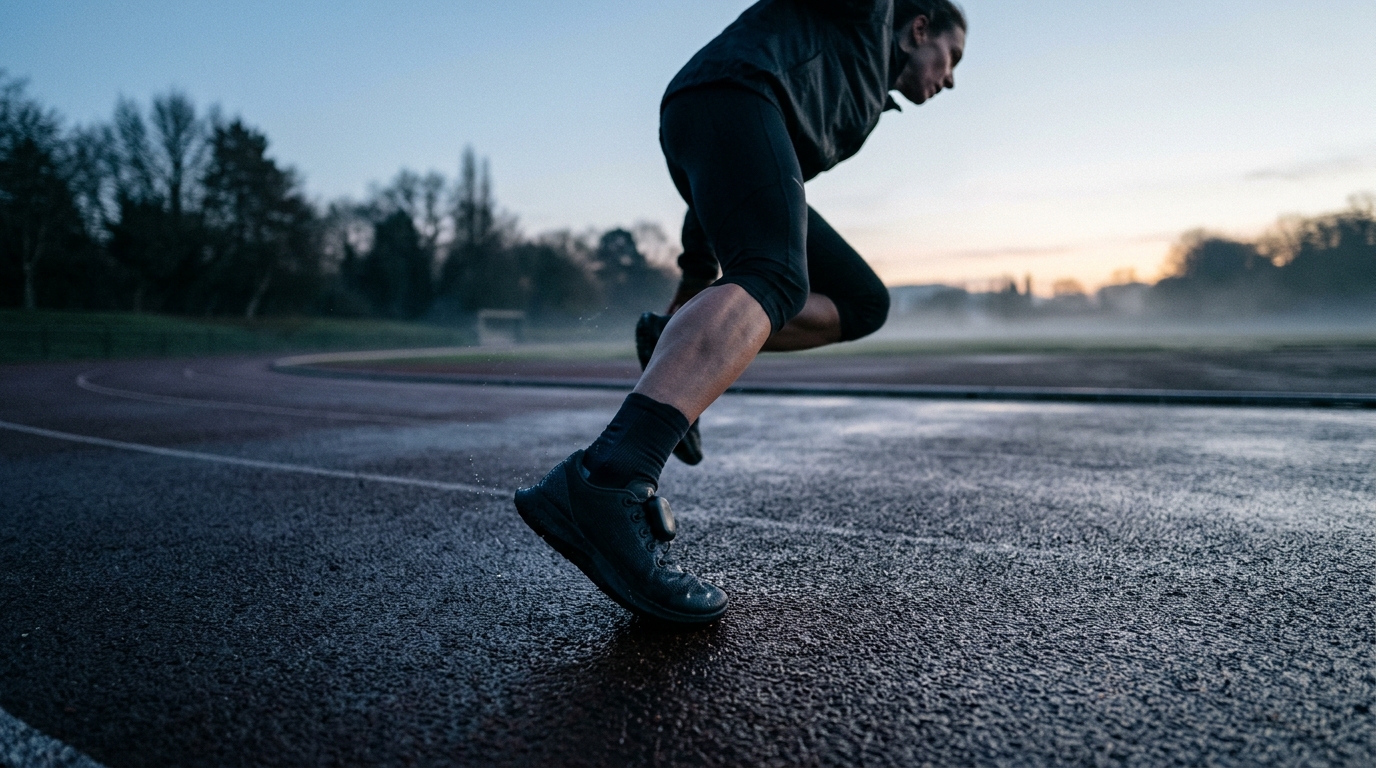
A single night without sleep leaves a measurable fingerprint in the way a person runs, and a small sensor worn on the lower back can pick it up just as well as a laboratory full of cameras, according to a new study published in Frontiers in Bioengineering and Biotechnology. When the models were given paired recordings from the same runner, they succeeded well above chance, with the wearable sensor reaching a best accuracy of 84 percent and the laboratory motion capture system reaching 81 percent. But when the models had to judge a single recording without any personal baseline, accuracy collapsed to roughly the level of a coin flip.
Label-permutation testing with 1,000 permutations confirmed that accuracy exceeded chance for eight of the ten model and system combinations. On the wearable dataset, logistic regression led with 84.2 percent accuracy, followed closely by k-nearest neighbors at 82.5 percent. On the laboratory dataset, random forest performed best at 80.6 percent, with extreme gradient boosting at 77.9 percent and decision tree at 74.6 percent.
The between-subject task told a very different story. Only one of the ten model and system combinations, logistic regression on the wearable dataset, reached statistical significance, and even that model achieved just 60.4 percent accuracy. On the laboratory side, random forest managed only 57.3 percent, and no model differed significantly from chance. The authors attribute this failure to the well-documented observation that inter-individual differences in gait patterns routinely exceed the magnitude of condition-induced effects, a phenomenon also reported in the exercise-induced fatigue detection literature, where subject-specific models consistently outperform group-based equivalents.
Despite their fundamental differences in measurement scope, the two systems converged on similar feature domains. Temporal organization of the stride cycle emerged as the most prominent signal: cadence dominated the wearable feature importance rankings, while ground contact time dominated the laboratory rankings. In direction, both features shifted toward a slower stride pattern under sleep deprivation, with cadence dropping by 0.9 percent and ground contact time lengthening by 1.5 percent compared with the rested condition. Loading-related variables formed a second recurring theme, and these consistently decreased under sleep deprivation: cumulative impact fell by 7.0 percent, impact magnitude by 5.9 percent, and peak loading rate by 3.8 percent, pointing toward an overall reduction in loading exposure when runners were sleep-deprived.
A third shared pattern was the consistent contribution of stride-to-stride variability features alongside mean-level variables in both systems. This shift was mixed rather than uniform: variability increased for some features, such as peak knee flexion variability, which rose 27.5 percent, and dynamic stability variability, which rose 26.6 percent, but decreased for others, including peak ankle plantarflexion moment variability, down 15.8 percent, and braking variability, down 24.0 percent. The authors caution that feature importance values reflect contribution to model discrimination rather than direct physiological sensitivity, and that the importance estimates were computed by refitting models on the full dataset rather than aggregating across held-out cross-validation folds, making them exploratory rather than validated biomarkers.
The researchers offer several hypothesis-generating mechanistic interpretations for these patterns. Leg stiffness at ground contact depends partly on anticipatory muscle preactivation governed by feedforward mechanisms, and sleep deprivation is known to impair higher-order sensorimotor and predictive control processes. This may leave the leg inadequately stiffened at touchdown, potentially contributing to the longer ground contact times, reduced cadence and lower impact-related variables observed across both systems. The authors also suggest the loading reduction may reflect a conservative protective strategy in which load reduction is prioritized over stiffness and propulsive efficiency when precise anticipatory control is compromised. A possible distal-to-proximal redistribution of joint work is also proposed, though the authors note this remains speculative in the absence of direct electromyographic evidence.
Contrary to the researchers’ hypothesis that the laboratory system would outperform the wearable owing to its richer feature space, both systems achieved comparable within-subject classification accuracy. The authors note that the optimal model family differed between systems: linear and distance-based models excelled on the wearable dataset, while tree-based ensembles performed better on the laboratory dataset. One plausible contributor is the difference in feature dimensionality, as large-scale benchmarking across 243 datasets has shown that the performance advantage of random forest over logistic regression shifts from negative to positive as dimensionality increases. The laboratory system drew from 83 candidate features compared with 36 for the wearable, which could partly explain why ensemble methods outperformed linear models for the laboratory system but not for the wearable.
Several limitations temper the findings. The sample of 21 participants, while typical for laboratory gait studies, limits statistical power, and fold-level accuracy varied substantially across cross-validation partitions, with some folds yielding near-perfect classification and others falling near chance. The experimental protocol involved total sleep deprivation, an extreme condition uncommon in real-world athletic settings, so it remains uncertain whether subtler forms of partial sleep loss would produce similar or qualitatively different gait adaptations. All running was performed on a treadmill at fixed speeds, leaving open whether the observed changes would manifest during overground running at self-selected paces. The wearable system also processes raw accelerometry through a proprietary algorithm whose exact computational definitions are not fully transparent, limiting cross-platform reproducibility. The authors conclude that individualized, baseline-referenced monitoring may be important for detecting sleep-deprivation-related changes in running gait, and that a single trunk-mounted wearable sensor may offer a practical solution for real-world monitoring when paired recordings are available.
Subject of Research: Machine learning detection of sleep deprivation from running biomechanics using wearable and laboratory motion capture systems
Article Title: Detecting sleep deprivation from running biomechanics using machine learning classification: a comparison between wearable and laboratory motion capture
Article References: Seynaeve, M., Hendrickx, K., Vanwanseele, B., & de Beukelaar, T. (2026). Detecting sleep deprivation from running biomechanics using machine learning classification: a comparison between wearable and laboratory motion capture. Frontiers in Bioengineering and Biotechnology, 14, Article 1939545. https://doi.org/10.3389/fbioe.2026.1939545
Image Credits: AI Generated
DOI: 10.3389/fbioe.2026.1939545
Keywords: sleep deprivation, running biomechanics, machine learning, wearable sensors, motion capture, gait analysis, recreational runners, fatigue detection, injury risk, treadmill running, randomized crossover, trunk accelerometry
News Source: Gregory Coleman. (November 5, 2026). One sleepless night leaves a machine-readable fingerprint in a runner’s gait. Scienmag.