• HOME
  • NEWS
  • EXPLORE
    • CAREER
      • Companies
      • Jobs
    • EVENTS
    • iGEM
      • News
      • Team
    • PHOTOS
    • VIDEO
    • WIKI
  • BLOG
  • COMMUNITY
    • FACEBOOK
    • INSTAGRAM
    • TWITTER
Saturday, May 16, 2026
BIOENGINEER.ORG
No Result
View All Result
  • Login
  • HOME
  • NEWS
  • EXPLORE
    • CAREER
      • Companies
      • Jobs
        • Lecturer
        • PhD Studentship
        • Postdoc
        • Research Assistant
    • EVENTS
    • iGEM
      • News
      • Team
    • PHOTOS
    • VIDEO
    • WIKI
  • BLOG
  • COMMUNITY
    • FACEBOOK
    • INSTAGRAM
    • TWITTER
  • HOME
  • NEWS
  • EXPLORE
    • CAREER
      • Companies
      • Jobs
        • Lecturer
        • PhD Studentship
        • Postdoc
        • Research Assistant
    • EVENTS
    • iGEM
      • News
      • Team
    • PHOTOS
    • VIDEO
    • WIKI
  • BLOG
  • COMMUNITY
    • FACEBOOK
    • INSTAGRAM
    • TWITTER
No Result
View All Result
Bioengineer.org
No Result
View All Result
Home NEWS Science News Chemistry

On the road to non-toxic and stable perovskite solar cells

Bioengineer by Bioengineer
May 11, 2020
in Chemistry
Reading Time: 2 mins read
0
IMAGE
Share on FacebookShare on TwitterShare on LinkedinShare on RedditShare on Telegram

IMAGE

Credit: HZB/Meng Li

Among the new materials for solar cells, the halide perovskites are considered particularly promising. Within a few years, the efficiency of such perovskite solar cells raised from a few percents to over 25 %. Unfortunately, the best perovskite solar cells contain toxic lead, which poses a hazard to the environment. However, it is surprisingly challenging to replace the lead with less toxic elements. One of the best alternatives is tin. Halogenide perovskites with tin instead of lead should show excellent optical properties, but in practice, their efficiencies are mediocre and decrease rapidly. And this rapid “aging” is their main disadvantage: the tin cations in the perovskite structure react very quickly with oxygen from the environment so that their efficiency drops.

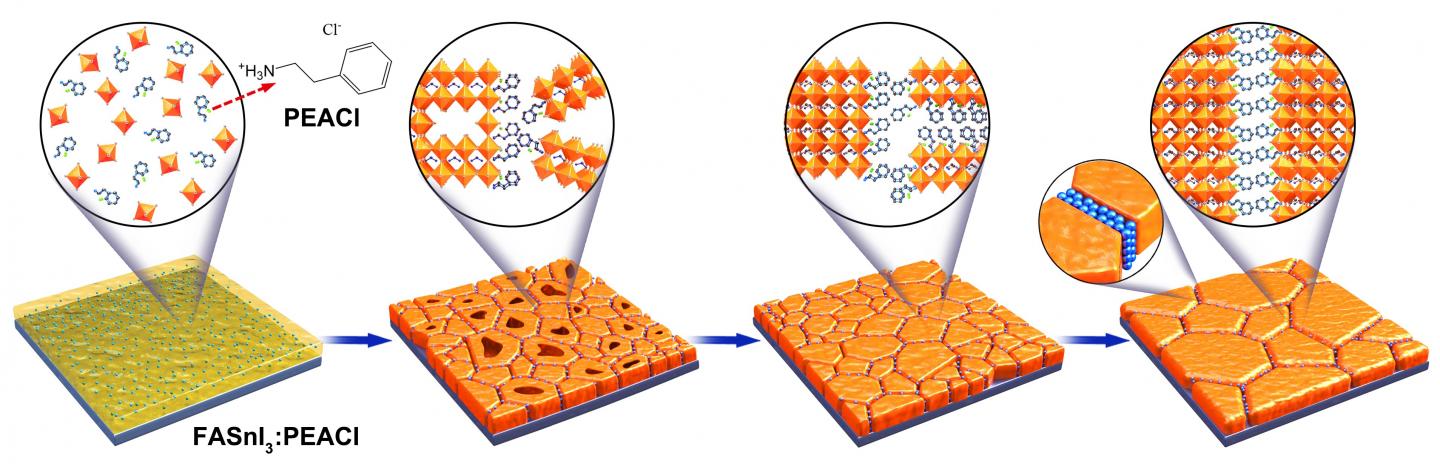
Now, an international cooperation led by Antonio Abate, HZB, and Zhao-Kui Wang, Institute of Functional Nano & Soft Materials (FUNSOM), Soochow University, China, has achieved a breakthrough that opens up a path to non-toxic perovskite-based solar cells that provides stable performance over a long period. They also use tin instead of lead but have created a two-dimensional structure by inserting organic groups within the material, which leads to so-called 2D Ruddlesden-Popper phases. “We use phenylethylammonium chloride (PEACl) as an additive to the perovskite layers. Then we carry out a heat treatment while the PEACl molecules migrate into the perovskite layer. This results in vertically ordered stacks of two-dimensional perovskite crystals” explains first author Dr Meng Li. Li is a postdoc in Abate’s group and has organised the close cooperation with the Chinese partners. At the Shanghai Synchrotron Radiation Facility (SSRF), they were able to precisely analyse the morphology and crystal characteristics of the perovskite films after different annealing treatments.

The best of these lead-free perovskite solar cells achieved an efficiency of 9.1 % and high stability values, both under daytime conditions and in the dark. The PEACl molecules accumulate between the crystalline perovskite layers as a result of the heat treatment and form a barrier that prevents the tin cations from oxidising. “This work paves the way for more efficient and stable lead-free perovskite solar cells,” Abate is convinced.

###

Media Contact
Dr. Antonio Abate
[email protected]

Original Source

https://www.helmholtz-berlin.de/pubbin/news_seite?nid=21321;sprache=en

Related Journal Article

http://dx.doi.org/10.1021/acsenergylett.0c00782

Tags: Chemistry/Physics/Materials SciencesEnergy SourcesEnergy/Fuel (non-petroleum)Materials
Share12Tweet8Share2ShareShareShare2

Related Posts

New Drexel Study Reveals Key to Keeping Students on Track in Physics Learning — Chemistry

New Drexel Study Reveals Key to Keeping Students on Track in Physics Learning

May 15, 2026
Reversible Glue Technology Powers Up with Electric Activation — Chemistry

Reversible Glue Technology Powers Up with Electric Activation

May 15, 2026

Sweet as Honey: Unveiling a New Heat Transport Regime in Ultrathin Semiconductors

May 15, 2026

High-Precision Boltzmann Luminescent Nanothermometry Achieved Through Predictive Rules

May 15, 2026
Please login to join discussion

POPULAR NEWS

  • Research Indicates Potential Connection Between Prenatal Medication Exposure and Elevated Autism Risk

    843 shares
    Share 337 Tweet 211
  • New Study Reveals Plants Can Detect the Sound of Rain

    730 shares
    Share 291 Tweet 182
  • Salmonella Haem Blocks Macrophages, Boosts Infection

    62 shares
    Share 25 Tweet 16
  • Breastmilk Balances E. coli and Beneficial Bacteria in Infant Gut Microbiomes

    58 shares
    Share 23 Tweet 15

About

We bring you the latest biotechnology news from best research centers and universities around the world. Check our website.

Follow us

Recent News

New Kitasatospora Species and Synonym Proposed

Mental Health in Older Adults: Impact of Loneliness

Vertical Migration and Oceanography Shape Antarctic Krill Plastic Exposure

Subscribe to Blog via Email

Enter your email address to subscribe to this blog and receive notifications of new posts by email.

Join 82 other subscribers
  • Contact Us

Bioengineer.org © Copyright 2023 All Rights Reserved.

Welcome Back!

Login to your account below

Forgotten Password?

Retrieve your password

Please enter your username or email address to reset your password.

Log In
No Result
View All Result
  • Homepages
    • Home Page 1
    • Home Page 2
  • News
  • National
  • Business
  • Health
  • Lifestyle
  • Science

Bioengineer.org © Copyright 2023 All Rights Reserved.