• HOME
  • NEWS
  • EXPLORE
    • CAREER
      • Companies
      • Jobs
    • EVENTS
    • iGEM
      • News
      • Team
    • PHOTOS
    • VIDEO
    • WIKI
  • BLOG
  • COMMUNITY
    • FACEBOOK
    • INSTAGRAM
    • TWITTER
Saturday, May 16, 2026
BIOENGINEER.ORG
No Result
View All Result
  • Login
  • HOME
  • NEWS
  • EXPLORE
    • CAREER
      • Companies
      • Jobs
        • Lecturer
        • PhD Studentship
        • Postdoc
        • Research Assistant
    • EVENTS
    • iGEM
      • News
      • Team
    • PHOTOS
    • VIDEO
    • WIKI
  • BLOG
  • COMMUNITY
    • FACEBOOK
    • INSTAGRAM
    • TWITTER
  • HOME
  • NEWS
  • EXPLORE
    • CAREER
      • Companies
      • Jobs
        • Lecturer
        • PhD Studentship
        • Postdoc
        • Research Assistant
    • EVENTS
    • iGEM
      • News
      • Team
    • PHOTOS
    • VIDEO
    • WIKI
  • BLOG
  • COMMUNITY
    • FACEBOOK
    • INSTAGRAM
    • TWITTER
No Result
View All Result
Bioengineer.org
No Result
View All Result
Home NEWS Science News Biology

Oldest completely preserved lily discovered

Bioengineer by Bioengineer
July 11, 2019
in Biology
Reading Time: 2 mins read
0
IMAGE
Share on FacebookShare on TwitterShare on LinkedinShare on RedditShare on Telegram

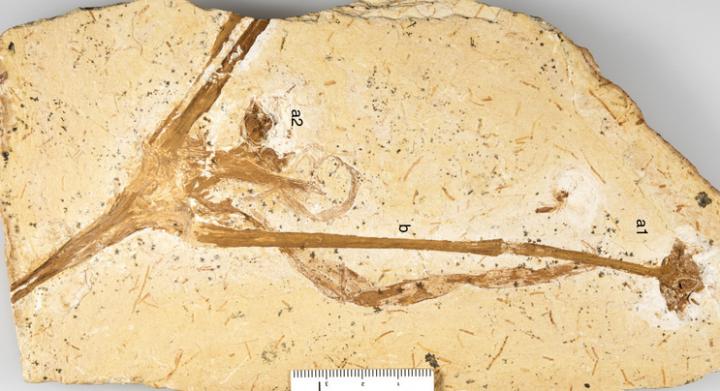
Already 115 million years ago, tropical flowering plants were apparently very diverse and showed all typical characteristics
IMAGE

Credit: MfN Berlin

Botanist Dr. Clement Coiffard of the Museum für Naturkunde Berlin discovered the oldest, completely preserved lily in the research collection: Cratolirion bognerianum was found in calcareous sediments of a former freshwater lake in Crato in northeastern Brazil. With an age of about 115 million years, Cratolirion is one of the oldest known monocotyledonous plants. These include orchids, sweet grasses, lilies and lilies of the valley.

Cratolirion is extraordinarily well preserved, with all roots, the flower and even the individual cells are fossilised. With a length of almost 40 centimetres, the specimen is not only extremely huge, but also shows almost all the typical characteristics of monocotyledonous plants, including parallel-veined, narrow leaves with a leaf sheath, a fibrous root system and triple flowers.

However, it was not trivial to examine the fossilised object, as it consisted of iron oxides associated with the stone. In order to see details here, Coiffard collaborated with the HZB physicist Dr. Nikolay Kardjilov, who is an expert in 3D analysis with X-rays and neutrons. At the HZB he also built up a 3D computed x-ray tomography and refined the data analysis in such a way that hardly any disturbing artefacts arise during the investigation of large, flat objects. This made it possible to analyse the details of the inflorescence hidden in the stone. A colour coding in the CT scan makes these details visible: the main axis is marked in turquoise, the supporting leaves in dark green, the pistils in light green and the remains of the actual petals can still be seen in orange.

Many early dicotyledonous flowering plants have already been described from the same sediments of the former freshwater lake in Crato. These include water lilies, aron rods, drought-resistant magnolias and relatives of pepper and laurel. In contrast to other flowering plants of the same age from the USA, Portugal, China and Argentina, the flowering plants of the Crato-Flora are unusually diverse. This could be due to the fact that Lake Crato was in the lower latitudes, but all other fossils of early flowering plants come from the middle latitudes.

From this newly described plant Cratolirion bognerianum and the species of Crato flora mentioned above, it can be deduced that the tropical flowering plants were already very diverse. “It is probable that flowering plants originated in the tropics, but only very few fossils have been described to date,” explains Coiffard. This study thus provides new insights into the role of the tropics in the development of early flowering plants and their rise to global supremacy.

###

Media Contact
Antonia Roetger
[email protected]

Original Source

https://www.helmholtz-berlin.de/pubbin/news_seite?nid=20620;sprache=en;seitenid=1

Related Journal Article

http://dx.doi.org/10.1038/s41477-019-0468-y

Tags: BiodiversityBiologyEcology/EnvironmentEvolutionPlant Sciences
Share12Tweet8Share2ShareShareShare2

Related Posts

Single mother must adapt swiftly — the survival of her colony depends on it — Biology

Single mother must adapt swiftly — the survival of her colony depends on it

May 15, 2026
Why Are Nearly Everyone Right-Handed? It Might Be Linked to How We Learned to Walk — Biology

Why Are Nearly Everyone Right-Handed? It Might Be Linked to How We Learned to Walk

May 15, 2026

Excessive Neuronal Activity Initiates Severe Autoimmune Brain Disorder

May 15, 2026

Precision Anti-Aging Strategies Focus on Eliminating Harmful Senescent Cells While Preserving Beneficial Ones

May 15, 2026
Please login to join discussion

POPULAR NEWS

  • Research Indicates Potential Connection Between Prenatal Medication Exposure and Elevated Autism Risk

    843 shares
    Share 337 Tweet 211
  • New Study Reveals Plants Can Detect the Sound of Rain

    730 shares
    Share 291 Tweet 182
  • Salmonella Haem Blocks Macrophages, Boosts Infection

    62 shares
    Share 25 Tweet 16
  • Breastmilk Balances E. coli and Beneficial Bacteria in Infant Gut Microbiomes

    58 shares
    Share 23 Tweet 15

About

We bring you the latest biotechnology news from best research centers and universities around the world. Check our website.

Follow us

Recent News

REM Sleep Breathing, Metabolism, and Memory Linked

Machine Learning Detects Flow Instability in Channels

LTBP4 Deficiency Reduces Heart Failure in Male Mice

Subscribe to Blog via Email

Enter your email address to subscribe to this blog and receive notifications of new posts by email.

Join 82 other subscribers
  • Contact Us

Bioengineer.org © Copyright 2023 All Rights Reserved.

Welcome Back!

Login to your account below

Forgotten Password?

Retrieve your password

Please enter your username or email address to reset your password.

Log In
No Result
View All Result
  • Homepages
    • Home Page 1
    • Home Page 2
  • News
  • National
  • Business
  • Health
  • Lifestyle
  • Science

Bioengineer.org © Copyright 2023 All Rights Reserved.