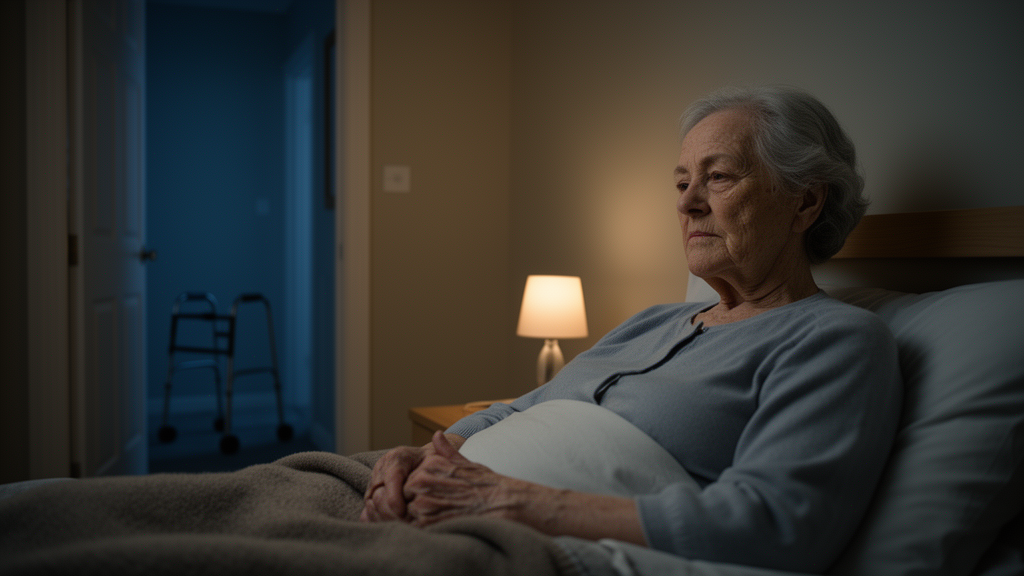
Older adults with dementia spend substantially less time on their feet and more time lying awake than their cognitively unimpaired peers, according to a cross-sectional analysis of 4,699 community-dwelling Norwegians aged 70 and older participating in the HUNT4 70+ study. The study, published in the European Review of Aging and Physical Activity, used accelerometers worn on the thigh and lower back for up to seven days to measure how standing, walking, sitting, lying awake, and sleep are distributed across a full 24-hour day at different points on the cognitive spectrum.
Participants were classified using DSM-5 criteria: 1,690 had mild cognitive impairment (MCI), 360 had dementia, and the remainder were categorised as cognitively unimpaired. Because the most impaired participants may be less likely to take part in health surveys, the researchers applied inverse probability weighting and multiple imputation by chained equations to address selection bias, and examined group differences with survey-weighted regression models adjusted for age, sex, education, marital status, self-rated health, obesity, depression, alcohol consumption, and smoking.
The pattern that emerged was one of progressive change across the cognitive spectrum. In fully adjusted models, older adults with dementia spent roughly half an hour less per day standing than both cognitively unimpaired peers and those with MCI, with adjusted differences of −29.0 minutes (95% CI −41.3, −16.5) and −30.3 minutes (95% CI −42.5, −18.2) per 24 hours respectively. Their walking time was also lower, by 16.1 minutes (95% CI −19.9, −12.4) compared with the MCI group and 17.2 minutes (95% CI −20.9, −13.4) compared with cognitively unimpaired peers, all statistically significant at p ≤ 0.001.
Time spent lying awake showed the largest differences of all. Adults with dementia lay awake 36.3 minutes longer per day than those with MCI (95% CI 17.1, 55.4) and 46.5 minutes longer than cognitively unimpaired peers (95% CI 28.7, 64.5). They also slept more, by 7.5 minutes per 24 hours (95% CI 0.9, 14.9), than cognitively unimpaired participants, a difference that reached significance at p = 0.04.
The contrast between the dementia and MCI groups was sharper than between MCI and unimpaired cognition. Adults with MCI differed from their cognitively unimpaired peers mainly in sedentary and sleep-related behaviours: they sat for less time (−12.4 minutes per 24 hours, 95% CI −20.0, −4.4), lay awake longer (+10.3 minutes, 95% CI 2.7, 17.9), and slept slightly longer (+3.9 minutes, 95% CI 0.8, 7.0), with all differences significant at p < 0.05. Notably, their standing and walking time was similar to that of cognitively unimpaired peers.
The measurement approach distinguishes this study from much of the earlier literature. Rather than relying on self-reported activity, the researchers used validated machine-learning models applied to accelerometer data from two body positions, allowing standing, walking, sitting, lying awake, and sleep to be separated within the same continuous 24-hour record. This matters because these behaviours make up the entire day, so an increase in one necessarily displaces another, and each has distinct health effects and functional implications.
The authors are careful about interpretation. The study is cross-sectional, meaning it captures a single point in time and cannot establish whether differences in movement cause cognitive decline or result from it. The clinical importance of the observed differences remains unknown, and the researchers call for future work on the independent and compositional effects of these behaviours — that is, on how the whole 24-hour composition, not each behaviour in isolation, relates to health and function.
Several limitations shape how the findings should be read. The data come from a single Norwegian population-based cohort of community-dwelling adults, so institutionalised older adults are not represented, and despite statistical corrections for selection bias and missing accelerometer data, some residual uncertainty is unavoidable. The confidence intervals, particularly for lying awake in the dementia group, are wide, reflecting the smaller number of participants with dementia.
Even so, the study offers an unusually detailed, device-based portrait of daily life across the cognitive spectrum in ageing. It suggests that as cognition declines from unimpaired to MCI to dementia, the day shifts away from upright activity and toward prolonged recumbence and fragmented wakefulness — a pattern whose causes and consequences the authors say now need to be untangled in longitudinal and compositional research.
Subject of Research: Device-measured 24-hour movement behaviours and sleep across cognitive status in older adults
Article Title: Distribution of device-measured 24-hour movement behaviours across the cognitive spectrum in older adults: the HUNT study
Article References: Sverdrup, K., Mork, P. J., de Bruin, E. D., Ernstsen, L., Livingston, G., Patel, K. V., Selbæk, G., Strand, B. H., Vereijken, B., & Tangen, G. G. (2026). Distribution of device-measured 24-hour movement behaviours across the cognitive spectrum in older adults: the HUNT study. European Review of Aging and Physical Activity. https://doi.org/10.1186/s11556-026-00433-x
Image Credits: AI Generated
DOI: 10.1186/s11556-026-00433-x
Keywords: dementia, mild cognitive impairment, older adults, accelerometry, physical activity, sleep, sedentary behaviour, HUNT study, 24-hour movement, cross-sectional study, Distribution, device-measured
News Source: Cassandra Pierce. (October 29, 2026). Older Adults with Dementia Stand and Walk Less, Lie Awake Longer, HUNT Study Finds. Scienmag.