• HOME
  • NEWS
  • EXPLORE
    • CAREER
      • Companies
      • Jobs
    • EVENTS
    • iGEM
      • News
      • Team
    • PHOTOS
    • VIDEO
    • WIKI
  • BLOG
  • COMMUNITY
    • FACEBOOK
    • INSTAGRAM
    • TWITTER
Monday, May 4, 2026
BIOENGINEER.ORG
No Result
View All Result
  • Login
  • HOME
  • NEWS
  • EXPLORE
    • CAREER
      • Companies
      • Jobs
        • Lecturer
        • PhD Studentship
        • Postdoc
        • Research Assistant
    • EVENTS
    • iGEM
      • News
      • Team
    • PHOTOS
    • VIDEO
    • WIKI
  • BLOG
  • COMMUNITY
    • FACEBOOK
    • INSTAGRAM
    • TWITTER
  • HOME
  • NEWS
  • EXPLORE
    • CAREER
      • Companies
      • Jobs
        • Lecturer
        • PhD Studentship
        • Postdoc
        • Research Assistant
    • EVENTS
    • iGEM
      • News
      • Team
    • PHOTOS
    • VIDEO
    • WIKI
  • BLOG
  • COMMUNITY
    • FACEBOOK
    • INSTAGRAM
    • TWITTER
No Result
View All Result
Bioengineer.org
No Result
View All Result
Home NEWS Science News Biology

OHSU scientists identify molecule that could help treat Parkinson’s

Bioengineer by Bioengineer
November 9, 2022
in Biology
Reading Time: 3 mins read
0
Haining Zhong, Ph.D., and Tianyi Mao, Ph.D.
Share on FacebookShare on TwitterShare on LinkedinShare on RedditShare on Telegram

Researchers at Oregon Health & Science University have discovered that the neurotransmitter adenosine effectively acts as a brake to dopamine, another well-known neurotransmitter involved in motor control.
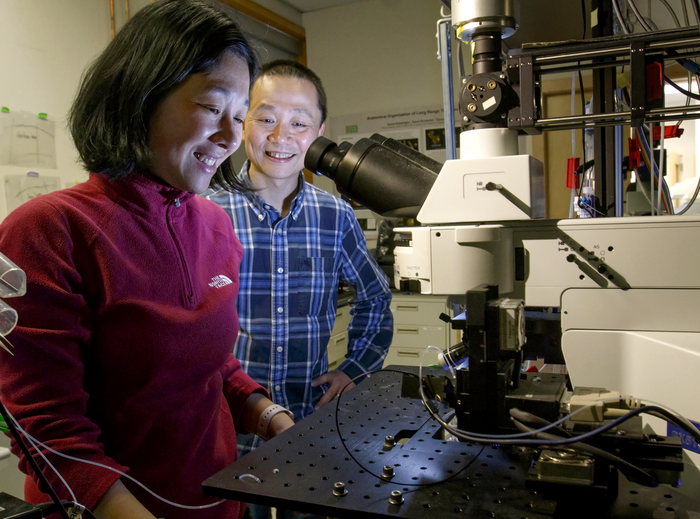
Haining Zhong, Ph.D., and Tianyi Mao, Ph.D.

Credit: Oregon Health & Science University

Researchers at Oregon Health & Science University have discovered that the neurotransmitter adenosine effectively acts as a brake to dopamine, another well-known neurotransmitter involved in motor control.

Scientists found that adenosine operates in a kind of push-pull dynamic with dopamine in the brain; the discovery published today in the journal Nature.

“There are two neuronal circuits: one that helps promote action and the other that inhibits action,” said senior author Haining Zhong, Ph.D., scientist with the OHSU Vollum Institute. “Dopamine promotes the first circuit to enable movement, and adenosine is the ‘brake’ that promotes the second circuit and brings balance to the system.”

The discovery could immediately suggest new avenues of drug development to treat symptoms of Parkinson’s disease, a movement disorder where the loss of dopamine-producing cells has been widely implicated as a cause.

Scientists have long suspected  that dopamine is influenced by an opposing dynamic of neuronal signaling in the striatum — a critical region of the brain that mediates movement along with reward, motivation and learning. The striatum is also the primary brain region affected in Parkinson’s disease by the loss of dopamine-producing cells.

“People for a long time suspected there has to be this push-pull system,” said co-author Tianyi Mao, Ph.D., a scientist at the Vollum who happens to be married to Zhong.

In the new study, researchers for the first time clearly and definitively revealed adenosine as the neurotransmitter that acts in an oppositional sense with dopamine. The study, involving mice, used novel genetically engineered protein probes recently developed in the Zhong and Mao labs. An example of that technology was highlighted last month in a study published in the journal Nature Methods.

Notably, adenosine is also well known as the receptor that caffeine acts upon.

“Coffee acts in our brain through the same receptors,” Mao said. “Drinking coffee lifts the brake imposed by adenosine.”

In addition to Zhong and Mao, Lei Ma, Ph.D. of the Vollum Institute is the first author. Co-authors include Julian Day-Cooney, Ph.D., Michael A. Muniak, Ph.D., and Maozhen Qin of the Vollum; and, Omar Jaidar Benavides, Ph.D., and Jun B. Ding, Ph.D., of Stanford University.

This work was supported by two BRAIN Initiative awards to Zhong and Mao through the National Institutes of Health, awards U01NS094247 and R01NS104944; as well as three awards through the National Institute of Neurological Disorders and Stroke of the NIH, award R01NS081071 to Mao and R21NS097856 and R01NS127013 to Zhong.


Journal

Nature

DOI

10.1038/s41586-022-05407-4

Method of Research

Experimental study

Subject of Research

People

Article Title

Locomotion activates PKA through dopamine and adenosine in striatal neurons

Article Publication Date

9-Nov-2022

Share12Tweet8Share2ShareShareShare2

Related Posts

The Power of Detecting Omics Regulations — Biology

The Power of Detecting Omics Regulations

May 4, 2026
Biological Aging Marker Connected to Cognitive Symptoms in Depression — Biology

Biological Aging Marker Connected to Cognitive Symptoms in Depression

May 4, 2026

What the Latest Science Really Says About Creatine’s Benefits for Body and Mind

May 4, 2026

Successful Birth Following Uterus Transplant Marks Medical Breakthrough

May 1, 2026

POPULAR NEWS

  • Research Indicates Potential Connection Between Prenatal Medication Exposure and Elevated Autism Risk

    834 shares
    Share 334 Tweet 209
  • New Study Reveals Plants Can Detect the Sound of Rain

    718 shares
    Share 287 Tweet 179
  • Scientists Investigate Possible Connection Between COVID-19 and Increased Lung Cancer Risk

    67 shares
    Share 27 Tweet 17
  • Salmonella Haem Blocks Macrophages, Boosts Infection

    61 shares
    Share 24 Tweet 15

About

We bring you the latest biotechnology news from best research centers and universities around the world. Check our website.

Follow us

Recent News

Maintaining Long-Term Abdominal Fat Loss Supports Cognitive Health

Mathematical Insight Empowers Designers to Create Stunning Shapes

Cal Poly Study Reveals How Time-Varying Magnetic Fields Can Create Exotic Quantum Matter

Subscribe to Blog via Email

Enter your email address to subscribe to this blog and receive notifications of new posts by email.

Join 82 other subscribers
  • Contact Us

Bioengineer.org © Copyright 2023 All Rights Reserved.

Welcome Back!

Login to your account below

Forgotten Password?

Retrieve your password

Please enter your username or email address to reset your password.

Log In
No Result
View All Result
  • Homepages
    • Home Page 1
    • Home Page 2
  • News
  • National
  • Business
  • Health
  • Lifestyle
  • Science

Bioengineer.org © Copyright 2023 All Rights Reserved.