A new International Space Station investigation, Advanced Colloids Experiment-Temperature-10, is using temperature changes to better understand how colloids — or ‘disordered solids’ — age or fail
Credit: NASA
If you think your strawberry jelly is unrelated to earthquakes, think again.
A new International Space Station investigation, Advanced Colloids Experiment-Temperature-10 (ACE-T-10), is using temperature changes to better understand how colloids – or ‘disordered solids’ – age or fail. Understanding this stress relaxation in disordered solids may provide hints about seismic events on earth. This experiment could also benefit the future exploration of the Moon, Mars and beyond by providing insight into material failure.
Colloids are materials where nanoparticles or small droplets of one material are dispersed in a fluid. These soft materials are common in daily life; examples are whipped cream, jelly, fabric softener, milk and muddy water.
ACE-T-10 studies colloids in which the attraction between nanoparticles gets stronger with increased temperature. While at room temperature, the colloid behaves as a liquid. When the suspension is heated to above approximately 40°C, the particles rapidly stick to each other, forming a rigid network that can sustain its own weight – a process called gelation.
This is similar to what happens in the tempering of glass. However, fast gelation produces stresses in the material that progressively relax through a cascade of restructuring events akin to ‘micro-quakes.’ The aftershocks eventually induce larger restructuring events involving the entire gel. These dramatic upheavals of the gel structure can be predicted, at least statistically, because they are heralded by an observable ‘jittery’ stage. ACE-T-10 confocal microscopy images enabled by the space station may allow scientists to highlight the rupture of these microscopic gel strands that is anticipated to lie beneath these curious tremors.
“Temperature plays a dual role in this,” said Primary Investigator Roberto Piazza. “It is the factor that changes the interactions between the particles, making them stick together; at the same time, it is the driving force that promotes the gel’s spontaneous restructuring. On Earth, however, gravity acts as an additional stress on the material that can influence the way the gel restructures. Experiments in microgravity are mandatory to quantify whether gravity (gel weight) plays a relevant role or not.”
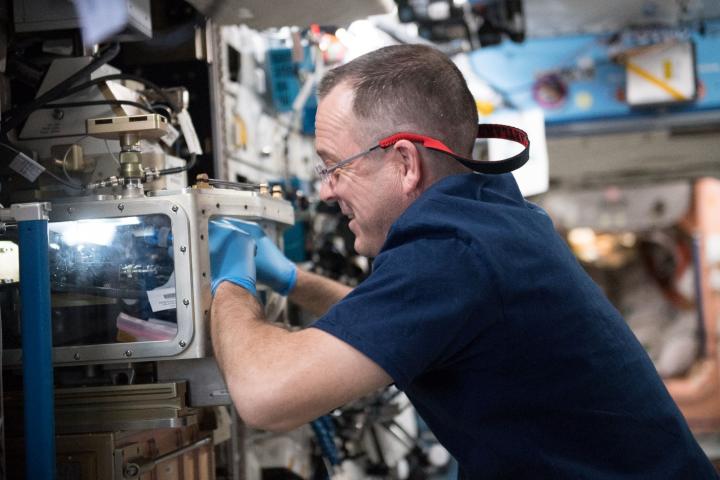
The space station’s laboratory provides other benefits as well. “The space station’s Light Microscopy Module (LMM) in the Fluids Integrated Rack allows scientists to control the temperature of the system and provides a 3D structure of the material,” said Stefano Buzzaccaro, co-investigator for ACE-T-10. “In collaboration with the European Space Agency (ESA), we are developing a light scattering setup that, in combination with the confocal LMM, gives us everything we need to try to understand the problem of gelation.”
Similar to colloids, the Earth’s crust also releases stress through earthquakes. ACE-T-10 could provide insight into the events that anticipate these quakes, allowing scientists to provide better forecasts of when they might happen.
It can also contribute to predictions related to product shelf life and the failure of structural materials in roads and bridges.
“This is especially important when you are on Mars and you have to construct materials using Martian crust,” said Buzzaccaro. “You can find a method to monitor the damage of the material you use and forecast its failure.”
Food for thought when you make your next colloid and peanut butter sandwich.
###
Media Contact
Carrie Gilder
[email protected]
Original Source
http://www.