Researchers led by Mroj Alassaf at the Fred Hutchinson Cancer Research Center in the United States have discovered a link between obesity and neurodegenerative disorders like Alzheimer’s disease. Using the common fruit fly, the research shows that a high-sugar diet — a hallmark of obesity — causes insulin resistance in the brain, which in turn reduces the ability to remove neuronal debris, thus increasing the risk of neurodegeneration. Publishing November 7th in the open access journal PLOS Biology, the research will impact therapies designed to reduce the risk of developing neurodegenerative diseases.
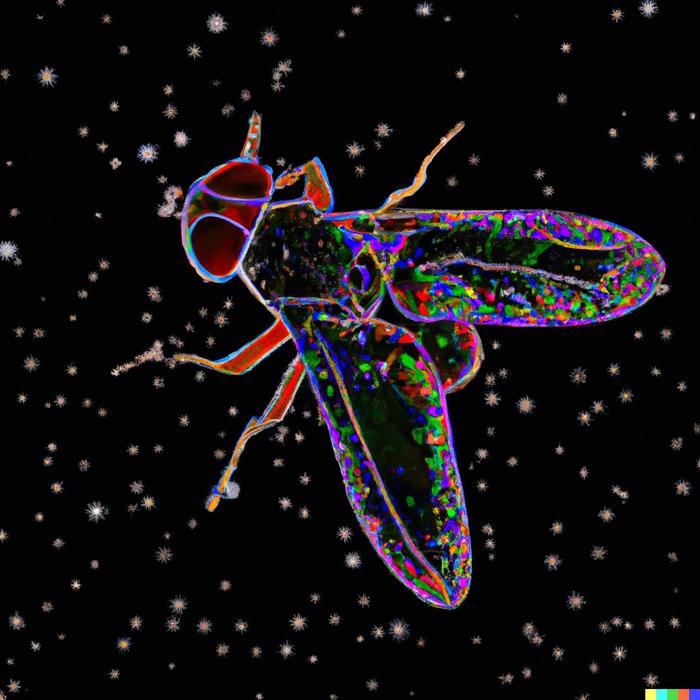
Credit: Akhila Rajan created this image using DALL-E and owns it. They are making it available under CC-BY 4.0 (CC-BY 4.0, https://creativecommons.org/licenses/by/4.0/)
Researchers led by Mroj Alassaf at the Fred Hutchinson Cancer Research Center in the United States have discovered a link between obesity and neurodegenerative disorders like Alzheimer’s disease. Using the common fruit fly, the research shows that a high-sugar diet — a hallmark of obesity — causes insulin resistance in the brain, which in turn reduces the ability to remove neuronal debris, thus increasing the risk of neurodegeneration. Publishing November 7th in the open access journal PLOS Biology, the research will impact therapies designed to reduce the risk of developing neurodegenerative diseases.
Although obesity is known to be a risk factor for neurodegenerative disorders like Alzheimer’s disease and Parkinson’s disease, exactly how one leads to the other remains a mystery. The new study focused on answering this question by taking advantage of the similarity between humans and fruit flies. Having previously shown that a high-sugar diet leads to insulin resistance in the peripheral organs of flies, the researchers now turned to their brains. Specifically, they examined glial cells because microglial dysfunction is known to lead to neural degeneration.
Levels of the protein PI3k indicate how much a cell is able to respond to insulin. The researchers found that the high sugar diet led to reduced PI3k levels in glial cells, indicating insulin resistance. They also looked at the fly equivalent of microglia, called ensheathing glia, whose primary function is to remove neural debris, such as degenerating axons. They observed that these glia had low levels of the protein Draper, indicating impaired function. Further tests revealed that artificial reduction of PI3k levels led to both insulin resistance and low Draper levels in ensheathing glia. Finally, they showed that after actually damaging olfactory neurons, the ensheathing glia could not remove the degenerating axons in the flies on the high sugar diet because their Draper levels did not increase.
The authors add, “Using fruit flies, the authors establish that high-sugar diets trigger insulin resistance in glia, disrupting their ability to clear neuronal debris. This study provides insight into how obesity-inducing diets potentially contribute to the increased risk of neurodegenerative disorders.”
#####
In your coverage, please use this URL to provide access to the freely available paper in PLOS Biology: http://journals.plos.org/plosbiology/article?id=10.1371/journal.pbio.3002359
Citation: Alassaf M, Rajan A (2023) Diet-induced glial insulin resistance impairs the clearance of neuronal debris in Drosophila brain. PLoS Biol 21(11): e3002359. https://doi.org/10.1371/journal.pbio.3002359
Author Countries: United States
Funding: This work is possible due to grants awarded to AR from the National Institute of General Medical Sciences (R35GM124593), the Brain Research foundation (BRFSG-2022-09), and the 2023 McKnight Foundation Neurobiology Disorders Award. MA is supported by a postdoctoral fellowship from the Helen Hay Whitney Foundation. The funders had no role in study design, data collection and analysis, decision to publish, or preparation of the manuscript.
Journal
PLoS Biology
DOI
10.1371/journal.pbio.3002359
Method of Research
Observational study
Subject of Research
Animals
COI Statement
Competing interests: The authors have declared that no competing interests exist.