• HOME
  • NEWS
  • EXPLORE
    • CAREER
      • Companies
      • Jobs
    • EVENTS
    • iGEM
      • News
      • Team
    • PHOTOS
    • VIDEO
    • WIKI
  • BLOG
  • COMMUNITY
    • FACEBOOK
    • INSTAGRAM
    • TWITTER
Wednesday, June 24, 2026
BIOENGINEER.ORG
No Result
View All Result
  • Login
  • HOME
  • NEWS
  • EXPLORE
    • CAREER
      • Companies
      • Jobs
        • Lecturer
        • PhD Studentship
        • Postdoc
        • Research Assistant
    • EVENTS
    • iGEM
      • News
      • Team
    • PHOTOS
    • VIDEO
    • WIKI
  • BLOG
  • COMMUNITY
    • FACEBOOK
    • INSTAGRAM
    • TWITTER
  • HOME
  • NEWS
  • EXPLORE
    • CAREER
      • Companies
      • Jobs
        • Lecturer
        • PhD Studentship
        • Postdoc
        • Research Assistant
    • EVENTS
    • iGEM
      • News
      • Team
    • PHOTOS
    • VIDEO
    • WIKI
  • BLOG
  • COMMUNITY
    • FACEBOOK
    • INSTAGRAM
    • TWITTER
No Result
View All Result
Bioengineer.org
No Result
View All Result
Home NEWS Science News Chemistry

NUST MISIS scientists managed to increase rocket fuel burning rate by almost 5 times

Bioengineer by Bioengineer
March 27, 2019
in Chemistry
Reading Time: 2 mins read
0
IMAGE
Share on FacebookShare on TwitterShare on LinkedinShare on RedditShare on Telegram

IMAGE

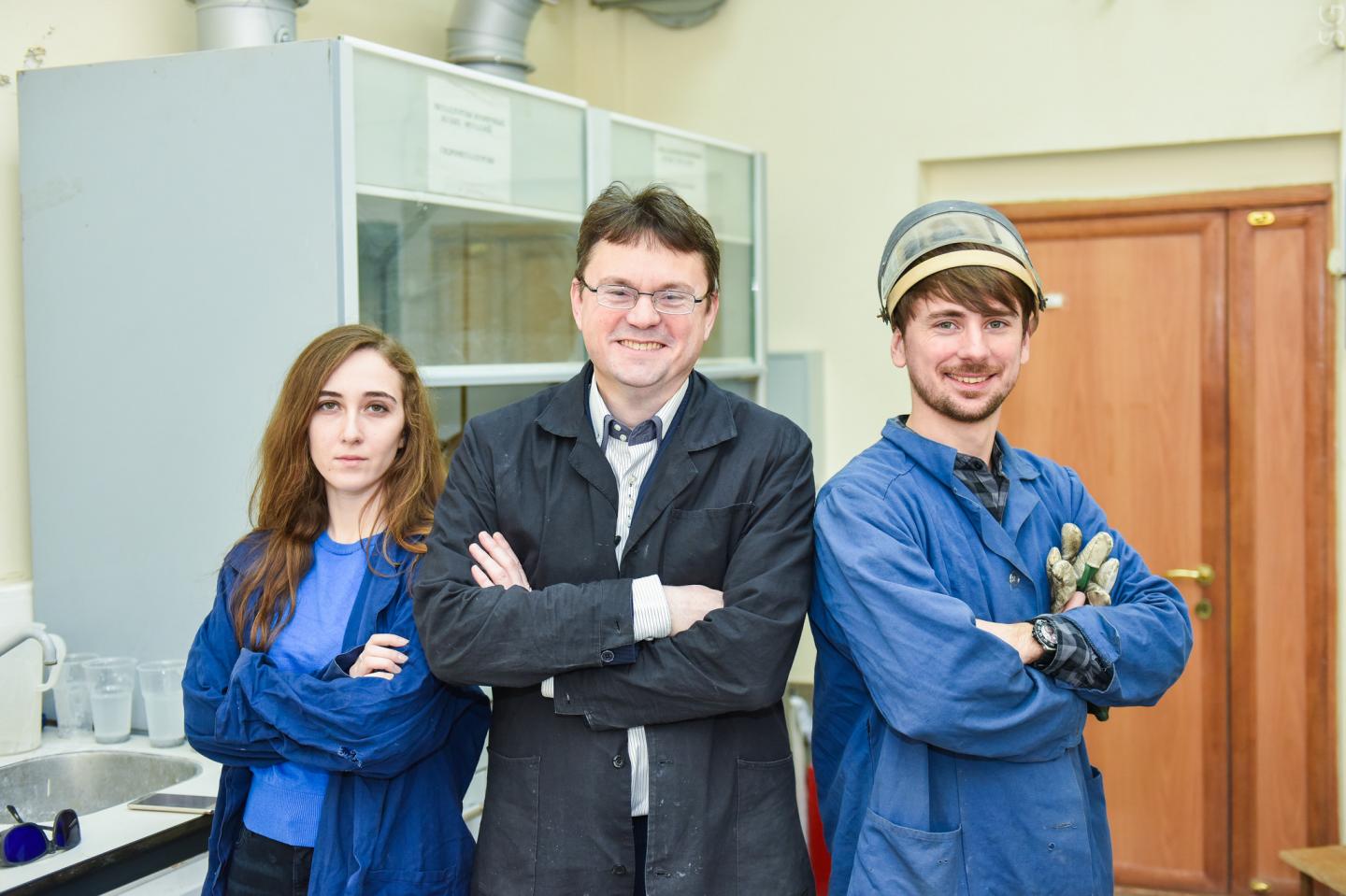
Credit: ©Sergey Gnuskov/NUST MISIS

Due to the unique catalysts based on metal nanopowders scientists of the National University of Science and Technology “MISIS” managed to increase the burning rate of solid rocket fuel by five times. The invention will make spacecraft five times faster.

Jet thrust in solid rocket engines is created by burning a mixture of high-energy substances capable of fast burning. At the same time, a large amount of heated gaseous body is released and forms a jet stream – that has been shown in the past by Konstantin Tsiolkovsky. As a rule, a polymer matrix with a filler of powerful combustible substances, oxidizing agents, metal powder, such as aluminum and various modifiers, is used as a solid fuel.

The basis of combustible substances in the modern solid rocket fuels composition is cyclic nitramines. They are chemically resistant to traditional combustion catalysts, such as metal oxides and lead salicylates. This property does not allow scientists to increase the fuel burning rate, on which a rocket’s flight speed directly depends.

Metal scientists from NUST MISIS have found that metal nanopowders can act as an effective catalyst for the burning of solid fuels reaction, which means it results in increasing the speed of an aircraft. During the laboratory tests conducted by the research team, nanoscale metal powders showed good catalytic activity.

In the course of the research, materials scientists added metal nanoparticles to the fuel, which accelerated the ignition of aluminum particles in the fuel composition. The use of nanopowders of aluminum, boron, nickel, and molybdenum made it possible to increase the burning rate by 1.5 times, regardless of pressure. Catalysts based on copper nanopowder showed the most impressive results – the fuel burning rate increased by almost 5 times. However, researchers believe that the obtained reagent needs to be improved.

“The copper nanopowder already reacts with the components of the fuel during its production at low temperatures, which reduces the efficiency of using such a catalyst,” said Alexander Gromov, project manager, chief researcher at the NUST MISIS Rapid Prototyping Center. Scientists are currently completing a series of laboratory tests of the obtained catalysts. The results of the materials scientists’ research are published in the Propellants, Explosives, Pyrotechnics journal.

###

Media Contact
Lyudmila Dozhdikova
[email protected]

Original Source

http://en.misis.ru/university/news/science/2019-02/5991/

Tags: Chemistry/Physics/Materials SciencesEnergy/Fuel (non-petroleum)Industrial Engineering/ChemistryMechanical EngineeringSpace/Planetary ScienceVehicles
Share12Tweet8Share2ShareShareShare2

Related Posts

Plasma Technology Extends Catalyst Lifespan in Hydrogen Production

June 24, 2026

Electric Field and Oxygen Spillover Collaborate to Control Electrode Migration in SOECs

June 24, 2026

Innovative Speckle-Based Metrology System Advances Precision Measurement of Next-Generation X-Ray Mirrors

June 24, 2026

Water-Activated PVA Film Transforms from Bioplastic to High-Performance Wood Adhesive

June 24, 2026
Please login to join discussion

POPULAR NEWS

  • Saying Goodbye to PGY-6: Pediatric Fellowship Realities

    103 shares
    Share 41 Tweet 26
  • Multi-Hospital Study Reveals Long Covid Burden Is Twice as High as Current Estimates

    92 shares
    Share 36 Tweet 23
  • Detection of EDCs in Breast Milk and Infant Urine Up to Six Months Highlights Early Exposure Risks

    77 shares
    Share 31 Tweet 19
  • New Drug Candidate Developed at McMaster Shows Potential for Treating Brain Cancer

    58 shares
    Share 23 Tweet 15

About

We bring you the latest biotechnology news from best research centers and universities around the world. Check our website.

Follow us

Recent News

Global Mining Threatens Forest Conservation Inside, Outside Protected Areas

Gene Variant rs11030119 Impacts BDNF Platelet Function

Decades of Data Reveal Which Orcas Call Puget Sound Home

Subscribe to Blog via Email

Enter your email address to subscribe to this blog and receive notifications of new posts by email.

Join 82 other subscribers
  • Contact Us

Bioengineer.org © Copyright 2023 All Rights Reserved.

Welcome Back!

Login to your account below

Forgotten Password?

Retrieve your password

Please enter your username or email address to reset your password.

Log In
No Result
View All Result
  • Homepages
    • Home Page 1
    • Home Page 2
  • News
  • National
  • Business
  • Health
  • Lifestyle
  • Science

Bioengineer.org © Copyright 2023 All Rights Reserved.