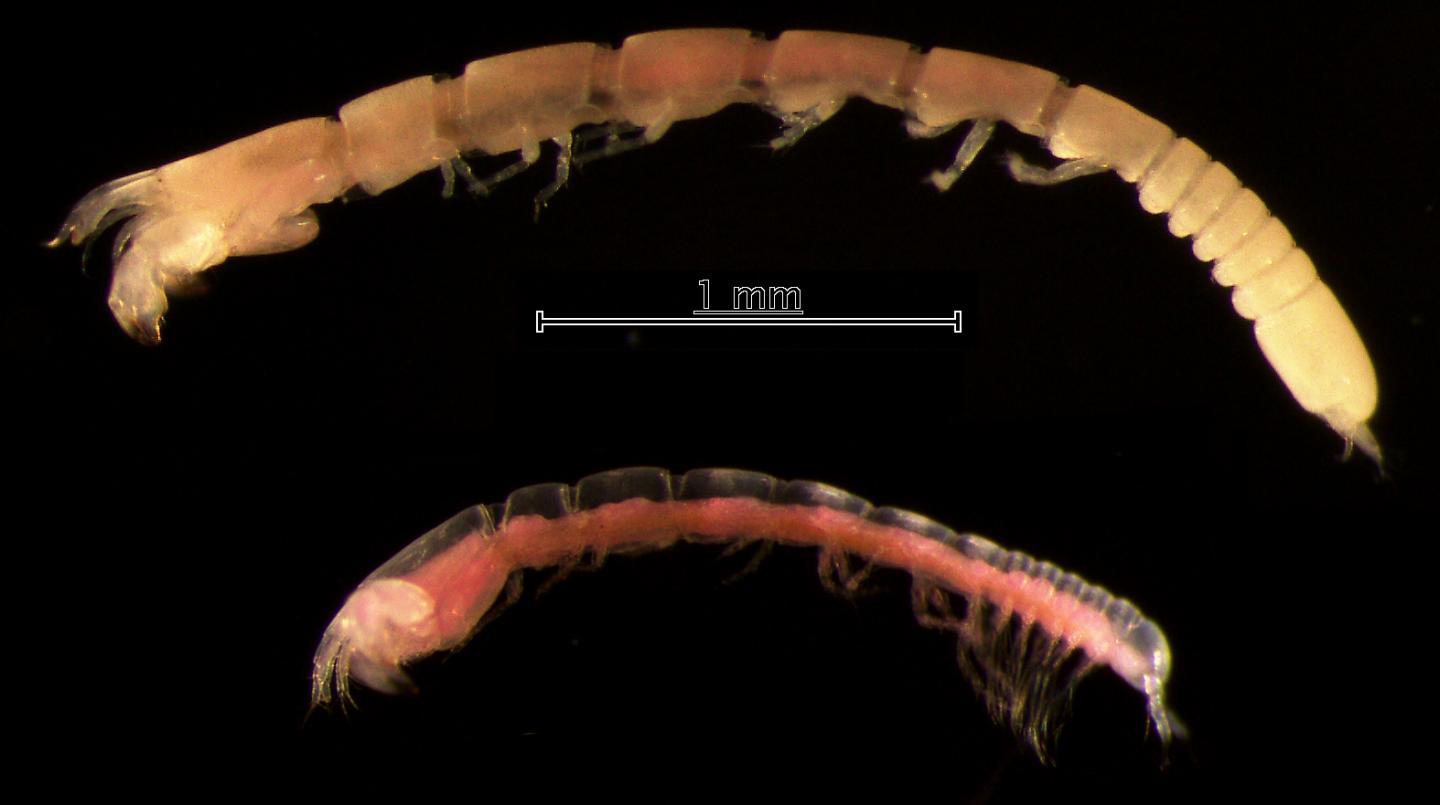
Credit: National University of Singapore
Tanaids are one of the most underappreciated animals in the world. These small crustaceans can be found in virtually all marine benthic habitats, from mangroves, rocky shores and coral reefs along the coasts to mud volcanoes, cold seeps and trenches in the deepest oceans. They even inhabit the shell surfaces of sea turtles, live inside gastropod shells like hermit crabs, and reside under the skin of deep-sea sea cucumbers.
When present, tanaids are often one of the dominant animals in the community. Due to their sheer number, tanaids are likely to play important ecological roles but information on their biology remains elusive. The knowledge gaps include answers to the most basic questions — How many species are there? What are their names? Experts have estimated that there could be up to 57,000 tanaidacean species worldwide. Currently, however, less than 1,500 species have been described, and the majority of these are in the temperate environments.
Research Associate Mr Chim Chee Kong and Research Assistant Ms Samantha Tong from the Tropical Marine Science Institute at the National University of Singapore (NUS) are on a quest to discover more of these nameless taxa, specifically in the relatively species-rich but poorly studied tropical Indo-Pacific.
Both researchers recently described two new species found in the abyssal polymetallic nodule fields in the eastern Pacific Ocean during a 2015 expedition. One of them was named Unispinosus eopacificus after the locality of where it was discovered, and the other was named Portaratrum birdi in honour of a leading tanaidacean taxonomist. They also erected the genus Unispinosus in the same paper, which was published in the journal Zootaxa on 31 March 2020.
The discovery of these two new species are of significant importance for environmental management because they were found in the Clarion-Clipperton Zone (CCZ), an understudied area in the middle of the Pacific Ocean characterised by polymetallic nodule fields. These fields contain commercially valuable metals such as nickel, copper, and rare earth elements that were formed over millions of years.
“Data on the biodiversity in this resource-rich region can allow the International Sea Authority to make well-informed decisions on whether to prioritise certain areas for conservation,” explained Ms Tong.
Many tanaids new to science were also uncovered during another deep-sea expedition in South Java in 2018, and are in the process of being described by Mr Chim and Ms Tong.
With access to a large amount of local material, primarily collected during the Comprehensive Marine Biodiversity Survey conducted in 2013, the two NUS researchers have also been able to identify more tanaids in local waters. To date, Mr Chim has identified more than 20 species of tanaids from local waters and, as a result, raised the current knowledge of our natural heritage. Prior to this study, only one tanaid species had been formally recorded from Singapore waters, based on specimens that were collected in the 1900s.
Last year, he and Ms Tong described an unusual tanaidacean species found in Singapore that were living inside dead barnacles, which is a novel microhabitat recorded for this group of crustaceans. The findings on the newly named Xenosinelobus balanocolus were reported in the journal Zootaxa on 8 July 2019.
“Taxonomic studies are extremely time-consuming, especially for microscopic animals such as tanaids, but at the same time, they are very rewarding as the results provide the strong foundation for further scientific hypotheses to build upon,” said Mr Chim, who is also a part-time doctoral student at the Department of Biological Sciences at the NUS Faculty of Science.
###
Media Contact
Rachel Lim
[email protected]
Original Source
https:/