• HOME
  • NEWS
  • EXPLORE
    • CAREER
      • Companies
      • Jobs
    • EVENTS
    • iGEM
      • News
      • Team
    • PHOTOS
    • VIDEO
    • WIKI
  • BLOG
  • COMMUNITY
    • FACEBOOK
    • INSTAGRAM
    • TWITTER
Thursday, June 25, 2026
BIOENGINEER.ORG
No Result
View All Result
  • Login
  • HOME
  • NEWS
  • EXPLORE
    • CAREER
      • Companies
      • Jobs
        • Lecturer
        • PhD Studentship
        • Postdoc
        • Research Assistant
    • EVENTS
    • iGEM
      • News
      • Team
    • PHOTOS
    • VIDEO
    • WIKI
  • BLOG
  • COMMUNITY
    • FACEBOOK
    • INSTAGRAM
    • TWITTER
  • HOME
  • NEWS
  • EXPLORE
    • CAREER
      • Companies
      • Jobs
        • Lecturer
        • PhD Studentship
        • Postdoc
        • Research Assistant
    • EVENTS
    • iGEM
      • News
      • Team
    • PHOTOS
    • VIDEO
    • WIKI
  • BLOG
  • COMMUNITY
    • FACEBOOK
    • INSTAGRAM
    • TWITTER
No Result
View All Result
Bioengineer.org
No Result
View All Result
Home NEWS Science News Chemistry

NRL-camera aboard NASA spacecraft confirms asteroid phenomenon

Bioengineer by Bioengineer
December 11, 2019
in Chemistry
Reading Time: 2 mins read
0
IMAGE
Share on FacebookShare on TwitterShare on LinkedinShare on RedditShare on Telegram

IMAGE

Credit: (U.S. Navy photo by Brendan Gallagher and Guillermo Stenborg)


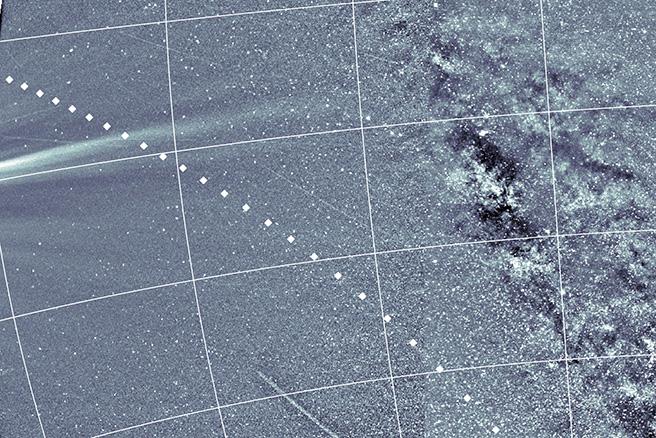
WASHINGTON – A U.S. Naval Research Laboratory-built camera mounted on the NASA Parker Solar Probe revealed an asteroid dust trail that has eluded astronomers for decades.

Karl Battams, a computational scientist in NRL’s Space Science Division, discussed the results from the camera called Wide-Field Imager for Solar Probe (WISPR) on Dec. 11 during a NASA press conference.

WISPR enabled researchers to identify the dust cloud trailing the orbit of the asteroid 3200 Phaethon.

“This is why NRL’s heliospheric imagers are so ground-breaking,” Battams said. “They allow you to see near-Sun outflows massively fainter than the Sun itself, which would otherwise blind our cameras. And in this case, you can also see solar system objects extremely close to the Sun, which most telescopes cannot do.”

He said the trail is best seen near the Sun where 3200 Phaethon’s dust is more densely packed, making WISPR a vital tool for scientists.

The data captured by WISPR determined the asteroid dust trail weighs an estimated billion tons, and measures more than 14 million miles long. The findings raise questions about the trail’s origin.

“Something catastrophic happened to Phaethon a couple of thousand years ago and created the Geminid Meteor shower,” Battams said. “There’s no way the asteroid is anywhere near active enough when it is near the Sun to produce the mass of dust we are seeing, so we are confident that WISPR is seeing part of the Geminid meteor stream.”

WISPR, designed, developed and led by NRL, records visible-light images of the solar corona and solar outflow in two overlapping cameras, which together cover more than 100-degrees angular width from the Sun.

Understanding how the solar environment behaves is important to the Navy and Marine Corps because when the solar winds reach Earth, they can affect GPS, spacecraft operations, and ground-based power grids.

WISPR and the Parker Solar Probe will continue to orbit the Sun for the next five years.

###

About the U.S. Naval Research Laboratory

NRL is a scientific and engineering command dedicated to research that drives innovative advances for the Navy and Marine Corps from the seafloor to space and in the information domain. NRL headquarters is located in Washington, D.C., with major field sites in Stennis Space Center, Mississippi, Key West, Florida, and Monterey, California, and employs approximately 2,500 civilian scientists, engineers and support personnel.

Media Contact
Mary Estacion
[email protected]
202-404-6422

Original Source

https://www.nrl.navy.mil/news/releases/nrl-camera-aboard-nasa-spacecraft-confirms-asteroid-phenomenon

Tags: AstronomyAstrophysicsComets/AsteroidsMeteorologyPlanets/MoonsSpace/Planetary ScienceStars/The Sun
Share12Tweet8Share2ShareShareShare2

Related Posts

AI and Physics Collaborate to Design Advanced Hydrogen Storage Materials

June 25, 2026

International Team Including Dresden Scientists Develops Novel Designer Proteins for Advanced Study of Living Tissue

June 25, 2026

New Study Uncovers Key Factors Driving Water Chemistry in Nanoscale Environments

June 25, 2026

Plasma Technology Extends Catalyst Lifespan in Hydrogen Production

June 24, 2026
Please login to join discussion

POPULAR NEWS

  • Saying Goodbye to PGY-6: Pediatric Fellowship Realities

    103 shares
    Share 41 Tweet 26
  • Multi-Hospital Study Reveals Long Covid Burden Is Twice as High as Current Estimates

    92 shares
    Share 36 Tweet 23
  • Detection of EDCs in Breast Milk and Infant Urine Up to Six Months Highlights Early Exposure Risks

    77 shares
    Share 31 Tweet 19
  • New Drug Candidate Developed at McMaster Shows Potential for Treating Brain Cancer

    58 shares
    Share 23 Tweet 15

About

We bring you the latest biotechnology news from best research centers and universities around the world. Check our website.

Follow us

Recent News

Tracking Lanthanide-Labeled Microplastics in Plants

POSTECH Researchers Slash Cost of Reconstituted Cell-Free Systems by 95%

AI and Physics Collaborate to Design Advanced Hydrogen Storage Materials

Subscribe to Blog via Email

Success! An email was just sent to confirm your subscription. Please find the email now and click 'Confirm' to start subscribing.

Join 82 other subscribers
  • Contact Us

Bioengineer.org © Copyright 2023 All Rights Reserved.

Welcome Back!

Login to your account below

Forgotten Password?

Retrieve your password

Please enter your username or email address to reset your password.

Log In
No Result
View All Result
  • Homepages
    • Home Page 1
    • Home Page 2
  • News
  • National
  • Business
  • Health
  • Lifestyle
  • Science

Bioengineer.org © Copyright 2023 All Rights Reserved.