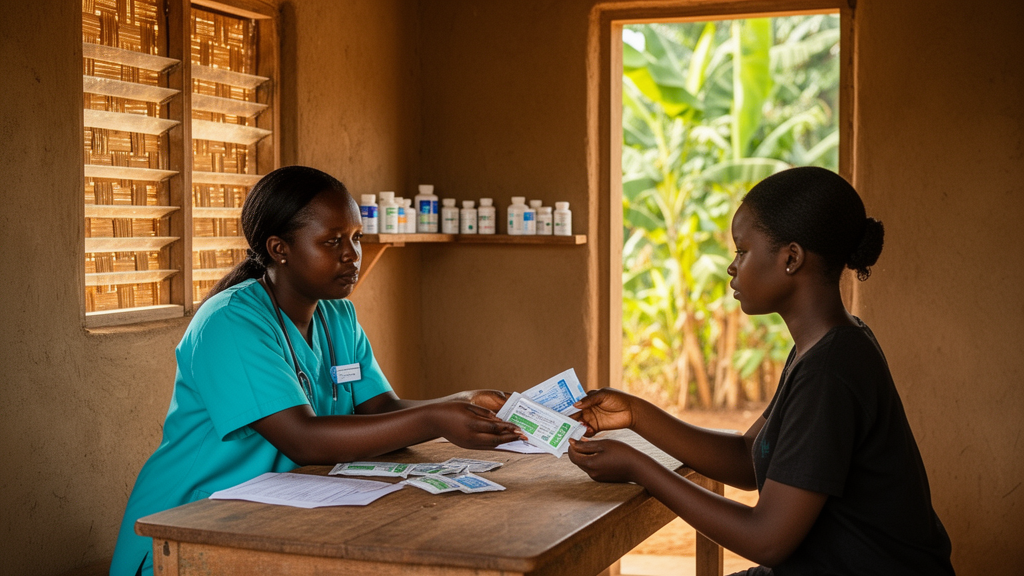
A large-scale comparative analysis of Demographic and Health Surveys across thirty-five sub-Saharan African nations reveals that community-level disparities strongly dictate modern contraceptive uptake, producing divergent patterns between women in marital unions and those who are unmarried. Led by Hailu Refera Debere, Shuai Guo, and Xiaoying Zheng, the investigation evaluated pooled survey records representing 472,811 women of reproductive age surveyed between 2011 and 2022. While modern contraception is recognized as a central proximate determinant of fertility reduction within the framework established by Bongaarts, the region continues to experience elevated total fertility rates averaging 4.6 births per woman, nearly doubling the global average of 2.3. The research demonstrates that beyond individual socioeconomic characteristics, the immediate neighborhood environment accounts for substantial proportions of variance in contraceptive adoption, with geographical divides differing sharply depending on whether a woman is married, never married, or formerly married.
To evaluate these complex dynamics, the investigators analyzed standardized data gathered through stratified two-stage cluster sampling from enumeration areas established during national censuses. The analytic sample was restricted to non-pregnant women aged 15 to 49 years to focus exclusively on individuals currently at risk of pregnancy who could actively use modern contraception to delay, space, or limit childbearing. The primary dependent variable distinguished women using modern contraceptive methods—such as oral contraceptive pills, injectables, subdermal implants, intrauterine devices, female or male sterilization, male condoms, and emergency contraception—from those relying on traditional approaches like abstinence and withdrawal or using no method at all. Individual-level records incorporated demographic variables including age, educational attainment, employment status, household wealth quintiles, exposure to mass media, access to family planning information, and fertility preferences comparing ideal against living children.
The methodological design incorporated multilevel random-intercept logistic regression models with three hierarchical levels to account for the clustering of individual women nested within communities and communities nested within countries. Community-level indicators were constructed by aggregating enumeration area cluster data, utilizing a fifty-percent threshold to classify neighborhoods according to local poverty rates, illiteracy levels, and distance barriers to health facilities. The physical accessibility metric specifically captured whether women reported distance to a health facility as a major obstacle when seeking medical care, reflecting subjective operational access rather than simple straight-line map distance. The mathematical parameters were estimated through maximum likelihood using adaptive Gauss-Hermite quadrature across ten quadrature points within the glmer routine of the lme4 package in R, utilizing the NLoptwrap optimizer with computational limits extending to 50,000 function evaluations to ensure convergence across complex likelihood surfaces without incorporating sampling weights into the regression coefficients.
Analysis of the random effects in the baseline null models underscored distinct structural pathways governing contraceptive decisions across marital categories. Among women currently in union, 13.1 percent of the total variance in modern contraceptive adoption was attributable to community-level factors, while country-level differences accounted for 16.2 percent. Conversely, among never-married and formerly married women, community context accounted for 8.4 percent of the variance, whereas national differences explained an expansive 34.2 percent. Incorporating individual and community-level covariates into the fully adjusted three-level model accounted for 42.7 percent of community-level variance and 39.4 percent of country-level variance for married women, compared to explaining 36.7 percent of community variance and 25.8 percent of country variance among unmarried women.
Descriptive findings revealed profound geographical variation in modern contraceptive prevalence and specific method preferences throughout the subcontinent. Southern African nations reported the highest regional uptake among women of reproductive age, led by Namibia at 53.2 percent, Zimbabwe at 51.1 percent, Lesotho at 50.7 percent, Malawi at 49.8 percent, and South Africa at 49.8 percent. Among married women, prevalence climbed to 72.6 percent in Zimbabwe and 64.7 percent in Malawi. In contrast, Western and Central African countries lagged considerably, with modern contraceptive use falling below 10 percent in Chad at 5.6 percent and the Democratic Republic of Congo at 9.2 percent. Furthermore, specific method choices varied: married women in Zimbabwe relied predominantly on oral contraceptive pills at 61.3 percent, whereas married women in Malawi favored injectables at 50.6 percent, and those in Burkina Faso and Rwanda leaned heavily toward subdermal implants at 47.6 percent and 41.4 percent, respectively.
Among never-married women, modern contraceptive use exhibited entirely different geographic and programmatic dynamics across the continent. Southern African nations again led in uptake, with prevalence reaching 49.7 percent in Namibia, 45.8 percent in South Africa, and 30.5 percent in Lesotho, but fell precipitously to 8.6 percent in Zimbabwe and 9.8 percent in Malawi despite the exceptionally high prevalence recorded among married peers in those same two countries. In parts of Central and Western Africa, unmarried women demonstrated higher adoption rates than married cohorts, with Sierra Leone recording 30.5 percent, the Republic of Congo reporting 28.2 percent, and Liberia reaching 27.8 percent. Across all surveyed countries, male condoms, injectable suspensions, and subdermal implants constituted the primary modern methods utilized by never-married women. Conversely, traditional family planning practices remained widespread in Central Africa; in the Democratic Republic of Congo, 57.9 percent of all reproductive-age women utilized traditional methods, encompassing 61.7 percent of married, 51.3 percent of never-married, and 44.7 percent of formerly married women.
Evaluation of individual fixed effects uncovered an inverse age gradient between marital groupings that highlights shifting reproductive timelines. Among married women, older cohorts exhibited diminished odds of modern contraceptive use: individuals aged 25 to 34 were 7.5 percent less likely (adjusted odds ratio of 0.925) and those aged 35 and older were 42.6 percent less likely (adjusted odds ratio of 0.574) to adopt contraception compared with women under 24 years of age. In stark contrast, never-married and formerly married women aged 25 to 34 were 23.0 percent more likely to use modern contraceptives relative to those aged 24 and younger, before usage declined by 51.1 percent among those aged 35 and older.
Socioeconomic gradients also operated differently across marital boundaries, particularly regarding household wealth indexes. Among married women, residing in wealthier households consistently improved contraceptive uptake, with women from poorer, middle, richer, and richest quintiles being 15.5 percent, 18.5 percent, 20.3 percent, and 18.1 percent more likely to use modern contraception relative to the poorest quintile. Conversely, among unmarried women, living in higher-wealth households was associated with an 11.4 percent and 24.4 percent decrease in contraceptive adoption among richer and richest tiers compared to the poorest. However, community-level wealth maintained a universally positive association across both groups: married women living in moderately poor and non-poor communities had 7.3 percent and 14.8 percent higher likelihoods of using modern methods, while unmarried women in corresponding neighborhoods experienced 13.3 percent and 23.4 percent increases, demonstrating that broad community economic development facilitates reproductive healthcare access irrespective of private household resources.
Community educational and institutional environments exerted substantial influences on contraceptive behavior across all cohorts. Residing in non-illiterate communities increased modern contraceptive adoption by 66.6 percent for married women and 35.5 percent for unmarried women compared with residing in highly illiterate localities. Similarly, eliminating healthcare accessibility hurdles within the community increased adoption by 17.0 percent among married women and 14.8 percent among unmarried women. At the individual level, primary and secondary schooling elevated contraceptive likelihood by 42.9 percent and 62.4 percent for married women, and by 46.5 percent and 71.3 percent for unmarried women. Exposure to family planning messaging and media access yielded consistent gains, increasing use by 28.6 percent and 14.7 percent among married women, and by 35.6 percent and 7.2 percent among unmarried women, while formal employment raised uptake by 28.0 percent and 44.2 percent across the respective groups.
To capture longitudinal trajectories across the continent, the authors conducted random-effects meta-analyses of intraclass correlation coefficients estimated from multilevel logistic models across repeated survey rounds. Among married women in 26 of 32 countries with multiple surveys, community-level heterogeneity progressively declined over time, signaling converging contraceptive behaviors across administrative clusters in countries such as Burkina Faso, Cameroon, the Democratic Republic of Congo, Gabon, and Tanzania. Conversely, community heterogeneity expanded in Burundi, Chad, Comoros, Guinea, and Togo. Among never-married women, trends proved more volatile, with community-level heterogeneity decreasing in 18 countries but rising in Comoros, Ethiopia, Guinea, Niger, Nigeria, and Togo.
The authors emphasized that their conclusions are subject to several analytical limitations inherent to large international cross-sectional survey compilations. Because Demographic and Health Surveys rely on secondary retrospective self-reports, data quality remains vulnerable to misreporting, recall inaccuracies, and varying comprehension of specific modern contraceptive formulations. Crucially, the cross-sectional design precludes establishing causal mechanisms, meaning all reported statistical relationships represent associative patterns rather than verified causal effects. Furthermore, pooling records across thirty-five sovereign nations highlights regional averages that may mask idiosyncratic national dynamics, and standardized survey instruments could not directly measure localized traditional belief systems, religious doctrines, or community stigma. The findings nonetheless demonstrate that closing sub-Saharan Africa’s reproductive health gaps requires moving beyond uniform national policies to implement decentralized, equity-oriented community interventions that address the distinct obstacles confronted by married and unmarried women.
Subject of Research: Multilevel analysis of community-level variations in modern contraceptive use across 35 sub-Saharan African countries
Article Title: Community-level variations in contraceptive use among women in union and those not in union: a comparative study of 35 sub-Saharan African countries
Article References: Debere, H. R., Guo, S., & Zheng, X. (2026). Community-level variations in contraceptive use among women in union and those not in union: a comparative study of 35 sub-Saharan African countries. Contraception and Reproductive Medicine, 11(1), Article 39. https://doi.org/10.1186/s40834-026-00453-z
Image Credits: AI Generated
DOI: 10.1186/s40834-026-00453-z
Keywords: contraceptive use, sub-Saharan Africa, Demographic and Health Surveys, multilevel modeling, community-level variation, intraclass correlation coefficient, family planning, reproductive health, marital status, fertility determinants, women's health, health equity, public health disparities, contraceptive prevalence, random-intercept models, meta-analysis
News Source: Phoebe Ingram. (November 16, 2026). Community Gaps Shape Modern Contraceptive Access Across Thirty-Five African Countries. Scienmag.