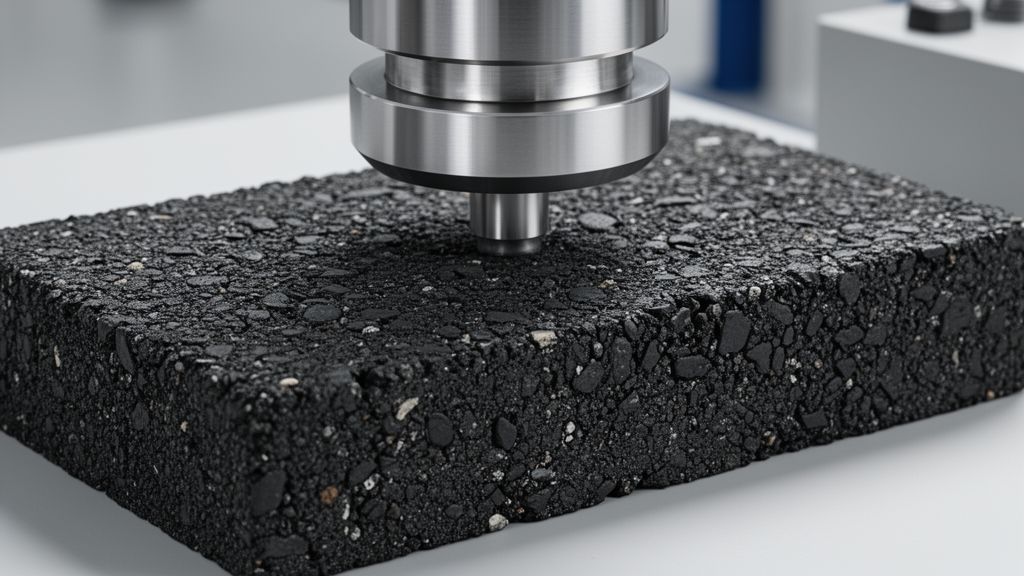
Civil engineers evaluating sustainable road surface alternatives have demonstrated that altering unit thickness and crumb rubber particle size substantially enhances the structural performance of paving blocks manufactured from Buton rock asphalt. Conventional modular pavements across residential streets, sidewalks, and parking areas have historically relied upon precast cement concrete units, which exhibit notable durability and straightforward installation but carry severe ecological burdens stemming from energy-intensive cement manufacturing and associated carbon dioxide releases. Seeking to mitigate these environmental impacts without sacrificing surface durability, researchers formulated a hot-mix asphalt wearing course material utilizing thirty percent natural rock asphalt sourced from Southeast Sulawesi, softened with fifteen percent recycled automotive engine oil and fortified with scrap tire rubber granules. Through three-point bending assessments, core-drilled Marshall stability measurements, and multi-variable response surface methodology, the experimental investigation quantified how mechanical resistance, void structuring, and moisture tolerance respond to physical block geometry and additive fineness. The resulting empirical models reveal that block thickness serves as the primary determinant of overall load-bearing capacity, whereas recycled rubber particle sizing governs mixture densification and dictates moisture vulnerability under sustained water exposure.
The transition toward asphalt-bound modular surfacing requires resolving the inherent material limitations of natural bitumen while managing waste streams responsibly. Buton rock asphalt deposits contain extensive natural reserves estimated at six hundred seventy-seven million tons, composed of roughly seventy to eighty percent calcium carbonate mineral limestone alongside ten to forty percent natural bitumen. Incorporating thirty percent of this natural resource into asphalt mixtures delivers valuable mineral filler and displaces nonrenewable petroleum-derived binders, yet unrefined rock asphalt remains exceptionally stiff, exhibiting a low penetration value of twenty-six units and an elevated softening point of fifty-two degrees Celsius. To counterbalance this excessive stiffness and forestall premature low-temperature thermal cracking, the formulation incorporated fifteen percent waste engine oil obtained from automotive crankcase maintenance. This petroleum residue, rich in lightweight fractions and low-molecular-weight hydrocarbons, acts as an effective softening agent that re-establishes an asphalt binder penetration value comparable to conventional penetration sixty-seventy grade paving bitumen, thereby establishing an adaptable binding matrix capable of supporting recycled polymer modifiers within modular surface blocks.
To reinforce the softened binder matrix and repurpose nonbiodegradable solid waste, the experimental program incorporated one point seventy-five percent crumb rubber derived from discarded automotive tires processed through mechanical grinding. Extended milling durations of thirty, forty, and fifty hours broke intermolecular cross-links via shear and impact forces, achieving partial devulcanization while leaving primary hydrocarbon chains intact. Scanning electron microscopy confirmed that progressive mechanical grinding refined crumb rubber granule dimensions from an initial range of zero point eight one four to zero point nine one six micrometers down to zero point zero eight four to zero point one two four micrometers. Accompanying energy-dispersive X-ray spectroscopy identified systematic chemical surface alterations, marked by a decrease in elemental carbon from eighty-six point seventeen percent to seventy-five point thirty-eight percent and a concurrent rise in surface oxygen content from eight point forty-five percent to fourteen point fifty-eight percent. This mechanical breakdown eliminated detectable surface zinc while exposing silicon, sulfur, and calcium, creating an active, highly oxidized particulate interface that substantially enhanced physical contact and dispersion within the asphalt-limestone matrix.
Evaluation of the physical properties of the binder demonstrated that crumb rubber introduces a pronounced stiffening and elastomeric reinforcing effect when blended into the softened rock asphalt matrix. Adding large, medium, and small rubber particles systematically decreased binder penetration values from sixty-eight point six tenths of a millimeter down into a range spanning fifty-two point eight to fifty-eight point eight tenths of a millimeter. Concurrently, the binder softening point rose from forty-five point eight degrees Celsius up to sixty-six point eight to sixty-eight point six degrees Celsius, while ductility contracted from fifty-seven centimeters to approximately fifteen centimeters. These interdependent physical shifts were captured by a second-order polynomial regression model yielding a coefficient of determination of zero point nine two five one and a significance value below zero point zero zero zero one. The resulting penetration index dropped into negative territory between minus one point seven six one and minus two point one seven eight, demonstrating that smaller rubber particles impart higher temperature stability and plastic deformation resistance at the expense of binder ductility.
The fabrication of the asphalt concrete paving block specimens followed hot-mix asphalt wearing course standards, combining aggregate blends, thirty percent rock asphalt, and modifiers through dry and wet preparation pathways. To replicate full-scale paving block geometries, mixtures were compacted into two hundred millimeter by one hundred millimeter molds at three standard thickness variations of sixty, eighty, and one hundred millimeters using consistent stamper compactor energy. Uniformity across specimen sets was verified by measuring post-compaction density, which served as an experimental control parameter before initiating mechanical evaluations. Structural flexibility was evaluated using five replicate specimens per test condition through three-point bending tests conducted after thirty minutes of immersion at sixty degrees Celsius to capture standard baseline flexural capacity. Additional durability evaluations subjected matching specimen sets to twenty-four-hour immersion conditioning at sixty degrees Celsius to evaluate material retention under severe warm-water exposure, simulating moisture-induced degradation within saturated modular road pavement environments.
Mechanical testing demonstrated that unit thickness is the governing physical factor determining the flexural resistance of modular asphalt paving blocks. Increasing block thickness from sixty millimeters to one hundred millimeters produced a thirty to thirty-five percent increase in flexural strength under standard testing conditions, elevating structural resistance from approximately zero point three four five megapascals to zero point four six five megapascals. In contrast, reducing crumb rubber particle size across the identical thickness tiers yielded a more modest flexural improvement of five to ten percent. Statistical modeling via exponential growth functions described this structural response with coefficients of determination ranging from zero point nine two one to zero point nine nine nine.
Volumetric characterization of core specimens drilled from installed pavement layers revealed that crumb rubber particle refinement significantly alters internal void configurations and improves overall mixture compaction. Marshall test specimens demonstrated that reducing rubber particle sizes lowered the void in mix percentage from four point twenty-six percent to three point ninety-five percent, while inter-aggregate void space decreased from twenty point ten percent to nineteen point eighty-five percent. Simultaneously, voids filled with asphalt expanded from seventy-eight point eight zero percent to eighty point zero nine percent, and compacted mixture density increased from two thousand forty-eight to two thousand fifty-five kilograms per cubic meter. These volumetric responses followed power law mathematical trends exhibiting coefficients of determination between zero point nine four zero and zero point nine nine eight. The microscopic refinement of the rubber particles provides an enlarged specific surface area that facilitates superior aggregate contact, packing voids more efficiently and allowing asphalt mastic to form denser structural networks capable of resisting consolidation under compressive forces.
Marshall stability testing further confirmed the mechanical reinforcement provided by crumb rubber refinement within the rock asphalt paving mixture. Incorporating crumb rubber elevated Marshall stability from nine hundred seventy point seventy-five kilograms in unmodified control specimens up to one thousand one hundred seventy-two point sixty-six kilograms, representing a performance gain of fifteen to twenty percent, alongside an improvement in residual stability from seventy-eight point zero five percent to eighty-one point twenty-nine percent. To capture the complex interdependent relationship connecting flexural capacity and Marshall stability across varying block geometries, researchers applied a cosine rational-response surface model. The resulting multi-variable mathematical formulation achieved coefficients of determination spanning zero point nine one four eight to zero point nine four nine six. Analysis of variance indicated that thickness variations generated a higher Fisher test statistic of eleven point thirty-one with a probability value of zero point zero three six seven, confirming statistical dominance over rubber particle size variations, which registered a statistic of six point forty-five and a probability of zero point zero four eight zero.
Under extended water immersion, testing revealed that while block thickness consistently aids load distribution, moisture resistance depends nonlinearly on crumb rubber grain sizing. Following twenty-four hours of warm-water saturation, specimen flexural strength dropped across all configurations to values between zero point nineteen and zero point twenty-eight megapascals. Rather than following the linear gains observed under standard dry testing, moisture resistance peaked at intermediate rubber particle dimensions of zero point four one seven micrometers, which achieved post-immersion flexural values of zero point twenty-four to zero point twenty-six megapascals. The residual flexural strength index rose from sixty-one point sixty-three percent for coarse rubber particles up to sixty-three point fifty-seven percent for medium-sized granules, but plummeted to fifty-two point forty-eight percent when ultra-fine zero point one zero four micrometer rubber was used. Analysis of variance across immersion data confirmed model robustness with regression coefficients of determination between zero point nine three seven and zero point nine four five, demonstrating that excessively fine rubber particles compromise internal moisture resistance despite delivering superior dry stiffness.
The experimental findings demonstrate that while incorporating Buton rock asphalt, waste engine oil, and recycled rubber yields viable asphalt paving blocks, physical performance depends on carefully matching thickness to environmental exposure. Response surface modeling confirms that one hundred millimeter paving blocks provide optimal flexural and Marshall stability, whereas medium crumb rubber grain sizes of approximately zero point four one seven micrometers provide the optimal compromise between structural stiffness and moisture damage resistance. The authors note, however, that statistical models and predictive equations derived in this study remain bounded by the nine discrete factor combinations tested across three thickness levels and three rubber particle ranges.
Subject of Research: Mechanical and volumetric evaluation of Buton rock asphalt paving blocks modified with crumb rubber and waste engine oil
Article Title: Evaluation of the effects of asphalt paving block thickness and crumb rubber size on buton rock asphalt-modified paving blocks using response surface methodology
Article References: Ifrad, A. M., Hadiwardoyo, S. P., Sumabrata, R. J., Lumingkewas, R. H., Rifai, A. I., & Vania, K. (2026). Evaluation of the effects of asphalt paving block thickness and crumb rubber size on buton rock asphalt-modified paving blocks using response surface methodology. Journal of King Saud University – Engineering Sciences, 38(6), Article 46. https://doi.org/10.1007/s44444-026-00118-x
Image Credits: AI Generated
DOI: 10.1007/s44444-026-00118-x
Keywords: asphalt paving blocks, Buton rock asphalt, crumb rubber, waste engine oil, flexural strength, response surface methodology, Marshall stability, volumetric characteristics, pavement durability, sustainable construction, residual flexural strength index, three-point bending test, tire recycling, binder modification, voids in mix, road surface layers
News Source: Denise Maddox. (November 18, 2026). Asphalt Paving Block Thickness and Rubber Grain Size Determine Structural Load Capacity. Scienmag.