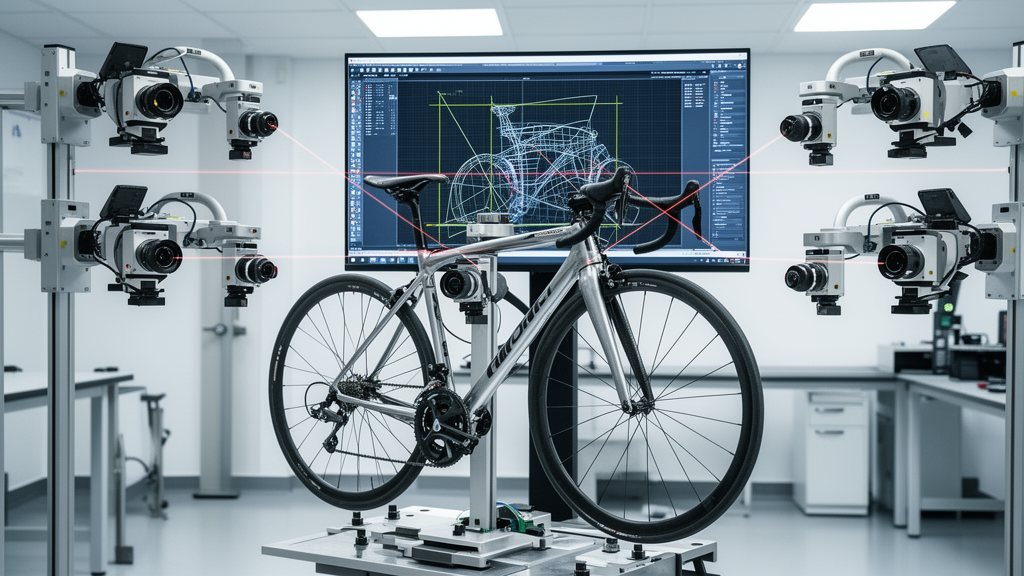
Researchers have developed a cyber-physical computer vision framework capable of verifying competitive bicycle dimensions from a single still photograph to streamline pre-race regulatory compliance checks. The experimental system, described by an engineering team led by Austin Han-Ju Lee and Gavriil Tsechpenakis, pairs an off-the-shelf consumer action camera with a custom-engineered mounting fixture and specialized deep learning software to detect key bike landmarks and compute critical geometric measurements. Governed by the Union Cycliste Internationale, elite cycling competitions enforce strict dimensional boundaries to guarantee fair play and rider safety across all sanctioned events. By formulating landmark recognition as a structured one-shot learning task, the investigators demonstrated that automated image-based metrology can accurately capture essential frame geometry while substantially reducing equipment transportation weight, initial financial expense, and setup friction during busy pre-race staging operations.
In time-trial events, technical commissaires from the Union Cycliste Internationale conduct mandatory inspections within designated control tents, typically assessing bicycles between one and two hours prior to racing and repeating the verification fifteen minutes before start time. This official inspection protocol includes measuring critical frame and component dimensions, ensuring the bicycle meets minimum weight thresholds, and scanning the assembly to rule out illicit mechanical assistance. When a racing bicycle fails to satisfy the governing body’s technical parameters, commissaires bar the athlete from starting until team mechanics implement necessary physical adjustments and present the machine for reinspection.
To overcome the inaccuracies of manual tape measures and traditional mechanical gauges, race authorities introduced an official laser jig inspection apparatus in 2022 for pre-race dimension checking. That existing laser system stabilizes the bicycle inside a dedicated fitting platform while a technical commissaire manually guides a movable laser sensor across two orthogonal axes to measure regulatory terminal points. Although an experienced commissaire can complete an official measurement pass in roughly thirty seconds once the hardware is ready, the laser assembly possesses noticeable operational disadvantages in field environments. Transporting the laser apparatus requires a protective case approximately 1.5 meters long weighing around 20 kilograms, while single-unit acquisition costs hover near 6000 United States dollars. Furthermore, assembling the multi-component frame requires hand tools and loose bolts, introducing assembly delays of two to three minutes alongside the ongoing risk of misplacing small parts during transit between international race venues.
Addressing these logistics challenges, the engineering team designed an integrated cyber-physical prototype built from widely accessible commercial components and a foldable structural jig. The physical mounting platform weighs 18.6 pounds, or 8.44 kilograms, and folds into an integrated carrying case without loose fasteners, permitting full deployment in three to ten minutes depending on operator familiarity. During inspection, the bicycle is stabilized at the front wheel and seat post on a dedicated ramp, aligning the frame parallel to a camera-mounting rod that fixes optical distance and eliminates complex depth estimation bottlenecks. Optical data acquisition relies on a standard GoPro Hero13 Black action camera linked over a universal serial bus cable to an ordinary laptop computer for automated image analysis. Excluding manufacturing labor, the total material cost of this prototype setup ranges between 2300 and 2850 United States dollars, including approximately 800 dollars for single-unit platform fabrication, the action camera, and the processing computer.
The board displays a six-by-six checkerboard pattern composed of three-by-three centimeter squares mounted coplanar with the bicycle, establishing an exact real-world scale factor of 2.73 pixels per millimeter for optical conversion. Before running automated inspections, the team removed lens distortion using an offline camera calibration technique that calculates optical intrinsics across twelve to fourteen calibration frames sampled from spatial position clusters. This calibration protocol achieved an average residual distortion error of approximately 0.5 pixels while running in under one second during active testing. Once the camera captures a high-resolution 5600 by 4800 pixel side-view image, the software applies the precalculated distortion corrections and feeds the rectified image into the feature extraction and geometric verification pipeline without requiring further manual calibration adjustments.
The computational pipeline approaches bicycle landmark localization as a one-shot machine learning problem by merging deep visual representations with an explicit structural context graph. Rather than demanding massive annotated training sets to learn flexible spatial relationships from scratch, the system exploits the rigid, a priori known topology of diamond-frame bicycles. A reference photograph of a calibrated bicycle defines the locations of nine primary structural keypoints, their appearance signatures, and their topological connections. Feature extraction relies on a standard ResNet18 convolutional neural network backbone, which generates 512-dimensional deep feature embeddings for localized image patches across candidate regions. By coupling convolutional feature extraction with an explicit structural graph whose edges represent Euclidean distances, horizontal coordinate offsets, and planar angles, the system cleanly separates visual pattern recognition from geometric reasoning, allowing the framework to generalize robustly across diverse bicycle models from a single reference template.
Mathematically, the researchers formulated keypoint localization within a Discriminative Random Field framework that balances local visual appearance against rigid topological constraints. The objective energy function sums unary potential terms that evaluate local image appearance and pairwise interaction potentials that penalize spatial distortions between adjacent keypoints. Unary potentials quantify the cosine similarity between candidate image patches and reference embeddings using a monotonically decreasing exponential function, favoring regions that visually match known bicycle components. Pairwise interaction potentials evaluate edge deviations, computing normalized differences in Euclidean separation, horizontal coordinate displacement, and relative slope angles between neighboring graph vertices. Because optimizing these non-convex energy equations across full images can become computationally intractable, the algorithm executes approximate inference via the greedy Highest Confidence First heuristic, which leverages the sparse graph layout and strong topological priors to converge rapidly toward an optimal, mutually consistent landmark configuration.
To accelerate inference speed and prevent false detections across complex backgrounds, the researchers integrated an object detection stage to constrain proposal generation. They trained a YOLOv8 network on 124 labeled bicycle gallery images, partitioning the data into 105 training, 19 validation, and 14 test examples to recognize eight distinct bicycle parts: front wheels, front axles, rear axles, handlebars, bottom brackets, seats, seat posts, and steering stems. Restricting landmark search patches to the spatial bounding boxes generated by this initial part detector effectively eliminates outlying background noise and limits the candidate pool to the most plausible regions. For computational settings where training an object detector proves impractical, the authors showed that a simple K-nearest neighbors search can substitute for the detector, retrieving candidate patches closest to reference coordinates when scale and resolution remain uniform, thereby establishing an unsupervised localization workflow that relies solely on pre-trained convolutional representations.
The automated software evaluates seven specific geometric dimensions mandated under official Union Cycliste Internationale regulations alongside auxiliary wheel measurements. These official metrics include the horizontal offset between the bottom bracket pedal axle and the front tip of the saddle, the total wheelbase distance between front and rear axles, and the independent distances connecting each wheel axle to the central bottom bracket spindle. The system further verifies the horizontal reach between the front wheel axle and the farthest forward handlebar extremity, as well as the inclination angles of the seat post and saddle body. Beyond the primary skeletal graph, the software applies circle-fitting algorithms based on least-squares estimation to determine inner rim and outer tire radii from axle origins. Initial methodology validation across a baseline dataset of 138 web gallery images scaled to 1000 by 600 pixels confirmed that the contextual graph reliably resolves appearance ambiguities across disparate frame geometries.
Quantitative evaluations conducted on twenty ultra-high-resolution photographs captured with the physical prototype demonstrated consistent sub-centimeter localization performance across all designated landmarks. Image distortion rectification and spatial coordinate conversion required less than one second, while full end-to-end landmark extraction and measurement calculation executed in under twenty seconds per photograph. Across the full-resolution camera dataset, average localization errors measured 4.86 millimeters for the rear axle, 5.13 millimeters for the front axle, and 6.30 millimeters for the bottom bracket assembly. Saddle front and rear extremities exhibited errors of 4.95 millimeters and 5.04 millimeters, respectively, while the steering stem yielded 6.48 millimeters and the forward handlebar point showed 8.73 millimeters of displacement. Component slope calculations proved highly accurate, exhibiting mean errors of 0.75 degrees for seatpost tilt and 1.50 degrees for saddle angle, with repeated measurements showing maximum deviations of roughly 1.46 millimeters.
While these experimental outcomes establish vision-based metrology as a practical alternative to cumbersome mechanical jigs, the authors noted several critical operational limitations that warrant ongoing development. The observed spatial localization errors, ranging between 4.41 and 8.73 millimeters, do not yet satisfy the strict one-millimeter error tolerance mandated by official Union Cycliste Internationale technical rules. By comparison, ground-truth consistency assessments among three trained human annotators revealed baseline marking variabilities ranging from 4 to 8 pixels, equivalent to 1.5 to 2.9 millimeters of optical measurement ambiguity, with manual point labeling requiring 30 to 90 seconds per image. To bridge this performance gap, the prototype incorporates an interactive user interface allowing race commissaires to manually pan, zoom, and nudge keypoint coordinates to resolve contentious edge cases. Future iterations will explore multi-resolution proposal networks, broader environmental testing under direct sunlight and shadow conditions, and advanced calibration algorithms to achieve complete millimeter-level compliance verification.
Subject of Research: Computer vision metrology for pre-race bicycle dimension verification
Article Title: Camera-based race bicycle dimensions verification
Article References: Lee, A. H.-J., Stack, E. D., Scifert, C. A., Zhang, B., Ripberger, A. N., Krasilnikau, A., Thibault, G., Le Boeuf, G., Brunet, E., Mansson, J.-A., & Tsechpenakis, G. (2026). Camera-based race bicycle dimensions verification. Sports Engineering, 29(2), Article 46. https://doi.org/10.1007/s12283-026-00581-4
Image Credits: AI Generated
DOI: 10.1007/s12283-026-00581-4
Keywords: computer vision, bicycle metrology, Union Cycliste Internationale, sports engineering, keypoint detection, Conditional Random Field, Discriminative Random Field, YOLOv8, ResNet18, action camera, camera calibration, time-trial inspection, regulatory compliance, structural context graph, Highest Confidence First, sports technology, geometric verification
News Source: Elena Sutton. (November 18, 2026). Computer Vision System Verifies Race Bicycle Dimensions for Regulatory Compliance. Scienmag.