

• HOME
  • NEWS
  • EXPLORE
    • CAREER
      • Companies
      • Jobs
    • EVENTS
    • iGEM
      • News
      • Team
    • PHOTOS
    • VIDEO
    • WIKI
  • BLOG
  • COMMUNITY
    • FACEBOOK
    • INSTAGRAM
    • TWITTER
Saturday, May 16, 2026
BIOENGINEER.ORG
No Result
View All Result
  • Login
  • HOME
  • NEWS
  • EXPLORE
    • CAREER
      • Companies
      • Jobs
        • Lecturer
        • PhD Studentship
        • Postdoc
        • Research Assistant
    • EVENTS
    • iGEM
      • News
      • Team
    • PHOTOS
    • VIDEO
    • WIKI
  • BLOG
  • COMMUNITY
    • FACEBOOK
    • INSTAGRAM
    • TWITTER
  • HOME
  • NEWS
  • EXPLORE
    • CAREER
      • Companies
      • Jobs
        • Lecturer
        • PhD Studentship
        • Postdoc
        • Research Assistant
    • EVENTS
    • iGEM
      • News
      • Team
    • PHOTOS
    • VIDEO
    • WIKI
  • BLOG
  • COMMUNITY
    • FACEBOOK
    • INSTAGRAM
    • TWITTER
No Result
View All Result
Bioengineer.org
No Result
View All Result
Home NEWS Science News Biology

Novel thermal ablation system for transdermal drug delivery

Bioengineer by Bioengineer
July 27, 2017
in Biology
Reading Time: 2 mins read
0
Share on FacebookShare on TwitterShare on LinkedinShare on RedditShare on Telegram
IMAGE

Credit: Professor Takuro Niidome

Many diseases are treated with protein-based drugs. However, due to the size of the molecules, the only effective delivery method is through injection, which can suffer from low patient compliance. Furthermore, many of these types of drugs require multiple treatments that can take hours to complete, as is the case with rheumatoid arthritis. New drug delivery methods should be discovered and implemented to relieve patients of this taxing and expensive experience.

In an attempt to produce a better drug delivery system, researchers from Kumamoto University in Japan focused on a transdermal protein delivery system. There are multiple techniques currently being studied for this type of drug delivery mechanism, from microneedles to iontophoresis (transdermal drug delivery via electric current), but the Kumamoto University researchers designed to improve a technique called transdermal thermal ablation. This technique increases the permeability of the skin by heating and removing the first skin layer, the stratum corneum (SC). The difficulty is performing this without damaging deeper skin layers.

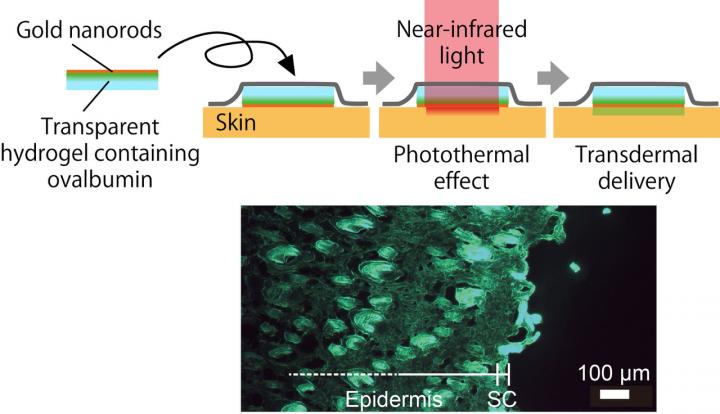
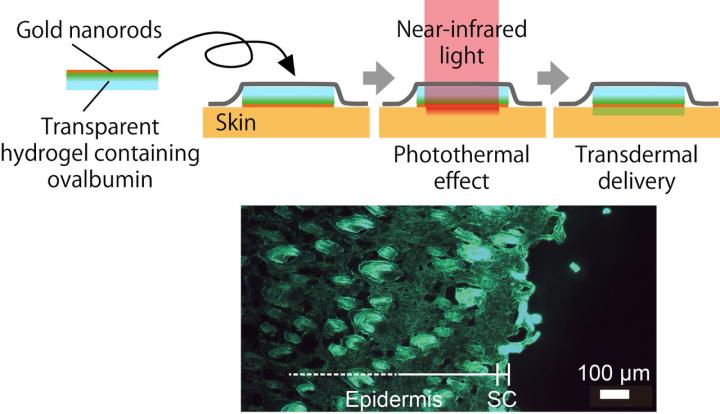
The researchers used a combination of transparent gel patches, gold nanorods, and near-infrared (NIR) light to create a unique thermal ablation system for transdermal drug delivery. They added fluorescently labeled ovalbumin (FITC-OVA) to the patches to determine the extent of protein translocation after NIR irradiation on murine skin. Both in vivo and in vitro experiments were performed using gel patches with gold nanorods, gel patches without gold nanorods (control 1), and gel patches with gold nanorods but without any form of irradiation (control 2). The two controls did not produce any thermal ablation effect on the skin, but the NIR irradiated gold nanorod patches heated the skin to around 43 degrees Celsius. This resulted in significant protein translocation for the in vitro experiment and moderate translocation for the in vivo experiment. The difference between these two results was likely due to a loosening of the skin cells after freezing for the in vitro experiment.

"Our experiments have shown that the photothermal effect on gold nanorods by irradiation of near-infrared light causes the skin to heat up and become more permeable," said Professor Takuro Niidome, leader of the research project. "It should be noted that our technique has yet to deliver any specific protein drugs, but we are confident that the research will contribute to the development of effective transdermal delivery systems."

This research can be found online in Elsevier's European Journal of Pharmaceutics and Biopharmaceutics.

###

[Reference]

Haine, A. T.; Koga, Y.; Hashimoto, Y.; Higashi, T.; Motoyama, K.; Arima, H. & Niidome, T., Enhancement of transdermal protein delivery by photothermal effect of gold nanorods coated on polysaccharide-based hydrogel, European Journal of Pharmaceutics and Biopharmaceutics, Elsevier BV, 2017, 119, 91-95. DOI: 10.1016/j.ejpb.2017.06.005

Media Contact

J. Sanderson
[email protected]

http://ewww.kumamoto-u.ac.jp/en/news/

Original Source

http://www.sciencedirect.com/science/article/pii/S0939641117306847 http://dx.doi.org/10.1016/j.ejpb.2017.06.005


Share13Tweet8Share2ShareShareShare2

Related Posts

Single mother must adapt swiftly — the survival of her colony depends on it — Biology

Single mother must adapt swiftly — the survival of her colony depends on it

May 15, 2026
Why Are Nearly Everyone Right-Handed? It Might Be Linked to How We Learned to Walk — Biology

Why Are Nearly Everyone Right-Handed? It Might Be Linked to How We Learned to Walk

May 15, 2026

Excessive Neuronal Activity Initiates Severe Autoimmune Brain Disorder

May 15, 2026

Precision Anti-Aging Strategies Focus on Eliminating Harmful Senescent Cells While Preserving Beneficial Ones

May 15, 2026
Please login to join discussion

POPULAR NEWS

  • Research Indicates Potential Connection Between Prenatal Medication Exposure and Elevated Autism Risk

    843 shares
    Share 337 Tweet 211
  • New Study Reveals Plants Can Detect the Sound of Rain

    730 shares
    Share 291 Tweet 182
  • Salmonella Haem Blocks Macrophages, Boosts Infection

    62 shares
    Share 25 Tweet 16
  • Breastmilk Balances E. coli and Beneficial Bacteria in Infant Gut Microbiomes

    58 shares
    Share 23 Tweet 15

About

We bring you the latest biotechnology news from best research centers and universities around the world. Check our website.

Follow us

Recent News

New Actinomycin Derivatives Target Malaria More Selectively

Mobile App Enhances Exercise for Older Adults’ Cognition

Botulinum Toxin Reduces Urinary Retention Post-Hemorrhoidopexy

Subscribe to Blog via Email

Enter your email address to subscribe to this blog and receive notifications of new posts by email.

Join 82 other subscribers
  • Contact Us

Bioengineer.org © Copyright 2023 All Rights Reserved.

Welcome Back!

Login to your account below

Forgotten Password?

Retrieve your password

Please enter your username or email address to reset your password.

Log In
No Result
View All Result
  • Homepages
    • Home Page 1
    • Home Page 2
  • News
  • National
  • Business
  • Health
  • Lifestyle
  • Science

Bioengineer.org © Copyright 2023 All Rights Reserved.
